
LSA-839
Base for statue of Vettius Agorius Praetextatus, governor of Achaea. From Thespiae (Achaea). 362-364
Record details
Photographs
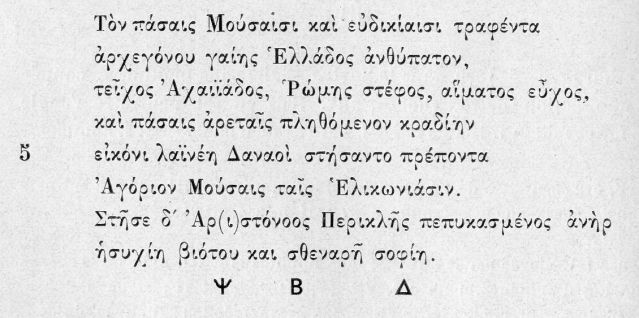
Inscription
Τὸν πάσαις Μούσαισιν καὶ εὐδικίαισιν τραφέντα
ἀρχεγόνου γαίης Ἑλλάδος ἀνθύπατον
τεῖχος Ἀχαιϊάδος, ῥώμης στέφος, αἵματος εὖχος,
καὶ πάσαις ἀρεταῖς πληθόμενον κραδίην
εἰκόνι λαϊνέῃ Δαναοὶ στήσαντο πρέποντα
Ἀγόριον Μούσαις ταῖς Ἑλικωνιάσιν
στῆσε δ’ ἀρ(ι)στόνοος Περικλῆς, πεπυκασμένος ἀνὴρ,
ἡσυχίῃ βιότου καὶ σθεναρῇ σοφίῃ
Ψ(ηφίσματος) Β(ουλῆς) καὶ Δ(ήμου)
Inscription translation
The Danaens (= Greeks) set up (the man who) nourishes all Muses (= arts) and all kind of justice, the proconsul of the age-old land of Achaea, the wall of Achaea, crown of Rome, glory of his blood (= family), he has reached the full climax in all virtues, the excellent Agorius, in a marble statue (dedicated to) the Heliconian Muses. The noble-minded Pericles set it up, a man crowned by the calmness of his life and by steady wisdom. By decree of the council and the people.
Bibliography
- Plassart, A., Inscriptions de Thespies, Bulletin de Correspondance Hellénique 50, 383-462, Paris 1926, 444-6 no. 85
Discussion
INSCRIPTION
Verse inscription in four elegiac distichs:
Τὸν πάσαις Μούσαισιν καὶ εὐδικίαισιν τραφέντα
ἀρχεγόνου γαίης Ἑλλάδος ἀνθύπατον
τεῖχος Ἀχαιϊάδος, ῥώμης στέφος, αἵματος εὖχος,
καὶ πάσαις ἀρεταῖς πληθόμενον κραδίην
εἰκόνι λαϊνέῃ Δαναοὶ στήσαντο πρέποντα
Ἀγόριον Μούσαις ταῖς Ἑλικωνιάσιν
στῆσε δ’ ἀρ(ι)στόνοος Περικλῆς, πεπυκασμένος ἀνὴρ,
ἡσυχίῃ βιότου καὶ σθεναρῇ σοφίῃ
Ψ(ηφίσματος) Β(ουλῆς) καὶ Δ(ήμου).
'The Danaens (= Greeks) set up (the man who) nourishes all Muses (= arts) and all kind of justice, the proconsul of the age-old land of Achaea, the wall of Achaea, crown of Rome, glory of his blood (= family), he has reached the full climax in all virtues, the excellent Agorius, in a marble statue (dedicated to) the Heliconian Muses. The noble-minded Pericles set it up, a man crowned by the calmness of his life and by steady wisdom. By decree of the council and the people'.
The epigram praises the outstanding virtues of the governor of Achaea, Vettius Agorius Praetextatus ('Agorius' here).
DESCRIPTION (from Plassart 1926)
Rectangular base with mouldings at top and bottom. On the top surface an oval cutting with several (dowel?) holes in it ('plusieurs trous des scellement'). There is no published image.
PROVENANCE AND CURRENT LOCATION
The base was found in the city of Thespiai, in the region called 'kastro'. The inscription records that it was set up 'to the Heliconian Muses', which would most immediately suggest the famous sanctuary near Thespiae in the valley of the Permessos. But, as Plassart points out, Pausanias testifies to a second sanctuary of the Muses within Thespiae itself. This second one was located in the centre of the area today called 'kastro' (Plassart 1926, 445). The base is today in the Thebes Museum, inv. no. 293.
HONORAND AND DATE
Vettius Agorius Praetextatus was an outstanding Roman senator of the mid fourth century and a zealous pagan (PLRE I, 722-4 Vettius Agorius Praetextatus 1). He was a very learned man and is known to have translated Greek verse and prose works into Latin. He was proconsul of Achaea under Julian 362-4.
FURTHER DISCUSSION
Of Vettius Agorius Praetextatus two honorific base inscriptions (CIL VI, 1777, 1778) and the inscription from the base of his funerary statue (CIL VI, 1779) are known from Rome. All follow the western tradition of soberly listing the offices of the honorand in a cursus honorum, as opposed to the verse inscription chosen for the same man in the Greek East.
Discussion references
- Corpus Inscriptionum Latinarum; , VI
- Jones, A. H. M. et al., The Prosopography of the Later Roman Empire. Vol. I 260-395, Cambridge et al. 1971 (1975)
Cite: Last Statues of Antiquity, LSA-839 (Ulrich Gehn).