
LSA-84
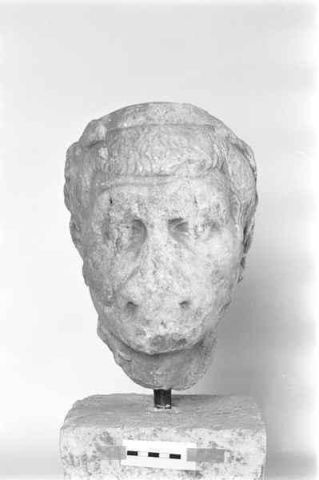
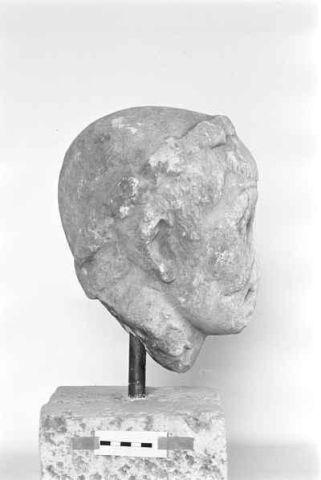
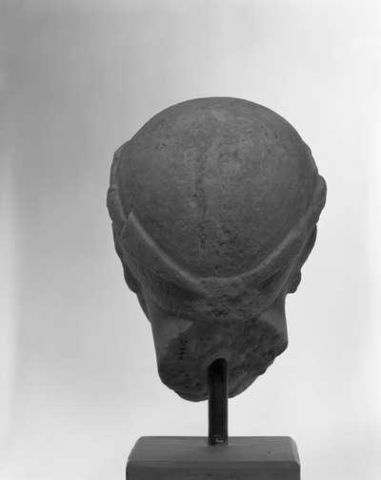
Portrait head of man wearing wreath of Isthmian victor. Corinth (Achaea). Late third to fourth century?
Record details
Photographs
Bibliography
- de Grazia, C. E., American School of Classical Studies at Athens, "Excavations of the American School of Classical Studies at Corinth:
The Roman Portrait Sculpture," Ph.D. Dissertation
, Columbia University, 1973, pp. 201-4 no. 47 pl. 61
Discussion
DESCRIPTION (Object)
Fine-grained white marble, H (overall) 28.5, (chin to crown) 24.5, W 16.5, D 20.6 cm. The neck is broken from the adam’s apple at the front to the hairline in the back. The surface is battered, the nose is chipped off, eyebrows, eyes, mouth, chin and ears are chipped.
The hair is indicated by long, thin shallow chisel-lines. It is worked out only around the face; behind the wreath it is finished with a rasp. The head in its present state is probably the result of a late-antique re-work, as indicated by the hairline behind the right ear.
The irises were circumscribed by a circular incised line; the pupils are battered beyond description.
PROVENANCE/ LOCATION
The provenance of the head is unknown. It was brought into the museum around 1897 by a native of Old Corinth, along with a 3rd century female head. It is today in tthe Corinth museum inv. no. S 340.
DESCRIPTION (Subject)
The portrayed is a middle aged clean shaven man wearing the pine crown of the victor in the Isthmian games. His hair is dipping in a circular line into the forehead and in the same way from the temples into the face. The brow is furrowed by one irregular fold.
DATE
The head was dated to the mid 3rd century by Johnson 1931 because of the flat hair; De Grazia 1973 dated to the tetrarchic period because of the square structure of the head, the hairline, and the modellings.
The hairline dipping into the face above the brow and at the temples is a fashion mode of tetrarchic heads like the porphyry bust from Athribis (LSA-836). The irregular furrow on the brow could support a tetrarchic date for our head.
Cite: Last Statues of Antiquity, LSA-84 (Amelia Brown / Ulrich Gehn).