
LSA-843
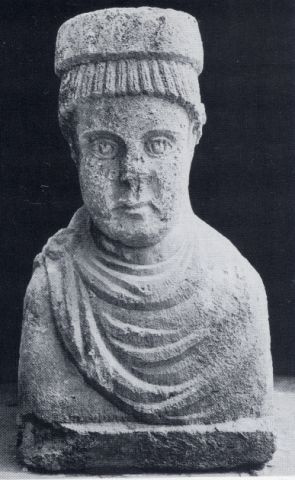
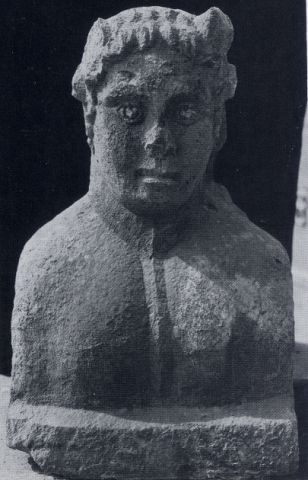
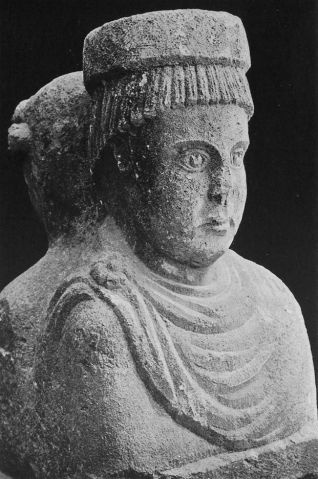
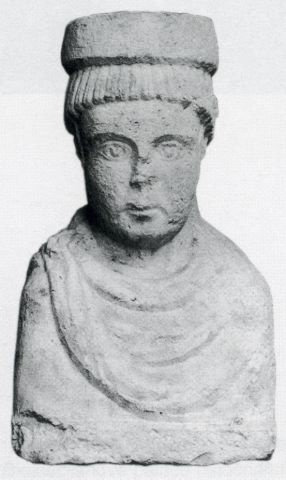
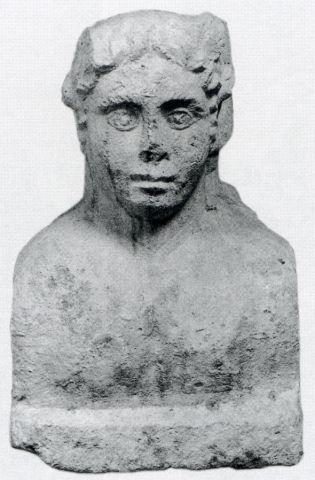
Double herm with portrait of emperor in military cap and horned river god? Salona (Dalmatia). Early fourth century ?
Record details
Photographs
Bibliography
- Cambi, N., Imago Animi. Antički Portret u Hrvatskoj, Split 2000, 181-2, 404, no. 131, pl. 174
- L'Orange, H. P., Das spätantike Herrscherbild von Diokletian bis zu den Konstantin-Söhnen, 284-361 n. Chr. Das Römische Herrscherbild. III. Abteilung ; Bd. 4 , Berlin 1984, pp. 12. 25. 102 pl. 9 a. c
- L'Orange, H. P., Studien zur Geschichte des spätantiken Porträts, Oslo 1933, 19-21 figs. 36. 38
Discussion
DESCRIPTION (Object)
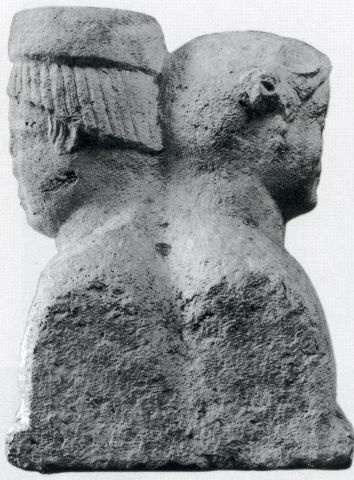
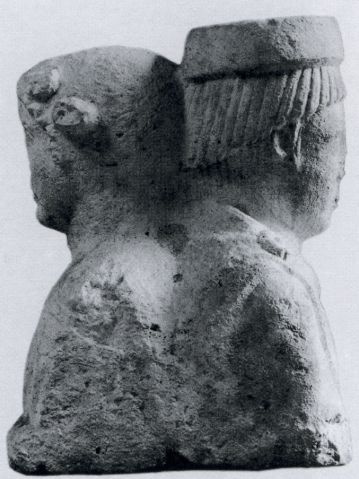
Double bust of grey limestone, H 66 cm. One face is a human figure, the other one a composite being with a human face and bull’s horns, ears and body. The bust includes the upper arms and breast of the human figure, and the breast of the bull. It is set on a rectangular plinth which protrudes slightly at the front and rear. The tip of the nose of the human figure is chipped, and there are chips scattered over the surface. Both horns of the composite being are broken leaving only butts; the nose is broken and the lips are chipped.
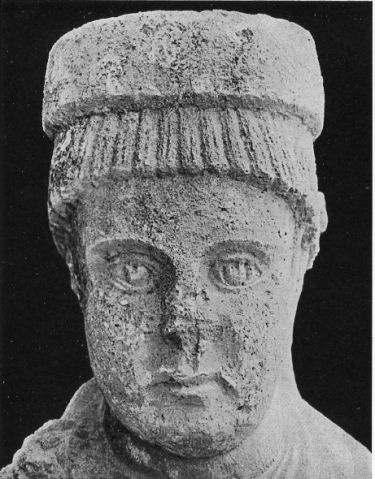
Both faces are slightly irregular; the right side of the human is broader than the left, and there is a vertical fold running down the left corner of the mouth. Likewise the right side of the composite being is broader, and on the left side a naso-labial fold is indicated.
The hair of the human is plastically set off the flesh and is articulated with superficially engraved parallel vertical chisel lines. The hair of the composite being is washed; it surrounds the head like a tight fitting cap, and is set off the flesh by a clear cut line.
The eyebrows of the human are sharp grouts. The iris is circumscribed by a circular line, the pupil is a lunular cavity. The eyes of the composite being are marked in the same way; the eybrows are marked by short diagonal chisel strokes.
The rendering of the folds of the garment is in rough, wood-cut like chisel work; in the same technique the bull’s dewlap is indicated.
PROVENANCE AND CURRENT LOCATION
The herm was first recorded, together with its counterpart LSA-844, by L’Orange 1931 in a private house in the area of Diocletian’s palace in Spalato (Im Dorf Solin (Salona) auf einer Terasse des Hauses Pepo Sperać); his assumption that it was originally from Diocletian’s palace has not been questioned since (see below, 'Further Discussion'). It is today in the Solin Museum, without published inv. no.
DESCRIPTION (Subject)
The human portrait depicts a man with an oval face. He is clean shaven and without folds save one running down from the left corner of his mouth. He is wearing his longish hair in a caplike style, confined by a straight line from the neck to the brow. The hair is lank and brushed forward from the centre of the skull. The ears are only partly covered, in front of each ear a curl is hanging down. On his head he is wearing a flat round military cap (pilleus pannonicus). He is dressed in a tunic (indicated by some folds on the right arm) and a cloak (chlamys) which is fixed on the right shoulder by a four-leaved disc-fibula with a central knob.
The hair of the composite being is parted above the centre of the brow. Its human face is clean shaven and youthful without folds or wrinkles; horns, ears, thick neck and the strong breast with the stylized dewlap add animal features to it.
HONORAND AND DATE
L’Orange 1931 quoted stylistic and antiquarian arguments (the pilleus pannonicus, the military cloak with the disc-fibula which he compared to the porphyry groups in the Vatican (LSA-840, LSA-841) and in Venice (LSA-4, LSA-439)) for a tetrarchic date; he interpreted the double busts as depictions of the tetrarchs, and identified the human portrait of our bust (his bust no. 2) as Diocletian (L’Orange 1931, 43-4). In response to critics (Crome 1935) L’Orange 1984 suggested combinations of a divine figure (the bull, representing a river god) and an emperor; he maintained the view that the human figure represented the Augusti of the tetrarchy, our bust being Diocletian. The river god according to L’Orange was a symbol of fertility (kourotrophos).
Zuchtriegel 2005 argued that the hairstyle and the clean-shavenness indicated a date in the Constantinian rather than the tetrarchic era. He proposed to see Constantine and one of his sons in the portrayed; the combination with river gods referred to the securing of the boarders achieved by the emperors.
Delbrueck 1932 in a laconic statement dismissed L'Orange's identifications throughoutly.
The combination of a human figure with a divine makes the identification of the human as an emperor probable (but see Wrede 1985, 74); if the busts were honorific monuments, then the installation in an imperial palace would even exclude a non-imperial person. Supposed the identification as emperors, the findspot favours the interpretation as tetrarchs; the hairstyle of the human figures and their clean-shavenness, however, speak strongly against this. The hairstyle, on the other hand, is neither readily referable to Constantine and his sons whose portraits throughoutly show free ears; the absence of a diadem, moreover, would need an explanation after 325. Neither the style nor the iconography of the human figures can convincingly be associated with either tetrarchic or Constantinian imperial portraiture and are perhaps best understood as the result of local workmanship (but see below, 'Further Discussion').
FURTHER DISCUSSION
The double herms have not been interpreted in a satisfying way so far. All identifications have presupposed that they were honorific monuments in the imperial realm; nothing is known, however, about their function and original setting. The herm as a pattern for imperial hounours remains unparalleled and it is arguable whether this cheap and reduced form of representation was appropriate for a distinguished person, even an emperor (Wrede 1986, 77). Further double herms are known from Salona; they formed part of the accoutrement of the amphitheatre which was probably executed in the early 4th century and underwent several repair and building activities into the 6th century (Dyggve & Weilbach 1933).
Discussion references
- Crome, J. F., Das Bildnis Vergils, Mantova 1935, p. 8 n. 11
- Delbrueck, R., Antike Porphyrwerke. Studien zur spätantiken Kunstgeschichte, vol. 6, Berlin 1932, p. 121 n. 1
- Dyggve, E. & F. Weilbach, Recherches a Salone, Tome II, Copenhagen 1933, p. 67 fig. 30 D, p. 69-71 figs. 31. 32, p. 116 fig. 59, p. 120-2 figs. 62. 63
- L'Orange, H. P., Die Bildnisse der Tetrarchen, Acta Archaeologica II, 1931, 29-52
- Wrede, H., Die antike Herme, Mainz 1985
- Zuchtriegel, G. 'Zu Datierung und Deutung der Doppelhermen von Solin', Archäologischer Anzeiger , 2005 (vol. 2), 17-25, figs. 2 and 4 (Constantine and sons)
Cite: Last Statues of Antiquity, LSA-843 (Ulrich Gehn).