
LSA-846
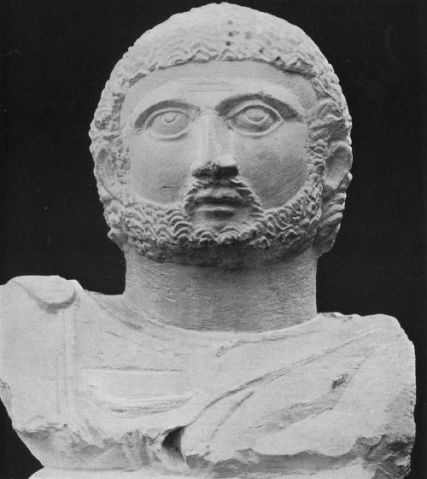
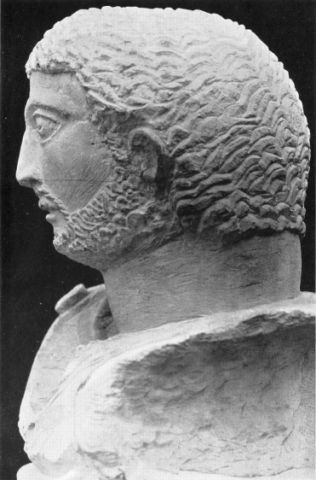
Portrait bust in limestone, possibly of tetrarch. Alexandria (Aegyptus). Third century.
Record details
Photographs
Bibliography
- Graindor, P., Bustes et statues-portraits d'Égypte romaine, Cairo 1937, 67-8 no. 22 pl. 20 b
- L'Orange, H. P., Das spätantike Herrscherbild von Diokletian bis zu den Konstantin-Söhnen, 284-361 n. Chr. Das Römische Herrscherbild. III. Abteilung ; Bd. 4 , Berlin 1984, 27, 106 (Galerius)
- L'Orange, H. P., Studien zur Geschichte des spätantiken Porträts, Oslo 1933, pp. 22-3, 112 cat. no. 16 figs. 46, 48
Discussion
DESCRIPTION (Object)
Limestone bust in acanthus chalice on a moulded plinth, all worked from one piece; H 35 cm. Both arms are broken; the edges of the acanthus appear chipped and there is a hole beneath the middle of the breast. An irregular series of small round holes is visible in the hair above the brow.
Hair and beard are separated from the flesh by a clear cut line. Both, hair and beard are arranged into short wavy strands by chisel work. The single strands have plastic volume; they are sharp edged. On the jawbones, the beard forms into irregular flaky locks.
The iris is circumscribed by a shallow circular line; it is larger in the left eye. The pupil is not marked.
The eyes are set against the surrounding portions of the face by sharp lines; the cheeks are not modeled. The ears are completely integrated into the contour line.
The portrait is modeled in a wood cut like style, face and neck are covered with tool marks. The face and the neck are abnormally wide. Both features should be attributed to the provincial workshop (L’Orange 1933, 112 compared the ornamental arrangement of hair and beard with palmyrene portrait style).
PROVENANCE AND CURRENT LOCATION
The bust is said to be from Alexandria. It is now in the Graeco-Roman Museum in Alexandria, inv. no. 3701.
DESCRIPTION (Subject)
The portrayed is a mature man as is indicated by the full beard; his full hair, however, shows that he is not aged. The head is unnaturally wide, the eyes enlarged, the delicate mouth small, the cheeks broad, the chin tiny. The broad head sits on a massive, column like neck. In the profile view, the back of the head is in a vertical line with the neck and the top of the head is flat. The lower face is receding.
The portrayed wears a trimmed full beard; his hair is dense, growing into the brow, the ears are free. He is dressed in a cloak (paludamentum) which is fixed on the right shoulder; this identifies him a s a soldier (or possibly an emperor). The right shoulder is higher than the left; possibly the right arm was risen.
HONORAND AND DATE
The extraordinary stylistic features are due to the material (local limestone) and probably local workshop traditions (see above, 'Description (Object)'; on the problem of stylistic dating in Egypt cf. Bergmann 2010). The short hair in combination with the beard fits iconographic patterns of military men through the 2nd, 3rd, and 4th century.
The head was assigned to the tetrarchic period by L’Orange 1933, 112-13. Graindor 1936 suggested to recognize a portrait of the emperor Valerian (253-60) in the head; this identification was doubted by Felletti Maj 1958 and dismissed by MacCoull 1968. Jucker 1961 suggested a private portrait of poor quality from around 300.
The hair style and notably the beard which forms into irregular flakes at the jawbones, are perhaps best comparable to fashion styles of the Severan and Gallienic period. The broad head type resembles the portraits of Gallienus (Augustus 252-68), particularly those of his sole rule (260-8). This solitaire is possibly a non-imperial portrait of the earlier or mid-3rd century. However, portraits of the Tetrarchs display a huge band of variations. Moreover, the epigraphic evidence reveals Egypt as a decisively 'imperial' region; it is well possible that this is a provincial variety of tetrarchic imperial portraiture.
Discussion references
- Berger, E. (ed), Antike Kunstwerke aus der Sammlung Ludwig. III Skulpturen, Mainz 1990
- Bergmann, M., Stile und Ikonographien im kaiserzeitlichen Ägypten,, K.Lembke et al. (eds.), Tradition and Transformation: Egypt under Roman Rule. Proceedings of the International Conference, Hildesheim, Roemer- and Pelizaeus- Museum, 3-6 july 2008 1-36, Leiden and Boston 2010
- Felleti Maj, B., Iconografia romana imperial da Severo Alessandro a M. Aurelio Carino, Rome 1958, 218 no. 286
- Jucker, H., Das Bildnis im Blätterkelch. Geschichte und Bedeutung einer römischen Porträtform, Olten 1961, 107-8 St. 56 pl. 45
- Kiss, Z., Études sur le portrait impérial romain en Egypte, Warszawa 1984, 90, 190 figs. 228-9
Cite: Last Statues of Antiquity, LSA-846 (Ulrich Gehn).