
LSA-847
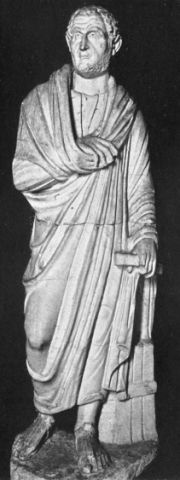
Portrait statue of man wearing himation. From Constantia (Tomis) (Scythia). Late second to third century.
Record details
Photographs
Bibliography
- Alexandrescu Vianu, M. 'Portraits romains dans les collections de Bucarest', Jahrbuch des Deutschen Archäologischen Instituts, 110 (1995), 316-321, fig. 24
Discussion
DESCRIPTION (Object)
Marble portrait statue worked from one block with head and plinth; H 180, H of plinth 12 cm. The statue is complete and in an excellent state of preservation; it has a support in the neck ('Nackenbosse').
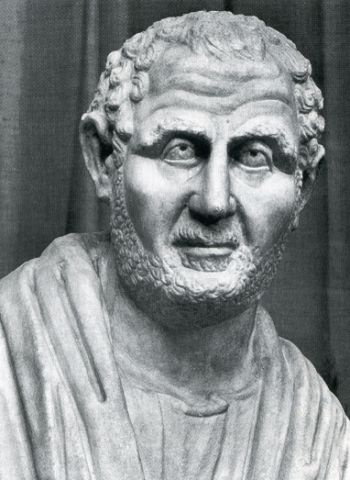
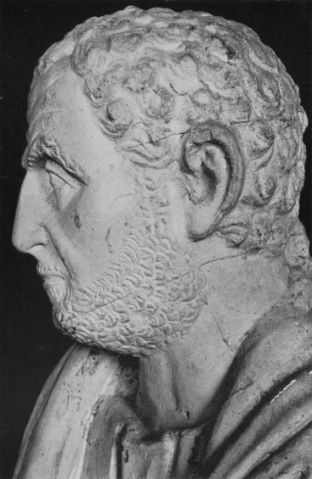
The hair is laid into loops separated from each other by chiselwork. Over the brow it is laid in lank strands, likewise without any drillwork. The short beard is divided into lunular locks by short chisel strokes.
The eyebrows are heftily raised which leads to three heavy and slightly asymmetric horizontal folds on the brow. The protruding eyes are standing remarkably narrow; in the wrinkles clearcut lines separate the temples from the cheeks. The pupil is indicated by a small round drill hole set next to the upper lid; they were probably once filled with coloured material. Deep lacrimal sacks are sketched out below the lower lids, completing the accentuated framework of the eyes. The cheeks are separated from the mouth by two deep naso-labial folds. The lower lip is separated from the chin by an incised horizontal line.
The man is standing on both soles with the weight over his left leg, the right knee is bent. The drapery is given in large parallel folds which follow the posture of the body. The head is turned to the right, the left side of the face accordingly is broader than the right; the front of the body was the principle aspect.
PROVENANCE AND CURRENT LOCATION
The statue was excavated in 1914 in the harbour of Constanţa, the area of ancient Tomis/ Constantia. It was recorded by Alexandrescu Vianu 1995 in the Bucarest National Museum of History, inv. no. 18855.
DESCRIPTION (Subject)
The portrayed is a man of advanced age with his hair thinning out above the brow and receding at the temples; his view is gazing upwards. He is wearing a himation over a chiton; his feet are clad in sandals. His left hand is hanging down the side of the body and holding a scroll. A rectangular bundle of scrolls stands at his left leg. The right arm is laid in an angle in front of the body and held in a loop of the garment. The bearing of arms and attire emulates that of the famous statue of the Athenian orator Aeschines of the late 4th century BC.
The well kept hair and trimmed beard, together with the distinguished drapery of his garment make a markedly cultivated appearance. Chiton and himation are the traditional dress of the Greek cultural sphere, representing civic virtues and education; the attribute of the scrolls underlines such virtues, and the adaption of the statuary type of Aeschines lays a stress on the rhethoric skills of the portrayed.
The raised eyebrows and the furrowed brow, the upward gazing view, together with the squint lips, lend the impression of thoughtfulness and unrest, even worry to the depicted’s face.
HONORAND AND DATE
The attire and attributes identify the portrayed as a man dedicated to the intellectual achievements and civic values associated with Greek culture.
Different proposals have been made as for the date of the statue, depending on the stylistic and typological assessment mainly of the portrait head. L’Orange 1933 assigned it to the tetrarchic period; Bordenache 1958 to the 2nd quarter of the 3rd century; Zanker 1985 to the Severan period. Vianu 1992 (repeated in Vianu 1995) in the most recent reassessment made the case for a date in the late 2nd century.
In my view, the hairstyle with the short, yet free falling curls which each have their own plastic volume makes a date in the earlier 3rd century preferable; the physiognomic features do not speak against this.
It is obvious, however, that this head escapes straightforward dating; I therefore include the whole range of scholarly assessments into my outer dates.
FURTHER DISCUSSION
The rendering of the hair into loops resembles the practice of palmyrenian portraiture. Vianu 1992, 466 suggests that this is due to a workshop of oriental origin active at Tomis.
Discussion references
- Alexandrescu-Vianu, M., Pour une nouvelle datation de la statue drapée de Tomis, Archäologischer Anzeiger 1992, 453-67
- Bordenache, G., Correnti d'arte e riflessi d'ambiente su alcuni ritratti dell' Museo Nazionale di Antichità, Dacia. Revue d'archéologie et d'histoire ancienne. Nouvelle Série II, 1958, 267-80, pp. 269-72
- Fittschen, K. and P. Zanker, Katalog der Porträts in den Capitolischen Museen und den anderen kommunalen Sammlungen der Stadt Rom, Band I, Mainz 1985, p. 132-3 with n. 23 a
- L'Orange, H. P., Studien zur Geschichte des spätantiken Porträts, Oslo 1933, 22, 112, no. 17, figs. 47 and 49
Cite: Last Statues of Antiquity, LSA-847 (Ulrich Gehn).