
LSA-849
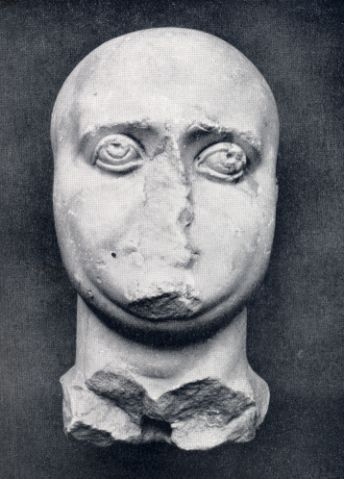
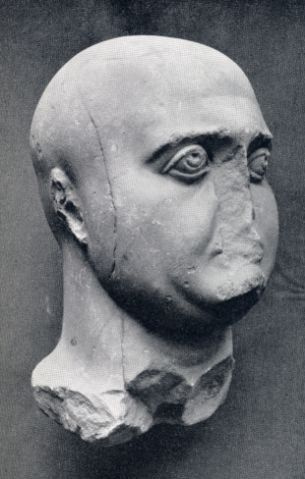
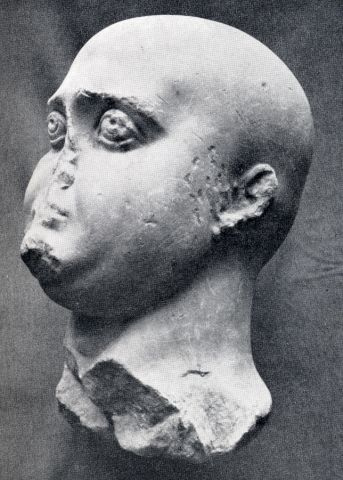
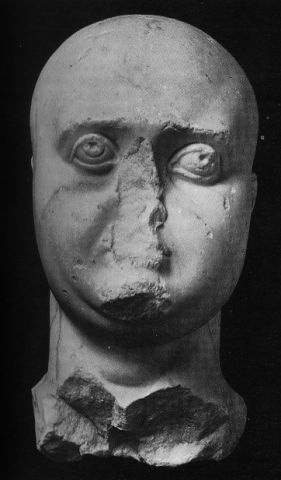
Portrait of priest of Isis with large eyes. From area of Gubbio? Fourth century or sixth century?
Record details
Photographs
Bibliography
- L'Orange, H.P. 'Un ritratto della tarda antichitá nel Palazzo dei Consoli di Gubbio' , Ricerche sull’Umbria tardoantica e preromanica. Atti del II Convegno di studi umbri. Gubbio 24-28 maggio 1964 , Gubbio 1965, 137-150, figs. 1-3 (Narses, 6th c.)
- Matteini Chiari, M. (ed.), Museo comunale di Gubbio. Materiali archeologici, Perugia 1995, 137-9, no. 81 (priest of Isis, c. 300)
Discussion
DESCRIPTION (Object)
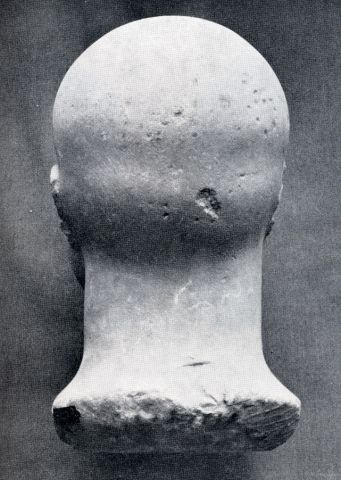
Over life-size head, separately worked. H: 31, W: 17, D: 20.5 cm. Medium-grained marble.
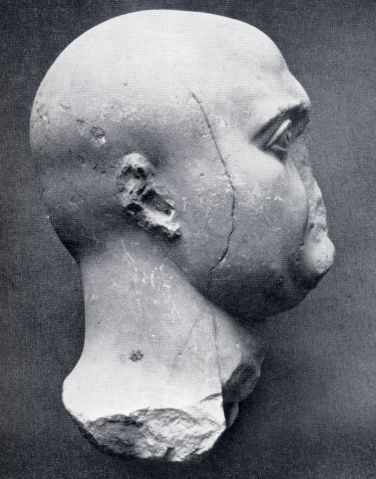
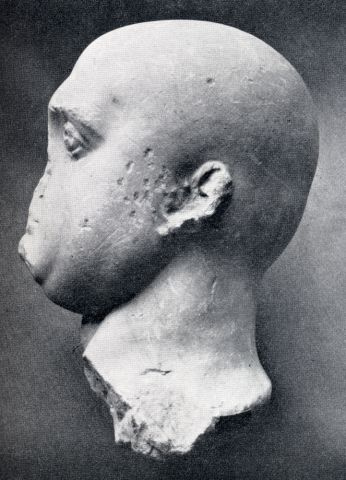
The head was worked separately with its neck. There is rectangular dowel hole in the underside of the base of the neck, around which the marble has broken. There is a crack through the right side of the head which again rises from the break around the dowel. The tip of the nose, mouth, chin, and the edges of the ears are broken and missing.
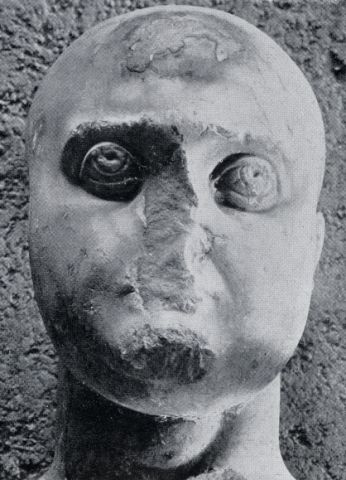
The irises of the eyes are marked with thick engraved semi-circles. The pupils are drilled.
PROVENANCE
Gubbio. It is now in Palazzo dei Consoli and was seemingly found in the area.
DESCRIPTION (Subject)
The head depicts a mature and corpulent man who is entirely hairless. On the upper part of the right brow is a deliberately scratched in X or cross (this is particularly visible in the photographs taken after the restoration in 1987). The bald head is well-modelled with natural indentations at the temples and at the back of the skull. The brow has a single crease below which it protrudes. The eyes are large, bulging, and have thick lids. The nose is short with defined naso-labial folds. The mouth appears to have been thin-lipped with upturned corners. The chin projects, and there is an abundant amount of loose skin beneath the chin. The neck is also thick with a large crease and a prominent Adam’s apple.
DATE AND HONORAND
The rendering of the eyes led H.P. L’Orange to date this head to the late-antique period. Initially he placed it in the Tetrarchic period, and then, after a personal examination, he put it in the sixth century. He believed that it was stylistically close to LSA-756, LSA-757, and LSA-758. He proposed to identify the head as Narses because Narses celebrated victories in Italy in the mid-sixth century, because Gubbio sent an embassy to the east to thank it for its help, and because Narses was an Armenian eunich (i.e. neither Greek nor Roman).
The head has since been convincingly associated with a series of portraits of men with shaven heads who were probably priests of Isis. They tend to have on the right upper forehead a cross or scar which associates them with Isis.
Nonetheless, the handling of the eyes is unusual and suggests a late date. Thus, it has most recently been published as c. 300. The use of the dowel to attach the head to its statue, as opposed to a tenon, is also a late technical habit and suggests re-use.
Discussion references
- L'Orange, H. P., Studien zur Geschichte des spätantiken Porträts, Oslo 1933, 27, 114, no. 22, figs. 59-60 (Tetrarchic)
Cite: Last Statues of Antiquity, LSA-849 (J. Lenaghan).