
LSA-85
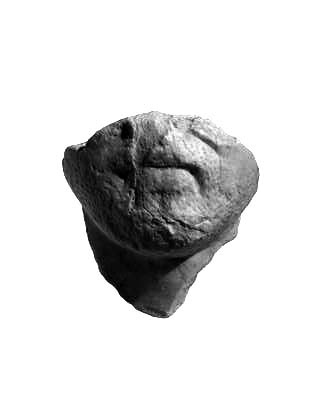
Fragment of bearded portrait head. Corinth (Achaea). Late third to early fourth century.
Record details
Photographs
Bibliography
- de Grazia, C. E., American School of Classical Studies at Athens, "Excavations of the American School of Classical Studies at Corinth:
The Roman Portrait Sculpture," Ph.D. Dissertation
, Columbia University, 1973, pp. 205-6 no. 49 pl. 62 - Johnson, F. P., Sculpture, 1896-1923: Corinth IX, 1, Cambridge, Mass. 1931, p. 91 no. 179
Discussion
DESCRIPTION (Object)
Preserved is the lower part of the face with mouth, chin, and a part of the neck. Fine-grained white marble, H 18, W 15.5, D 10 cm. The preserved portion is mended from several pieces, and the surface is chipped along the cracks.
The stubble beard is picked with a point directly into the surface.
PROVENANCE/ LOCATION
The fragment was found 1914 in a Byzantine wall resting on the pavement of the southeast corner of the Peribolos of Apollo. It is today in the Corinth museum, inv. no. S-1047.
DESCRIPTION (Subject)
The portrayed has full cheeks and wears a stubble beard (campaing beard).
DATE
The fragment was dated to the mid 3rd century byJohnson 1931, to the tetrarchic period by De Grazia 1973.
As De Grazia 1973 pointed out, the treatment of the beard has its most convincing parallels in portraits of the tetrarchic period.
Cite: Last Statues of Antiquity, LSA-85 (Ulrich Gehn).