
LSA-850
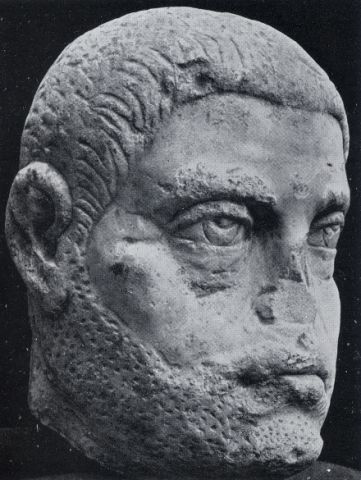
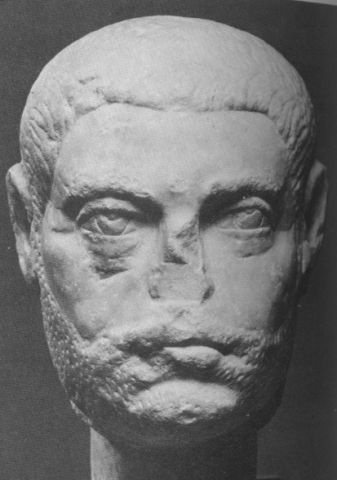
Portrait of man with short-cropped beard and brushed forward hair. From Italy. Late third to early fourth century AD.
Record details
Photographs
Bibliography
- Stutzinger, D. (ed.), Spätantike und frühes Christentum. Ausstellung im Liebieghaus, Museum alter Plastik, Frankfurt am Main. 16. Dezember bis 11. März 1984, Frankfurt a.M. (1983), 414-5, no.32 (early 4th c.)
Discussion
DESCRIPTION (Object)
Life-size head. H: 25 cm. Large-grained white marble with greyish crystals.
The head is broken through the neck. Part of the back of the head and neck (as per L’Orange no. 23) is missing. Most of the nose is missing; the mouth and eyebrows are battered. L’Orange reports that there is a dowel hole in the back surface of the head which was used to attach it to a wall. T he head has been re-cut from an earlier portrait. The ears are too large and slightly high for the face.
The hair of the fringe is rendered with curving strokes of a thick flat chisel. Behind the fringe it appears to be more cursorily rendered with shorter strokes. The beard is rendered with the taps of the point of a chisel. The eyes are marked by two parallel, U-shaped, engraved lines that indicate the iris and the edge of the pupil.
PROVENANCE:
Purchased in 1930-31 in Rome on the art market.
DESCRIPTION:
The head shows a mature man whose hair is brushed forward and whose beard and moustache are stubbly. The hair sits as a short unified cap; it perimeter over the brow is defined by the same continuous line that defines the inner edge of the beard. The fringe does recede slightly at the corners and consists of medium-length locks.
The face is intended to be aged. The brow is tall and square with one crease across the forehead. The eyes are large and have deep lines engraved beneath them to show wrinkles. The mouth has full lips, and the chin is short and protruding.
DATE
The brushed-forward fashion, short stubble beard, and intensely rendered eyes place this head in the later third or early fourth century. In terms of fashion, the type generally accepted as Maxentius, (see LSA-895,LSA-896, LSA-897) provides good comparanda. All scholars have compared it either to the portraits on the Arch of Constantine or Arch of Galerius. The closest parallel for the technique (eyes, hair, and beard) as well as physiognomy and fashion comes from Sperlonga (LSA-1043). A fragment from Minturno (LSA-1114)is also similar; all three are discussed together by Von Sydow.
Discussion references
- L'Orange, H. P., Das spätantike Herrscherbild von Diokletian bis zu den Konstantin-Söhnen, 284-361 n. Chr. Das Römische Herrscherbild. III. Abteilung ; Bd. 4 , Berlin 1984, 108 (private portrait)
- L'Orange, H. P., Studien zur Geschichte des spätantiken Porträts, Oslo 1933, 30, 114, no. 23
- Sydow, W. von, Zur Kunstgeschichte des spätantike Porträts im 4. Jahrhundert. n. Chr, Bonn 1969, 9-10 (Tetrarchic)
Cite: Last Statues of Antiquity, LSA-850 (J. Lenaghan).