
LSA-851
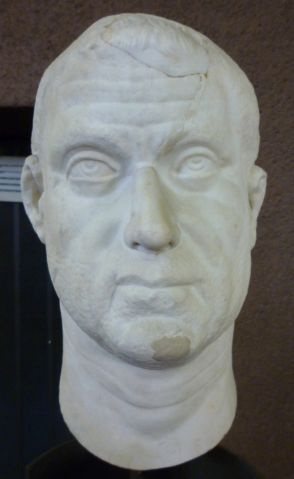
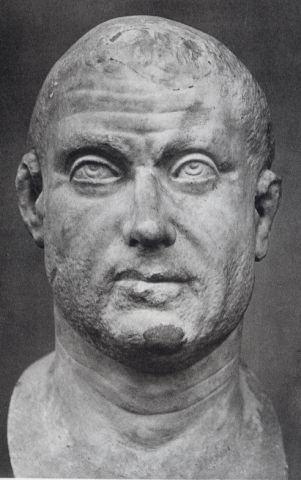
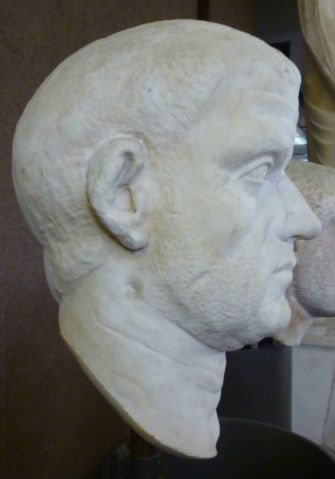
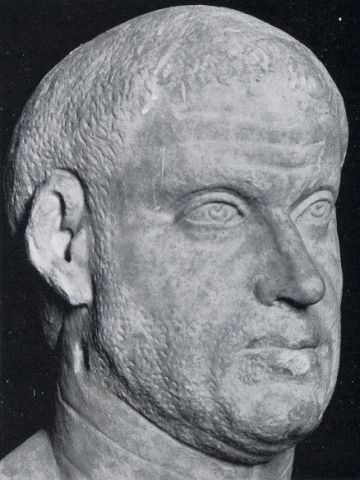
Over life-size head with large forehead and jowls, Constantius I? From environs of Rome? Late third century.
Record details
Photographs
Bibliography
- Giuliano, A., Catalogo dei ritratti romani del Museo Profano Lateranense, Vatican City 1957, 80, no. 98, pl. 58
Discussion
DESCRIPTION (Object)
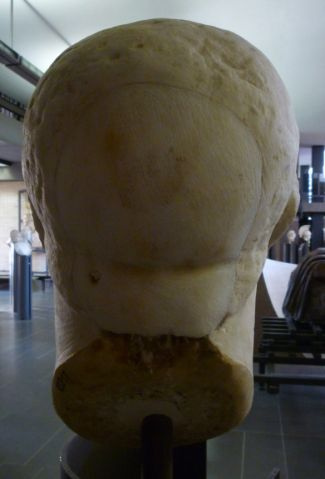
Over life-size head, separately worked. H: 35 cm. Fine-grained white marble.
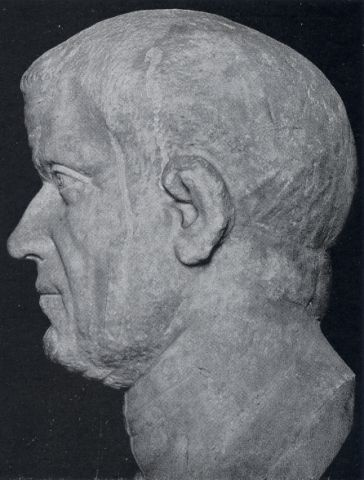
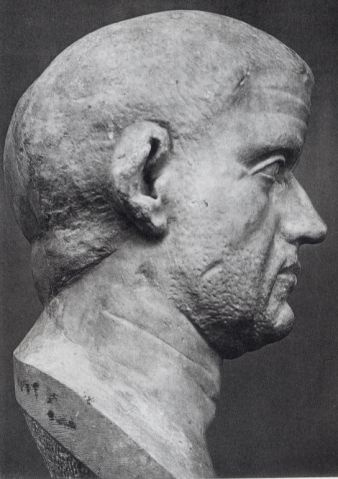
The head was worked separately with its neck. The bottom of the neck is smoothly worked and was inserted in the modern period into a bust. There is a separately-worked patch of hair at the back of the head; its surface has been finely engraved to show hair. The nose and an area of the chin are restorations. There is a notch under the right ear lobe.
The hair of the head is rendered with short strokes of a flat chisel. The hair of the beard is rendered with larger point marks of a chisel. The irises are indicated with semi-circular engraved lines; the pupils are engraved U-shapes within the irises.
The portrait has been re-cut from earlier one. The top of the head and area behind the ears have an unusual shape that is the result of the removal of hair. The brow slopes diagonally backwards to the more recessed plane of the face.
PROVENANCE
Rome or its environs
DESCRIPTION (Subject)
The head depicts a mature man with short hair and a stubble beard. He has a distinctive physiognomy and turns to his left.
The hair, which does not rise off the skull, is cut short around the ears and indents at the juncture of the skull and neck. The fringe comes slightly forward at the centre of the brow. The moustache and beard are rendered as stubble.
The brow is tall and slopes inwards. It is traversed by three to four deep creases. The eyes are small and set high on the face. The skin hangs loosely around them. The nose has a deeply indented root. The mouth is broad with full but irregular lips; the upper right side is fuller and shorter than the left. The chin is rounded and jutting but not deep. Below the chin is a roll of loose skin. In profile view a series of three sets of creases in the face are most visible; one set begins below the eyes; another corresponds to the naso-labial folds which, however, begin above the nostrils; and a final set descends from the corners of the mouth.
The neck is heavily creased and has a slightly protruding Adam’s Apple. There are more lines on the left side because he turns in that direction.
IDENTIFICATION AND DATE
The portrait is stylistically and physiognomically related to a series of over life-size heads from the Rome area. These include one now in Copenhagen, LSA-810, and two from Ostia, LSA-848 and LSA-1055. All three portraits furthermore relate to a type, known in two replicas, that has been identified as Constantius I; see LSA-806and LSA-855.
The head can be dated confidently to the Tetrarchic period. A specific identification however is at the moment impossible. Were these all re-cut and loose versions of one model or are they all simply important men with a similar face?
Discussion references
- L'Orange, H. P., Das spätantike Herrscherbild von Diokletian bis zu den Konstantin-Söhnen, 284-361 n. Chr. Das Römische Herrscherbild. III. Abteilung ; Bd. 4 , Berlin 1984, 100-101
- L'Orange, H. P., Studien zur Geschichte des spätantiken Porträts, Oslo 1933, 30, 114, no. 24, figs. 65 and 70
- Meischner, J., Bildnisse der Spätantike : 193-500 : Problemfelder : die Privatporträts , Berlin 2001, 61-2, fig.171 (AD 270-285)
Cite: Last Statues of Antiquity, LSA-851 (J. Lenaghan).