
LSA-852
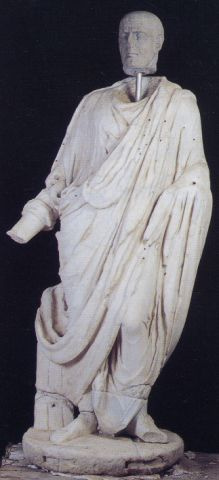
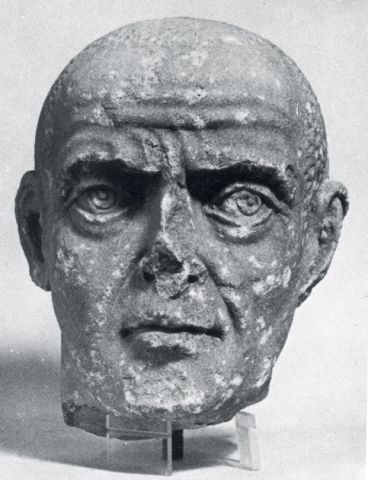
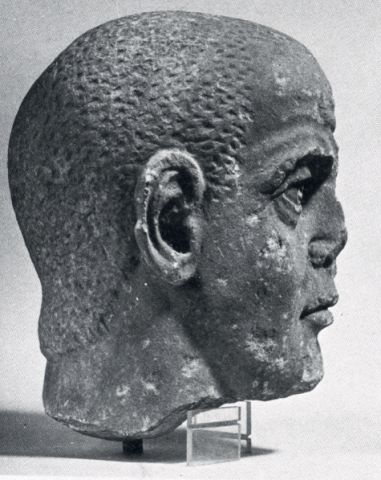
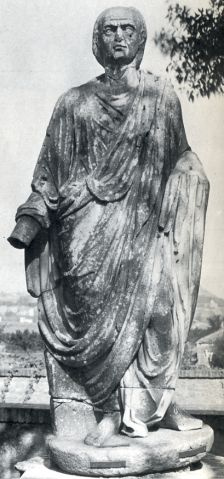
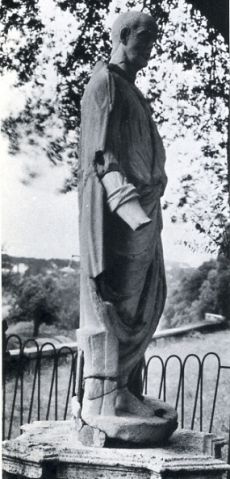
Portrait statue of clean-shaven elder man capite velato. From Italy. Late third to early fourth century.
Record details
Photographs
Bibliography
- Calza, R. et al. (eds.), Antichità di Villa Doria Pamphilj, Rome 1977, 304-305, no. 377, pls. 215-216
Discussion
DESCRIPTION (Object)
Over life-size head for insertion with over life-size statue. H: c. 206, W: 74, D: 51 cm. H (of head): 35.5 cm. Large-grained white marble with bluish crystals.
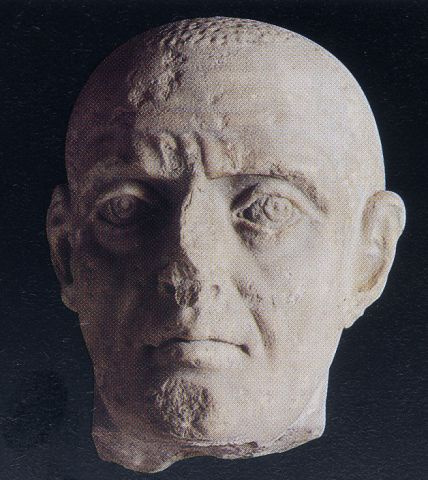
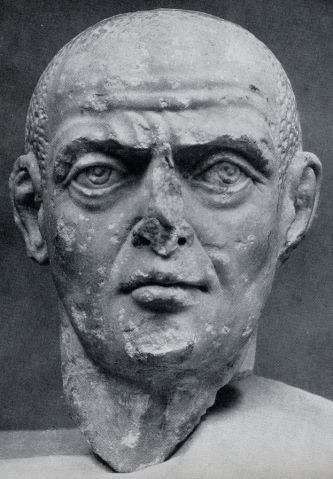
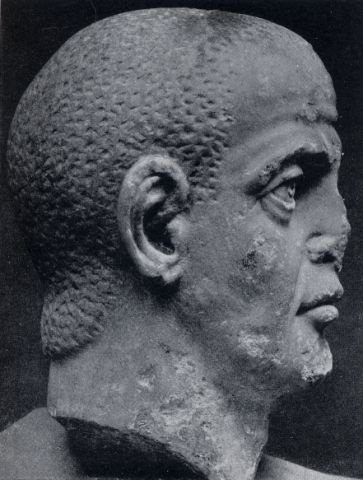
The head was worked for insertion and probably belonged with the statue. The head is broken unevenly through the neck. The tip of the nose is missing. The mouth and eyes are chipped. Furthermore, before the head was stolen c. 1930, the back of the head was covered by a toga. This was removed by the thieves to disguise the piece. The statue is missing the right forearm and part of the neck. It has numerous breaks and restorations.
The hair has been roughly picked onto the cranium. Some of this is contemporary to the portrait and some of it must post-date 1930 when the portion of the toga covering the back of the head was removed. The eyes have deeply engraved iris that are approximately semi-circular. The pupils are more broadly drilled but a follow a parallel path to the irises; this gives them a horse-shoe shape.
PROVENANCE
An inventory of the Villa Pamphili in Rome dated to 1666 records a statue of a consul 9 palms high. This may be a reference to this statue which had restorations in keeping with such a date. The statue was definitively on display in the gardens of the Villa in 1845. The head was lost around 1930. It was recognized on the art market by H.P. L'Orange who purchased it and gave it back to the Pamphili. In 1971 the Comune di Roma acquired part of the Villa and took the head to the Capitoline Museum. In 1999 the statue was removed from the gardens of the Villa for reasons of conservation (and replaced with a plaster cast). At that point the head and statue were reunited and can now be found inside the Villa Vecchia.
DESCRIPTION (Subject)
The statue portrays an older man in a toga which once covered the back of the head. The head, re-worked from an earlier portrait, now shows the expressive clean-shaven face of man in his 50s or 60s.
The togate statue follows a standard high imperial format in both pose and costume. The right arm is lowered by the side and probably held the edge of the sinus. The left arm, bent at a 90 degree angle, rests also at his side and may once have held a scroll. The figure wears a tunic, a toga, and senatorial shoes. The toga has deep sinus that reaches the right knee and small umbo. A bundle of tabellae or scrolls, only schematically represented, supports the figure on the outside of the advanced and weight-bearing right leg.
The portrait has a firm and distinctive aspect. The man has receding hair which clings closely to his head. Three modelled rolls of flesh cross the brow horizontally. Above the root of the nose are a series of vertical creases. The eyebrows flare upwards near their outer corners. The eyeballs are strongly marked, and the thick lids are heavily defined. Beneath the eyes the skin sags, and the cheeks are slightly hollow beneath the cheekbones. Strong naso-labial folds extend from the nose to the outer corners of the mouth which is firm and broad. The chin is strong and projecting.
DATE
The togate statue and the portrait head are of different dates. The statue belongs probably to the first half of the second century on the basis of costume, size, fashion, and carving.
The portrait head belongs to the late third or fourth century on account of the technical rendering of the hair and eyes and because of the clean-shaven fashion style. The roughly picked hair which clings to the skull and the emphatic eyes are methods that appear first in the late third century, especially in the portraiture of the Tetrarchs (see, for example, LSA-836, LSA-895, LSA-896, LSA-897, LSA-1027, LSA-1028, LSA-1030, and LSA-1031).
(They tend also to be common to re-cut portraiture (see, for example, LSA-1043, LSA-1045, and LSA-1126). The lack of a beard ought to be seen in conjunction with the new clean-shaven fashion of Constantine.
The disparity in date between head and body does not, however, mean that they do not belong together. Attaching a re-worked head to an older, but still acceptable, body or bust type is common in the fourth century (see below).
HONORAND
H. P. L’Orange, impressed by the individuality and strength of the portrait, identified this statue as Diocletian. Although this may be more or less chronologically suitable, the clean-shaven cheeks of the head make it most unlikely. Even the receding hairline is virtually unattested in the established portrait types of the Tetrarchs; it appears only in the Vienna-Izmir type (LSA-325, LSA-373, and LSA-687), which almost sure represents Licinius and is physiognomically different from this portrait.
It is easier to assume that this is a private portrait of a leading public figure in the environs of Rome. The toga costume, with all of its traditional connotations, was still clearly a desirable mode of representation in the fourth century for western men (see, for example, LSA-44, LSA-46, LSA-879, LSA-1124, and LSA-1130).
Discussion references
- Ensoli, S. and E. La Rocca (eds.), Aurea Roma: dalla città pagana alla città cristiana, Roma 2000, 541-2, no. 188
- L'Orange, H. P., Das spätantike Herrscherbild von Diokletian bis zu den Konstantin-Söhnen, 284-361 n. Chr. Das Römische Herrscherbild. III. Abteilung ; Bd. 4 , Berlin 1984, 101, pls. 14-15
- L'Orange, H. P., Studien zur Geschichte des spätantiken Porträts, Oslo 1933, 30, 115, no. 27, figs. 68 and 71
Cite: Last Statues of Antiquity, LSA-852 (J. Lenaghan).