
LSA-853
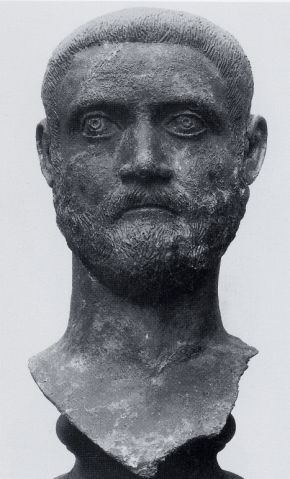
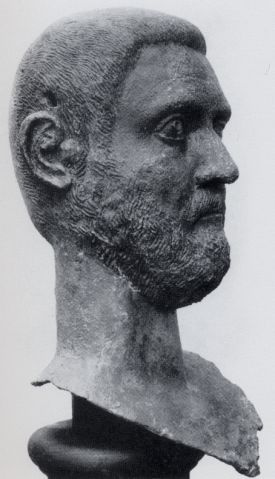
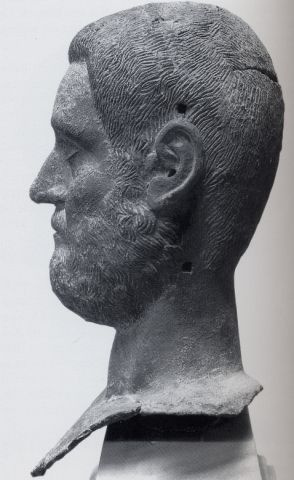
Bronze head, separately worked, of man with short beard, possibly a Tetrarch. Sabratha (Tripolitania). Late third century.
Record details
Photographs
Bibliography
- Lahusen, G. and E. Formigli, Römische Bildnisse aus Bronze : Kunst und Technik, Munich 2001, 309-310, no. 192 (Tetrarchic)
Discussion
DESCRIPTION (Object):
Over life-size head, worked separately. H: 43.2 cm. Bronze.
The head is preserved with its neck and the area of chest immediately adjacent to the base of the neck. The proper right edge of the chest is preserved; the left, however, is broken. There are four holes on the left side of the head: above the brow, above the ear, in the ear, and below the ear. These were not for the attachment of a crown; the corresponding holes on the right side have been closed. An indentation in the hair above the head suggests that a wreath was worn.
The short hair is rendered in fine engraved strands. The irises are circular and engraved. The pupils are hollowed circles
Provenance
The head was found in a well with another fragmentary bronze portrait (often identified as Decius). The cistern was located near the Forum and collected the water from the portico on the west side of Temple of Antoninus Pius.
DESCRIPTION (Subject):
The head depicts a short-haired man with a short but full beard and moustache. The hair is combed forward and cut high on the brow. The beard consists of separate tufts that turn in different directions. The brow has a single crease. The facial features are regular. The eyes are perhaps slightly larger than normal; the nose slightly more pointed; the chin slightly deeper.
The upper sternum is bare. Too much of the chest is exposed to imagine that this head was inserted into a cuirassed statue; even for a togate statue, the neckline of the drapery would have been very low. The head may have been attached to a nude statue.
HONORAND
The head is well over life-size. It was found discarded near the Temple of Antoninus Pius. It appears to have worn a wreath. It is made of bronze. Thus, most scholars have assumed that it represented an emperor. That it may have come from a naked statue would corroborate the hypothesis. The physiognomy however is unspecific. This makes it difficult to identify. Past proposals have included Philip the Arab, Licinius, and Diocletian.
DATE
The short hair and beard style were in fashion from the mid-third century through most of the fourth century. The frozen, inorganic, and non-specific aspect of the physiognomy has led almost all scholars to accept a Tetrarchic date.
Discussion references
- Bonacasa Carra, R.M. 'Due ritratti imperiali di bronzo nel Museo di Sabratha', Roman portraits : artistic and literary : acts of the third international conference on the Roman portraits held in Prague and in the Bechyně Castle from 25 to 29 September 1989
, Mainz 1997, 68-9, pl. 23 (Diocletian) - Fuhrmann. 'Archäologische Funde. Italien, Libyen', Archäologischer Anzeiger, Berlin 1941, 729-31, fig. 172
- L'Orange, H. P., Das spätantike Herrscherbild von Diokletian bis zu den Konstantin-Söhnen, 284-361 n. Chr. Das Römische Herrscherbild. III. Abteilung ; Bd. 4 , Berlin 1984, 101, pl. 17a-b
- L'Orange, H. P., Studien zur Geschichte des spätantiken Porträts, Oslo 1933, 30, 103, 115-16, no. 28
Cite: Last Statues of Antiquity, LSA-853 (J. Lenaghan).