
LSA-854
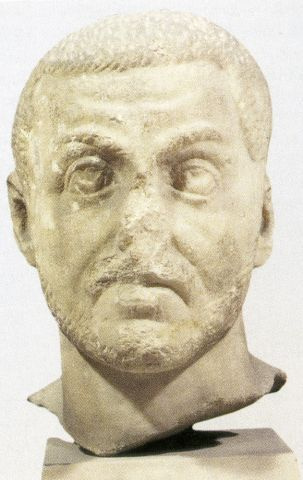
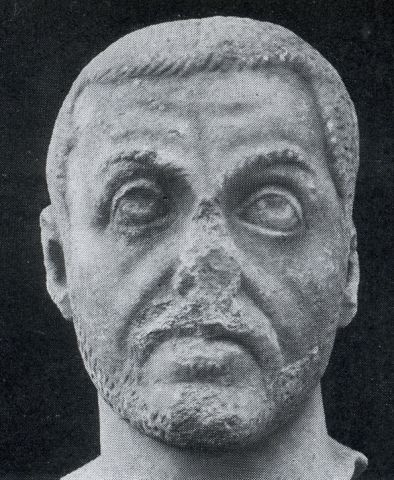
Portrait of man with short cropped hair and beard. From Italy. Late third century to early fourth century.
Record details
Photographs
Bibliography
- Donati, A. and G. Gentili, Costantino il Grande. La civiltà antica al bivio tra Occidente e Oriente, Milan 2005, 288, no. 130 (F. Sirano)
- L'Orange, H. P., Studien zur Geschichte des spätantiken Porträts, Oslo 1933, 30-31, 116, no. 30
Discussion
DESCRIPTION (Object)
Over life-size head. H: 32, W: 20 cm. Pentelic marble.
The head is preserved with the throat and a small portion of the shoulders. The nose is missing. The upper lip is damaged
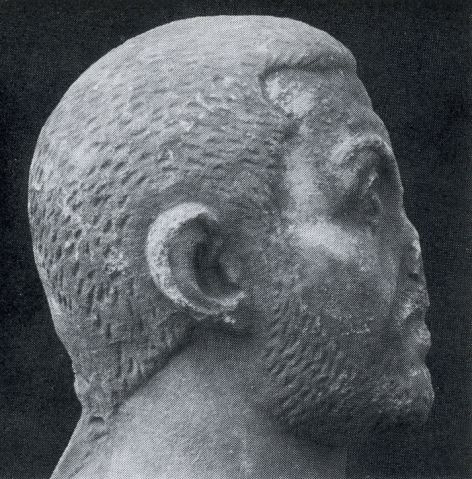
The hair and beard have been rendered with strokes of a large flat chisel into a slightly raised surface (probably worked down from an earlier portrait). The eyes have large semi-circular irises (engraved) and large hollowed-out pupils.
L’Orange and then Sirano suggest that this comes from the lid of a sarcophagus because of its upward turn. Sirano furthermore adds that the head was re-worked from a female portrait with a braid at the nape. Without published photographs of the back of the piece, this too is difficult to evaluate securely. Neither of the suggestions is entirely convincing to this author. The position of the re-cut head on the statue is difficult to assess. Moreover, the size of this re-cut head is large for a sarcophagus from Italy. A female hairstyle with a braid resting on the nape would belong at latest to the second century, and this is too early for a large sarcophagus. In regard to the neck element, it is equally possible that the head worked in one piece with its statue has neck pillar.
PROVENANCE
Unknown provenance.
DESCRIPTION (Subject)
The head shows a mature man with short hair and a stubble beard who turns to his left.
The hair is rendered as a uniform mass which recedes significantly at the right corner of the brow. The individual locks of the fringe are short and small and turn to the right. The stubble beard begins low on the cheek and is firmly defined within a continuous line on the cheek.
The brow is tall and has one horizontal crease and two indentations that follow the shape of the eyebrows. The eyebrows have a high arch and the eyes are large. The naso-labial folds and a line down the middle of the cheek are indicated.
DATE
The fashion style (short hair and beard) belongs between the middle of the third century and the early fourth century. The the technique of the eyes and eyebrows suggest a date later in this period.
Discussion references
- Bergmann, M., Studien zum römischen Porträt des 3. Jahrhunderts n. Chr., Bonn 1977, 151, pl. 44.1-2 (Tetrarchic, compares to Alba Fucens)
Cite: Last Statues of Antiquity, LSA-854 (J. Lenaghan).