
LSA-856
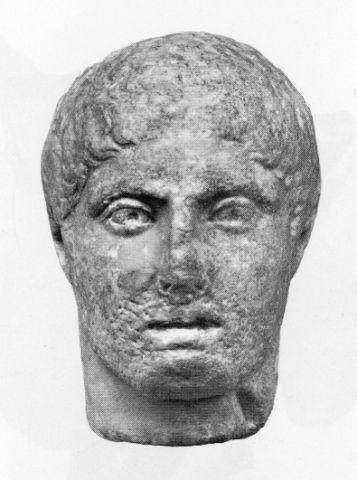
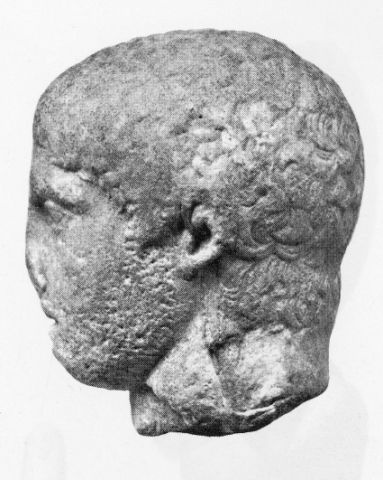
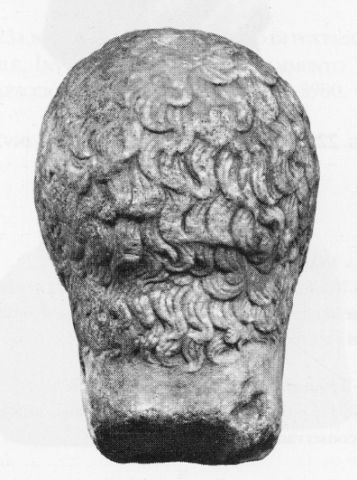
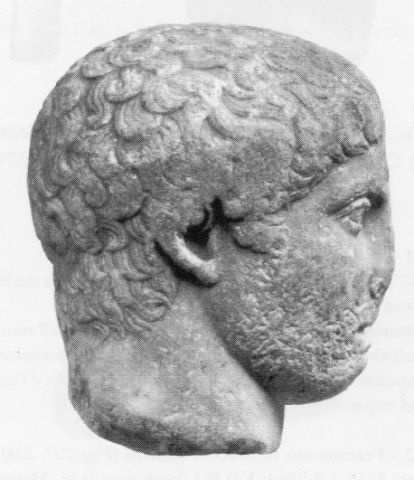
Head of polycleitan type reworked into portrait head. Gortyna (Creta). Late third to earlier fifth century
Record details
Photographs
Bibliography
- De Tommaso, G., Lippolis, E. & C. Portale, Scultura, Gortina V.3. Lo scavo del pretorio (1989-1995). - Vol. V.3* t. II -. I materiali. A cura di A. Di Vita, 570-592, Padova 2001, pp. 570-1 no. 1 figs. 216-19
Discussion
DESCRIPTION (Object)
Portrait head of a bearded male recut from a polycleitan type; medium grained marble. No measurements are recorded by De Tommaso et al. 2001. Nose, lips, and chin are chipped; the hairline is chipped in the centre of the brow so that the arrangement of the hair at this point is not visible. The surface appears washed and covered with minor chips, particularly on the (proper) left side. There is a rectangular cut at the left side of the neck and a further cut or break at the back of the neck.
The present aspect of the head is the result of a late-antique re-working. The original, 'polycleitan' locks are still visible at the backside. At the front and the sides the hair has been flattened and simplified. A beard has been picked in with a point, and the pupil has been marked by a circular drill hole.
PROVENANCE/ LOCATION
The head was excavated in the praetorium at Gortyna, in the sector 'B'. It is now in the Gortys museum, inv. no. 6691.
DESCRIPTION (Subject)
The adult age of the portrayed is indicated by the stubble beard, but no indications of advanced age disturb the smoothness of the face. The beard characterises the portrayed as a man of active life, possibly a soldier or an imperial office-holder.
De Tommaso et al. 2001 suggested to possibly recognise a portrait of Gratian in our head, one of the few post-tetrarchic 4th-century emperors showing a beard on coins; indeed a honorific statue for that emperor is testified to by inscriptions from the praetorium in Gortyn (LSA-472, LSA-770, LSA-950). This identification, however, in my view, is excluded by the fact that our head does not wear a diadem; neither does it display the imperial hairstyle of the late 4th century with its lank, neatly brushed hair.
DATE
The technique of the re-working, and particularly the rendering of beard and eyes, makes a late-antique date of this process likely. Other late-antique portrait heads from Gortyn further testify to late-antique re-use in this city; yet none of them provides a good parallel for the technical treatment of our head (LSA-859, LSA-860, LSA-861).
The arching hairline and the 'classical' appearance might match best the taste of the Theodosian period; the stubble beard is usually associated with portraiture of the tetrarchic era but is also displayed together with full hair, by the portrait of the comes sacrarum largitionum of 379 Flavius Julius Catervius on his late 4th century sarcophagus in Tolentino (PLRE I, 186-7 Flavius Julius Catervius; Dresken-Weiland 1998); it becomes fashionable again in the 5th century. The epigraphic evidence from Gortyn testifies to honorific monuments well into the 5th century (LSA-787).
While some indicators appear to speak in favour of a 4th-century date, a precise date for our head is beyond reach at the moment. We therefore assign a broad outer date from the late 3rd to the early 5th century when honorific statuary in Gortyn is still testified to.
Discussion references
- Dresken-Weiland, J., Repertorium der christlich-antiken Sarkophage. Zweiter Band. Italien mit einem Nachtrag Rom und Ostia, dalmatien, Museen der Welt, Mainz 1998, pp. 52-4 no. 148 pl. 56, 1–5; 57, 1–5
- Jones, A. H. M. et al., The Prosopography of the Later Roman Empire. Vol. I 260-395, Cambridge et al. 1971 (1975)
Cite: Last Statues of Antiquity, LSA-856 (Ulrich Gehn).