
LSA-858
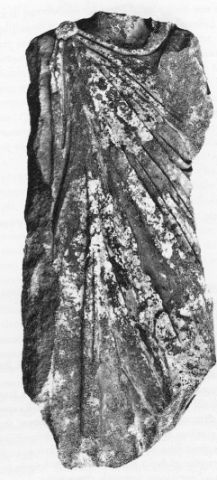
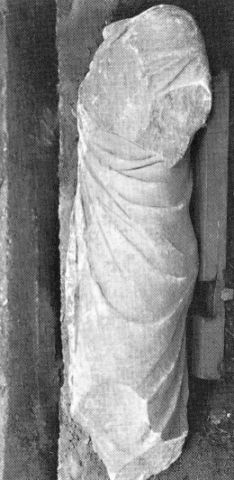
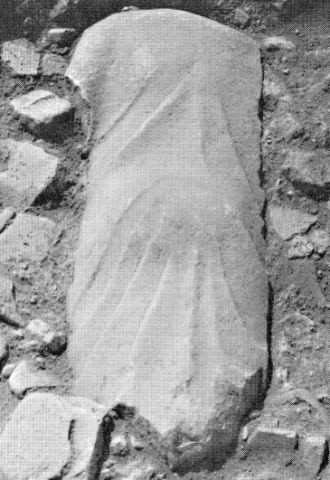
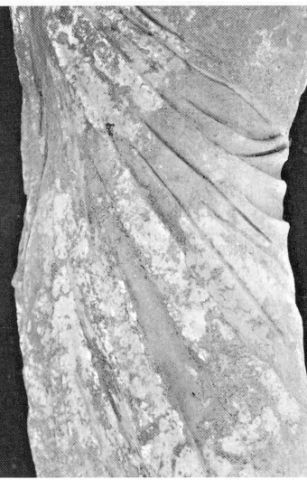
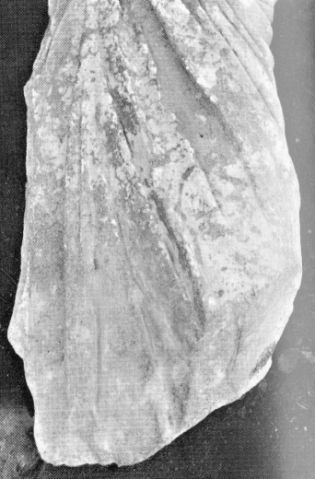
Torso of statue of man wearing Chlamys. Gortyna (Creta). Late third to earlier fifth century
Record details
Photographs
Bibliography
- De Tommaso, G., Lippolis, E. & C. Portale, Scultura, Gortina V.3. Lo scavo del pretorio (1989-1995). - Vol. V.3* t. II -. I materiali. A cura di A. Di Vita, 570-592, Padova 2001, pp. 580-2 no. 24 figs. 236-41
Discussion
DESCRIPTION (Object)
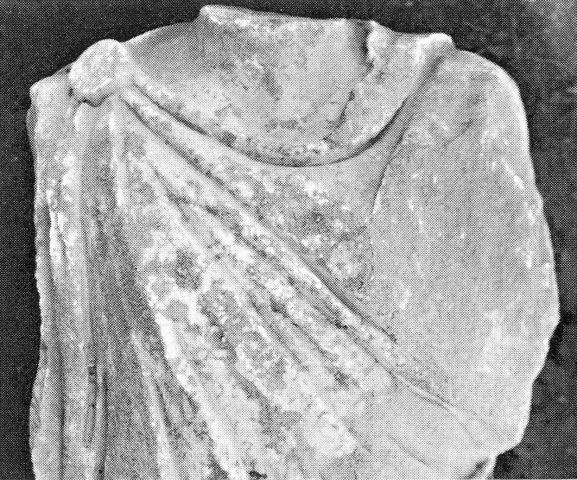
Torso of a statue of a man wearing the chlamys; fine grained white marble, H 105 cm (only measurement published by De Tommaso et al. 2001). Both arms, head, and both feet with lower legs are missing; in its present shape the torso is possibly the result of a re-work to make it fit for building-purposes. The neck is cut horizontally and has a rectangular dowel hole to attach the separately-worked head (De Tommaso et al. 2001, 580). The surface is covered with spots and chips.
At the front side a system of long folds is fanning out from the fibula on the right shoulder. The folds are articulated by extensive drillwork on the front side, while the back is worked out much less lavishly.
PROVENANCE/ LOCATION
The torso was excavated in the praetorium of Gortyn in 1989/95. It is today in the Gortys museum, inv. no. 5881.
DESCRIPTION (Subject)
The depicted is wearing a long chlamys fixed with a disc-fibula at the right shoulder. The lower seam is not preserved with the torso; the chlamys must have reached to the shin well beyond the knees. The cloak covers the entire body except for the right side which is framed by the two seams of the garment. It is wrapped tightly around the left side.
The figure is standing on its right leg, the left knee bent. This ponderation is visible at the left side, but does not affect the straight lining of the folds running down the front side. The right arm, not covered by the chlamys, was held straight down the right side, while the left arm, wrapped into the cloak, was bent in the elbow and held tightly to the left breast.
The chlamys is an old representational pattern used in Greek antiquity for ephebes and military personnel, but also for gods and mythological figures. In sculpture in the round from the early and high imperial periods it is mainly known in the form of 'fringe paludament' ('Fransenpaludamentum’) worn by iconic busts; I am aware of only one chlamys statue from this time (Claudius in Aquileia, Scrinari 1972 p. 30 no. 83). In the tetrarchic and constantinian periods the chlamys is displayed by imperial busts and statues (LSA-836, LSA-1007, LSA-1009, LSA-1010, LSA-1166), while in the late 4th and in the 5th century it is displayed by iconic sculptures of high-ranking imperial office-holders (LSA-15, LSA-19, LSA-20, LSA-21, LSA-22, LSA-23, LSA-24, LSA-54, LSA-80, LSA-150, LSA-169, LSA-170, LSA-171, LSA-184, LSA-460, LSA-1160, LSA-1168, LSA-1590; LSA-90, LSA-205, LSA-447, LSA-2282).
The statue from Gortyn wears a plain disc-fibula. This raises some problem for the assessment of the statue, since the fibulae of late-antique imperial portraits in the chlamydatus-type are usually lavishly decorated with precious stones; in but one case an imperial portrait is provided with a crossbow fibula (bust from Athribis, LSA-836), whereas in most cases the emperor is dressed with a pendile-fibula. The pendile fibula entered the imperial self-representation in the late tetrarchy and is shown by imperial chlamys-statues from the Constantinian period onwards (LSA-1007, LSA-1009, LSA-1010). State officials when displayed in works of art are usually decorated with a crossbow fibula (see below, 'Date').
The cloak and the fibula being the only indicators for an assignement of our statue, it probably represented an emperor or a high ranking official in the late-Roman state (see below, 'Date').
DATE
As De Tommaso et al. 2001, 582 point out, the technical properties of the statue as well as the length of the chlamys indicate a late antique date.
A disc fibula similar to the one displayed by our statue holds the chlamys worn by Constantine I during his oratio on the northern side of his triumphal arch in Rome (L'Orange-Gerkan 1939). At the arch of Galerius in Thessaloniki, the standing emperor to the right (from the viewer) in the triumphal representation of the tetrarchs appears to wear a disc fibula (Laubscher 1975). In later plastic representations, the imperial chlamys-costume is usually provided with a pendile-fibula (see above, 'Description (Subject)').
The crossbow-fibula of the state officials features prominently on the reliefs of the obelisk-base in Constantinople from 390/2 and is preserved with some chlamydatus-statues and busts from the late 4th and the 5th centuries (LSA-19, LSA-80 , LSA-171, LSA-447).
At the findspot of the statue, the praetorium of Gortyn, a major statuary program was set up during the later 4th century, culminating in the program of the governor Dositheus Oecumenius Asclepiodotus in 379/82 (LSA-472, LSA-770,LSA-773, LSA-774, LSA-775, LSA-776, LSA-777, LSA-778, LSA-779, LSA-780, LSA-781, LSA-782, LSA-783). One could possibly expect chlamys statues belonging to that program; one would expect, however, imperial chlamys-statues provided with pendile-fibulae and chlamys-statues of state-officials provided with crossbow-fibulae.
While the type of fibula seems to indicate a tetrarchic date for our statue, such an early date would not be contradicted by the sculptural style with the extensive drill-work. Given the type of the fibula, an identifcation of the chlamydatus as an imperial statue would then be most probable (see above, 'Description (Subject)').
In the face of the prominence of the later 4th and even the early 5th century in the epigraphic evidence for honorific statuary in Gortyn, however, a later, post-tetrarchic date cannot be excluded. We therefore assign broad outer dates from the late 3rd to the early 5th century to the statue.
Discussion references
- L'Orange, H. P. & A. v. Gerkan, Der spätantike Bildschmuck des Konstantinsbogens, Berlin 1939, pp. 80-9 pl. 5 a, 14, 15, 20a, d, 21, fig. 12
- Laubscher, H. P., Der Reliefschmuck des Galeriusbogens in Thessaloniki, Berlin 1975, pp. 69-78 pls. 45, 1; 51, 58, 60, 1
Cite: Last Statues of Antiquity, LSA-858 (Ulrich Gehn).