
LSA-859
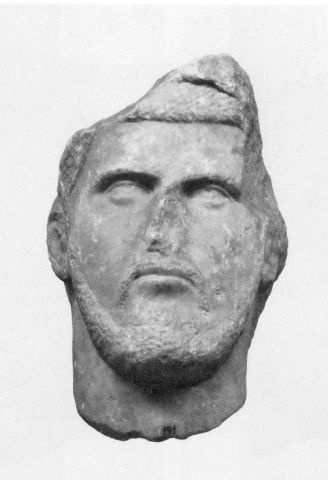
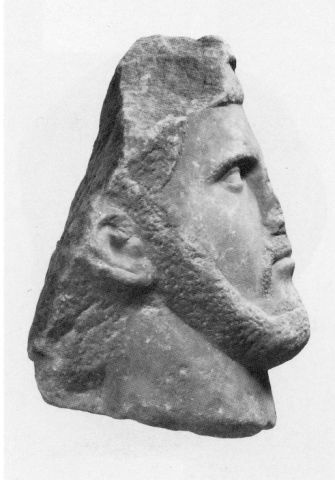
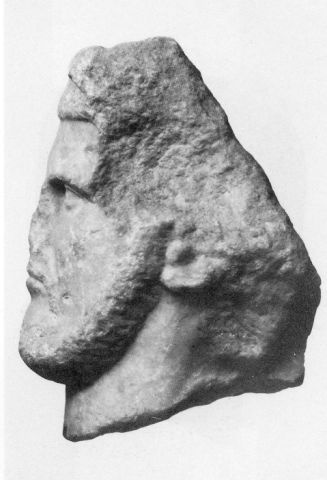
Portrait head of emperor wearing wreath or diadem, re-worked from earlier head. From Gortyna (Creta) (?). Late third to early fourth century
Record details
Photographs
Bibliography
- Portale, E. C., I ritratti, Gortina III. I. Romeo - E. C. Portale. Le sculture, Padua 1998, pp. 411.20 no. 24 pl. 57
Discussion
DESCRIPTION (Object)
Portrait head of a bearded male wearing a headgear, preserved with a part of the neck; medium grained white marble with yellowish patina (Portale 1998, 411). H (overall) 36.4 cm, (head alone) 31.5 cm, (face from chin to hair) 22.8 cm; W. 23.2 cm (all measurements from Datsoule-Stavride 1981, 598 n. 59; measurements slightly altered or simplified by Portale 1998, 411). The neck is broken in an irregular plain. The back of the head together with the left temple and the hair above the right temple are broken off. The nose is chipped off, the beard at the left side levigated (verrieben), and there are minor chips scattered over the face. The back of the neck has been left in the state of an ashlar ('Nackenbosse', Bergmann 1990, 383).
The hair is a compact mass, set against the flesh by a drilled or chiselled line and accentuated by strokes with a chisel or point. The beard has plastic volume at the jaws but is incised direcly into the flesh on the chin; it is accentuated in the same technique as the hair.
The small eyes are almond-shaped, the iris indicated by an incised line, the pupil by a shallow drill hole immediately below the lower lid. The eyebrows are marked by short chisel strokes.
The flesh is smooth with no wrinkles incised or modelled.
The head in its present state is the result of a late-antique re-working process (considered also by Portale 1998, 416-17).
Indicators for this are the unproportionally thick neck, the lengthened chin, and the misplaced right ear; Portale 1998, 417 furthermore points out that the plastic volume of hair and beard is graded to different levels at the (proper) right temple and at the chin. The small eyes, unexpected at a late-antique portrait, could be conditioned by the facial features of the original (Portale 1998, 417; Bergmann 1990, 386).
PROVENANCE/ LOCATION
The head was recorded to be from the environs of the sanctuary of Apollo in Gortyn by Vermeule 1968; this provenience is not confirmed by the museum-inventory ('ἐξ ἀγορὰς κήρας Μιτζοτάκης', quoted by Portale 1998, 411). Today it is in the Heracleion museum, inv. no. H 191.
DESCRIPTION (Subject)
The portrayed wears a trimmed full beard and has dense hair; no wrinkles or folds would identify him as an aged man. Eyes and mouth are small; the lips are pressed together and slightly protruding. The chin is exceptionally long; rather than an individual feature of the portrayed, this is a result of a late-antique re-working process conditioned by the original head (see above, 'Description (Object)', and below, 'Date').
Above the hairline a headgear in the form of a bulgy bend is visible; its surface appears without accentuation. This headgear has been interpreted as a lion's scalp by Vermeule 1968, 330 who identified the portrayed as Maximian Herculeus; Vermeule connected the head with an inscription to Maximian fom the sanctuary of Apollon in Gortyn (LSA-63). Vermeule's identification was accepted by L'Orange 1984, 104, with reservation, however, because the lion's scalp was not decifrable for him on the images published by Vermeule. Datsoule-Stavride 1981 challenged this view and addressed the headgear as a 'crown' (στεφάνι), ascerting that these were not restricted to emperors. Portale 1998, 413 accepts Datsoule-Stavride's assessment of the headgear but argues that the crown does indeed indicate an imperial portrait, as does the large size of the head ('il formato è colossale, il che nel periodo in questione sembra connotare solo le rappresentazioni ufficiali').
The head probably represents an emperor of the Tetrarchy. Portale 1998, 418-20 tentatively proposes Maximinus Daia, yet points out the difficulties which still delude attributions of unnamed portrait heads to single emperors of the Tetrarchy.
DATE
In the absence of any hard criteria, the dating of the head must rely on stylistic and typological considerations. The cubic forms and the picked beard and hair identify the head as a likeness of the tetrarchic period. According to a widespread hypothesis the pacified, classicising features assign our head to later phases in the tetrarchic era (Bergmann 1990, Laubscher 1999, Meischner 1986). A date in the 'second Tetrarchy’ was assumed by Portale 1998, 418 (referring to Bergmann 1990 and her considerations about portraiture between 293-313). We adopt the tetrarchic date as proposed by Bergmann 1990 for heads of this type and accepted by Portale 1998.
FURTHER DISCUSSION
The article by H. Jucker in Numismatica e antichità classiche 1992 was not accessible to me.
Discussion references
- Bergmann, M., Kaiserporträt der Jahre 293-313 n. Chr., Antike Kunstwerke aus der Sammlung Ludwig. III. Skulpturen. (edd. by E. Berger), Mainz 1990, pp. 383-401
- Datsoule-Stavride, A., Ta Romaika Portraita tou Mouseiou Herakleiou, Pepragmena tou d' (4th) diethnous kretologikou Synedriou. Tomos A' (2), Athens 1981, p. 598 no. 191 pl. 201
- Laubscher, H.-P., 'Beobachtungen zu tetrarchischen Kaiserbildern aus Porphyr', Jahrbuch des Deutschen Archäologischen Instituts 114, 207-252, (1999)
- Meischner, J., Die Porträtkunst der ersten und zweiten Tetrarchie bis zur Alleinherrschaft Konstantins: 293 bis 324 n. Chr., Archäologischer Anzeiger 1986, 223-250, Berlin 1986
- Vermeule, C. C., Roman imperial art in Greece and Asia Minor, Cambridge, Mass. 1968, pp.330, 332 fig. 170
Cite: Last Statues of Antiquity, LSA-859 (Ulrich Gehn).