
LSA-860
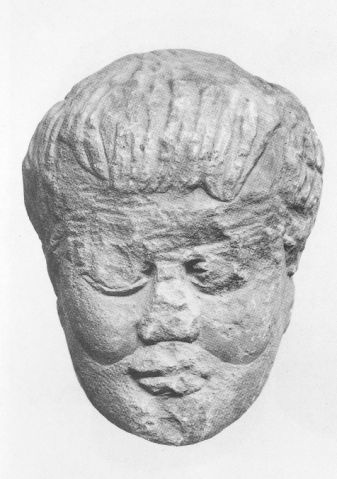
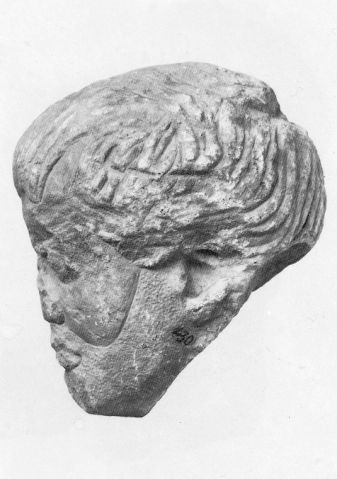
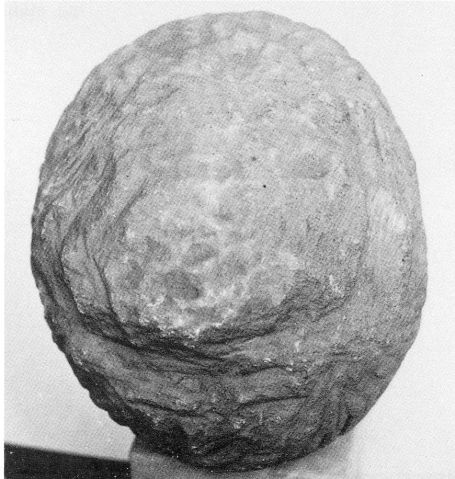
Portrait head of bearded man, re-worked from earlier head. From Gortyna (Creta). Late third to mid fourth century
Record details
Photographs
Bibliography
- Portale, E. C., I ritratti, Gortina III. I. Romeo - E. C. Portale. Le sculture, Padua 1998, pp. 420-4 no. 25 pl. 58
Discussion
DESCRIPTION (Object)
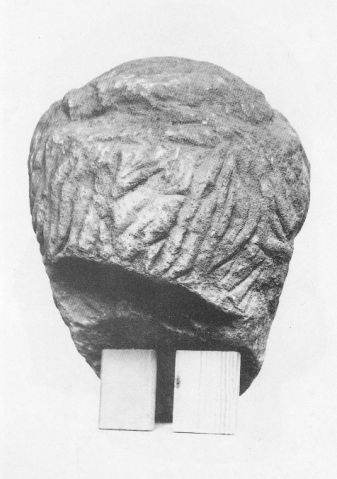
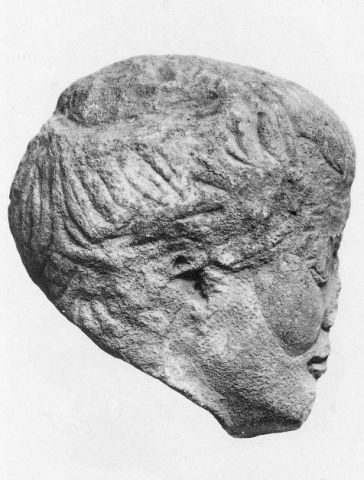
Portrait head of a bearded male, neck with part of the head broken. Fine-grained white marble, H (overall) 28. 1 cm, (chin to hair) 17.5 cm (no further measurements published by Portale 1998). Traces of a tool run horizontally over forehead and eyes, possibly from a deliberate act of destruction. Nose, lips, chin, and both ears are chipped. On the crown, a deep groove is running from the back to the (proper) right side.
The hair is indicated by long chiselled lines, parallel over the forehead, with irregularities on the sides and at the back; on the crown there is a circular area with point-marks. The strands of the hair are fringing out around the face. The beard is delineated by a sharp line against the flesh and accentuated by a fine point; it is slightly raised in volume against the flesh.
The carnate is scarsely modelled. The lower lid is sharply delineated against the cheeks. This and the delineation of the beard are the only caesurae in the otherwise taut surface of the cheeks.
The head in its present state is the result of a late-antique re-work, according to Portale 1998, 421-2 even of a second and third re-work. The tool-marks on the crown testify to a first phase of re-use in which the original hair was reduced to the picked surface. In the second phase, that surface was worked into the lank forward-brushed hair of the actual state. In a third phase, the receding angles over the temples were cut into the hair, thereby cutting single streaks of the previous phase (visible over the (proper) right temple).
PROVENANCE/ LOCATION
The head was excavted in the early 20th century in the praetorium of Gortyn (Portale 1998, 420). It is now in the Heracleion Museum, eastern store-room, inv. no. H 430.
DESCRIPTION (Subject)
The portrayed wears a stubble beard; his lank hair is brushed into the forehead forming a 'fork' above the (proper) inner left eye and a 'forceps' over the right eye. Above both temples, the hair is markedly receding; this is the only indicator of an advanced age.
Portale 1998,423, assessing the beard and the smooth carnate as indicators of a date in the later tetrarchic period of the early 4th century, proposed to ascribe the head to Licinius whose monetary image be distinguished from the 'tetrarchic type' by receding hair over the temples ('L'indicazione delle stempiature caratterizza infatti costantemente il ritratto monetale di Licinio, distinguendolo così dall impersonale "tipo tetrarchico"'). Vermeule 1968 believed that it was a portrait of Constantine I as Caesar.
Receding hair does indeed reoccur on the portraits in the round of Licinius (Smith 1997; LSA-325, LSA-373, LSA-512, LSA-687); there it is combined, however, with a trimmed 'tetrarchic' hairstyle and a decisively different hairline.
DATE
Portale 1998, 422 saw the second phase of late-antique rework in which the lank hair was designed around 270/ 90, the hairstyle being in the tradition of gallienic portraiture. The third phase in which the beard was designed and the hair above the temples was cut back, she saw in the later tetrarchic period in the early fourth century.
According to a widespread hypothesis the 'pacified' features with the unmodelled flesh as shown by our head assign it to later phases in the tetrarchic era (Bergmann 1990, Laubscher 1999, Meischner 1986). The combination of 'tetrarchic' stubble beard and brushed hair appears first in the portrait of Maxentius (L'Orange 1984 pl. 27 a, b (Dresden); pl. 27, c, d (Stockholm)).
According to the criteria quoted above, in our view a terminus post quem in the late 3rd/ early 4th century has to be assumed. Whether a narrow date in the late tetrarchy can be upheld, however, seems doubtable. 'Tetrarchic' hairstyles and beards are testified to in the time of Constantine I's sole reign (portrait statue of Dogmatius in Rome, LSA-903). A very similar treatment of hair and hairline is shown by another head from Gortyn dated to the early constantinian period by Portale 1998 (LSA-861). A combination of stubble beard and brushed hair, together with markedly receding temple-hair, can be observed at the portrait of Flavius Iulius Catervius on his sarcophagus in Tolentino as late as in the 380s (Dresken-Weiland 1998 pl. 57, 4). We therefore assign broad outer dates from the late 3rd to the 4th century to it.
Discussion references
- Bergmann, M., Kaiserporträt der Jahre 293-313 n. Chr., Antike Kunstwerke aus der Sammlung Ludwig. III. Skulpturen. (edd. by E. Berger), Mainz 1990
- Dresken-Weiland, J., Repertorium der christlich-antiken Sarkophage. Zweiter Band. Italien mit einem Nachtrag Rom und Ostia, Dalmatien, Museen der Welt, Mainz 1998
- L'Orange, H. P., Das spätantike Herrscherbild von Diokletian bis zu den Konstantin-Söhnen, 284-361 n. Chr. Das Römische Herrscherbild. III. Abteilung ; Bd. 4 , Berlin 1984
- Laubscher, H.-P., 'Beobachtungen zu tetrarchischen Kaiserbildern aus Porphyr', Jahrbuch des Deutschen Archäologischen Instituts 114, 207-252, (1999)
- Meischner, J., Die Porträtkunst der ersten und zweiten Tetrarchie bis zur Alleinherrschaft Konstantins: 293 bis 324 n. Chr., Archäologischer Anzeiger 1986, 223-250, Berlin 1986
- Smith, R.R.R.,'The public image of Licinius I: Portrait sculpture and imperial ideology in the early fourth century', JRS 87, 1997
- Vermeule, C. C., Roman imperial art in Greece and Asia Minor, Cambridge, Mass. 1968, pp. 354-5 fig. 178
Cite: Last Statues of Antiquity, LSA-860 (Ulrich Gehn).