
LSA-861
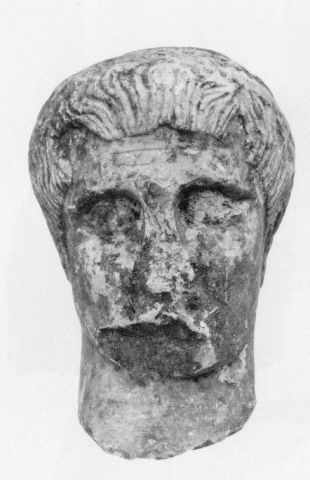
Portrait head of clean-shaven man, re-worked from earlier portrait. Gortyna (Creta). Earlier fourth century
Record details
Photographs
Bibliography
- Portale, E. C., I ritratti, Gortina III. I. Romeo - E. C. Portale. Le sculture, Padua 1998, pp. 424-30 no. 26
Discussion
DESCRIPTION (Object)
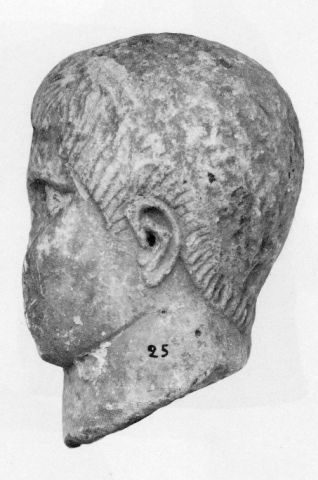
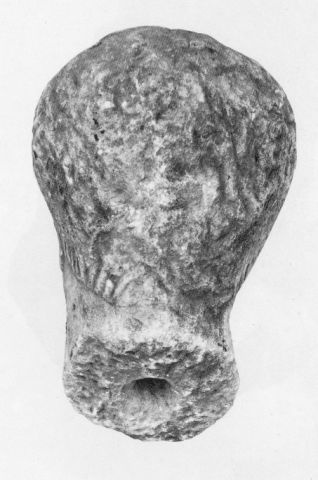
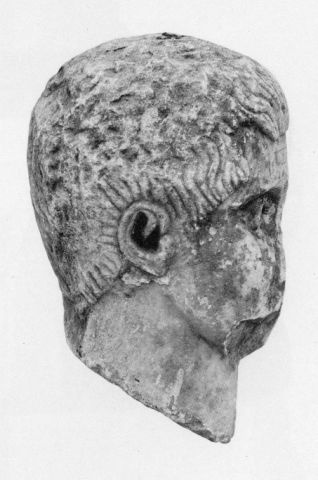
Large scaled portrait head of a clean-shaven male preserved with the neck and worked for insertion. Fine grained white mable; H (overall) 42 cm; (head alone) 32.9 cm; (chin to hair) 26 cm (all measurements given by Portale 1998, 424 for this previously unpublished head). Chin and nose are chipped off, further large chips on the back sides of head and neck. The head is covered with incrustations, markedly on mouth and eyes. The lower side of the neck is finished with a point and has a round hole (diameter 4.5 cm, depth 5 cm ca.) in its middle for the insertion of a dowel. Portale 1998, 424 records traces of mortar below the left ear and the chin and on the eyes; it was probably used as building material in a post-antique phase.
The hair is articulated along the hairline by rough vertical chisel strokes; this articulation goes all around the head, exempted only a span at the back right. Above this line, the skull is only roughly finished. Above the temples the hairline is cut back, in a triangular form at the (proper) left side, rounded at the righ side.
The brow is furrowed by two incised horizontal lines. The ears are of markedly diverse shape; both are tightly fitted into the contour-line. The eyebrows are burred and flat-arching.
The head in its present state is the result of a late-antique re-work. Traces of the levigation of material have been observed in front of both ears, and at the hairline especially where it is receding above the temples, by Portale 1998, 425. The rough finish of the skull and the ears pressed into the contour are further testimonies to this re-working process. The neck is unproportionally thick, especially in the side views. At the left side the jaw has been carved in a wood-cut-like manner into the material. The drill holes in the corners of the mouth are probably a relict of the original portrait. The flat-arching eyebrows probably are a ‚substrate’ of the original portrait, possibly a julio-claudian one (Portale 1998, 429).
PROVENANCE/ LOCATION
The head was excavated in 1912 in the praetorium at Gortyn. Today it is in a storeroom of the antiquarium by the Odeion in Gortys, inv. no. GO 25 (old inv. no. GO 55).
DESCRIPTION (Subject)
The portrait shows a clean-shaven man with lank forward-brushed hair. The smoothness of the face is contrasted by two horizontal furrows on the brow and by the receding hairline over both temples; both are indicators of maturity in the otherwise unfurrowed face.
The large scale of the head possibly, but not necessarily identifies our head as an imperial portrait; indeed any ascription to an emperor of the date in question appears impossible (see below, 'Date'). Licinius whose monetary portraits show him with receding hairline is excluded by the beardlessness of our head; Constantine I who re-introduced clean-shavenness into imperial self-representation is excluded by its receding hairline, and so are his sons and nephews (elaborately discussed by Portale 1998, 429-30).
The head possibly represents a local man from Gortyn or an official who has features of the new imperial portrait style of Constantine I applied to his own likeness.
DATE
The rendering of the hair, and especially of the receding hairline over the temples, resembles the technique applied at another head from Gortyn now in Heracleion (LSA-860) which was dated to the tetrarchic period by Portale 1998; she argues, however, that our portrait had an 'already clearly constantinian aspect' ('un aspetto già chiaramente "costantiniano"', Portale 1998, 427) which distinguished it from that other head. The clean-shavenness and the treatment of the hairline imply the development of the imperial portraits of Maxentius and Constantine I; the accentuation of the coiffure along the hairline is a feature of numerous heads attributed to Constantine or members of his dynasty (Portale 1998, 428). A date in the Constantinian period is supported, so Portale 1998, 428, by stylistic arguments (l. c., 428 quoting the cheekbones as 'landmarks' in the plastic structure of a head thereby applying general stylistic criteria developped by L'Orange 1933, 47-65 for the portraiture of the Constantinian period).
In our own view, Portale's arguments for a date in the Constantinian period is on solid ground, and a terminus post quem of around 312/15 (date of the arch of Constantine) should be accepted.
Discussion references
- L'Orange, H. P., Studien zur Geschichte des spätantiken Porträts, Oslo 1933
Cite: Last Statues of Antiquity, LSA-861 (Ulrich Gehn).