
LSA-864
Six fragments of plaque from base for imperial statues, possibly of Diocletian, Maximian, Galerius, and Constantius I. Salamis (Cyprus). 293-305
Record details
Photographs
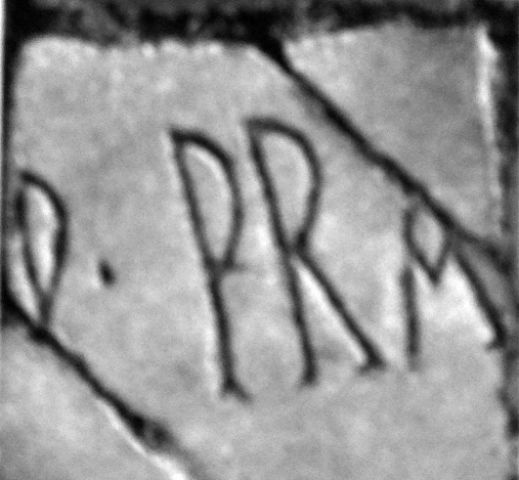
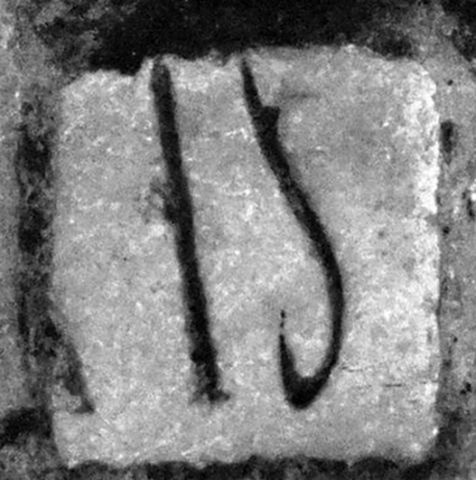
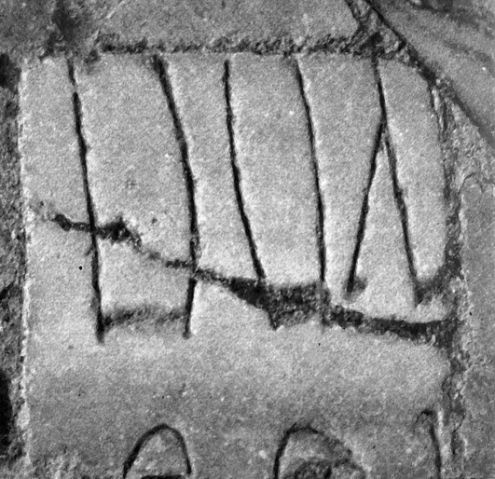
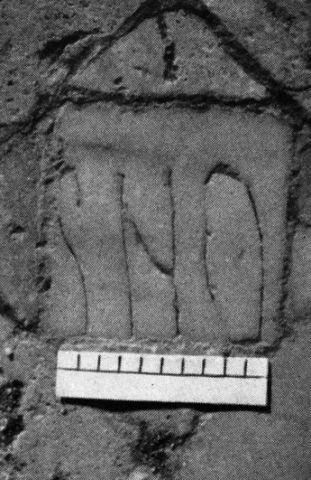
Inscription
[Piissi]mis [ac fortissimis] / dom[ini]s no[stris, imperatoribus] / [Di]ocl[etia]no e[t Maximiano, Augg(ustis), et] / [Maximiano et C]onst[anti]o, Cae[saribus], / [Antistius Sabinus, v(ir)] p(erfectissimus), praeses [prov(inciae) Cypri].
Inscription translation
To our most pious and most powerful lords, the emperors Diocletian and Maximian, Augusti, and Maximian and Constantius. Caesars; Antistius Sabinus, of perfectissimus rank, governor (praeses) of the province of Cyprus, [set this up].
Bibliography
- Pouilloux, J., Roesch, P. & J. Marcillet-Jaubert, Salamine de Chypre XIII. Testimonia Salamina 2, Paris 1987, p. 67 no. 152
Discussion
INSCRIPTION
In five lines:
[Piissi]mis [ac fortissimis] / dom[ini]s no[stris, imperatoribus] / [Di]ocl[etia]no e[t Maximiano, Augg(ustis), et] / [Maximiano et C]onst[anti]o, Cae[saribus], / [Antistius Sabinus, v(ir)] p(erfectissimus), praeses [prov(inciae) Cypri].
'To our most pious and most powerful lords, the emperors Diocletian and Maximian, Augusti, and Maximian and Constantius. Caesars; Antistius Sabinus, of perfectissimus rank, governor (praeses) of the province of Cyprus, [set this up].'
Letter height 5.5 - 8.5 cm.
We reproduce the inscription here as reconstructed and completed by Pouilloux et al. 1987. These authors reconstruct the fragments as part of a single inscription to all four emperors of the first tetrarchy. The last line with the title (and probably once the name) of the awarding governor is laid out in smaller letters.
However these same fragments have also been attributed to three <b>different</b> inscriptions by Mitford & Nicolaou 1974, who combined them with further fragments from the same findspot to make up the following dedications: to an unknown praeses of the 3rd century (Mitford & Nicolaou 1974 no. 25), to Diocletian and Galerius (Mitford & Nicolaou 1974 no. 39), and to Constantius II and Constans (Mitford & Nicolaou 1974 no. 42). See Further Discussion below.
DESCRIPTION (from Pouilloux et al. 1987, and the published photos)
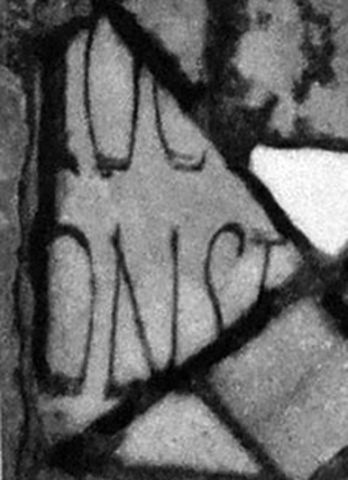
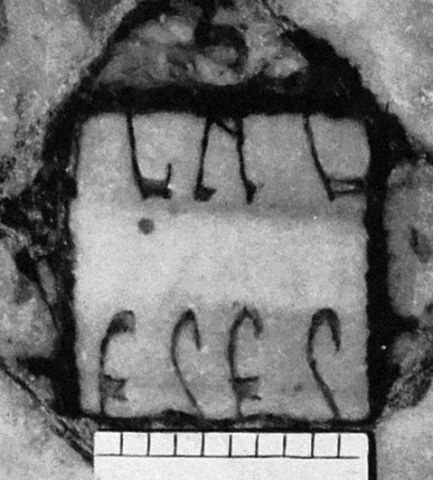
Six fragments (A-F) of a marble slab. The slab was cut into small pieces and used in the paving of the gymnasium of Salamis at a post-tetrarchic date. Fragment A: 8 x 7.5 cm, B: 12 x 12 cm; C: 15 x 16 cm; D: 13 x 13 cm; E: 11.5 x 11 cm; F: 12 x 11 cm.
Fragments A-D are carved on the back of an earlier inscription to Septimius Severus (Mitford & Nicolaou 1974 p. 33 no. 18).
The reconstruction by Pouilloux and his colleagues assigns the fragments to the following lines of the inscription: A: line 1; B: lines 2-3; C: line 2; D: lines 3-4; E: lines 4-5; F: line 5
Some notes should be added:
On fragment A, Pouilloux et al. read [Piissi]MIS [ac fortissimis], whereas we can only read IS. Mitford and Nicolaou 1974 p. 67 no. 42 (fragment d), viewing it the other way up, read [Dominis nostri]S IV[lio] Constantio, and considered it to be part of a dedication to Constantius II and Constans.
On fragment B, Pouilloux et al. read DOM[inis ....] / [Di]OCL[etiano ...], where we read DOM... / ...ỌC̣Ḷ. Mitford and Nicolaou 1974 p. 67 no. 42 (fragment b) read DOM[inis nostris...] / CON[stantio] and considered it to be part of the same dedication to Constantius II and Constans.
On fragment D, Pouilloux et al. read:[Di]OCL[etia]NO E[t Maximiano Augg(ustis) et] / [Maximiano et C]ONST[anti]o Cae[saribus], where we can only read ... OẸ ... / ...ONST..... Mitford and Nicolaou 1974 p. 67 no. 42 (fragment e) read [Constant]IO E[t] / [Flavio Iulio C]ONST[anti], and considered it to be part of the same dedication to Constantius II and Constans.
PROVENANCE AND MOST RECENTLY RECORDED LOCATION
Fragments A-D were uncovered in 1954 during the excavation of the gymnasium and brought to the Famagusta District Museum (Mitford & Nicolaou 1974, 33 no. 18). Fragments E and F were left in situ in the pavement of the gymnasium (Mitford & Nicolaou 1974, 46 no. 25 and 61 no. 39 (fragment e)).
HONORANDS, AWARDER AND DATE
Diocletian was Augustus 284-305, Maximian 286-305. Constantius I and Galerius were Caesars 293-305. If the reconstruction of the inscription is right, then it is dated by the common reign of the four emperors to 293-305.
The attribution of this inscription to the governor of Cyprus Antistius Sabinus (PLRE I, 792, Antistius Sabinus 9) is purely hypothetical (Mitford and Nicolaou 1974, 62), based on the fact that he dedicated other statues in Salamis to the tetrarchs (LSA-865, LSA-866).
FURTHER DISCUSSION
Our inscription was composed by Pouilloux and his colleagues from six fragments selected out of a total of some twenty fragments of the same type from the same findspot. Mitford and Nicolaou 1974 from the same pool of fragments composed three different honorific inscriptions (Mitford and Nicolaou 39, 40, 42). Neither of the scholarly attempts exhausts the set of extant fragments, and there is an intersection between the two attempts, Pouilloux et al. using for the inscription presented here fragments taken by Mitford & Nicolaou for their nos. 39 and 42. From the fact that there is an intersection, it follows that either of the two attempts can be right, but not both at the same time.
We have looked carefully at the possible reconstructions and have dismissed those of Mitford and Nicolaou as too implausible. For instance, one of their reconstructions (no.42) attributes a dedication to Constantius II and Constans to the efforts of a bishop Ofellius: '... cu[rante Ofel]lio Ṣ[ancto] / antis[tite urbis]', which would be unheard of. The letters ANTIS from which they derive 'antistite' are in fact almost certainly part of the name of the tetrarchic-period governor <b>Antis</b>tius Sabinus (and their reconstruction of the name Ofellius is based on a very dubious link to another fragmentary inscription (Mitford & Nicolaou 1974 no. 41)).
All reconstructions, including that of Pouilloux and his colleagues presented here, are highly hypothetical, given the fragmentary state of the evidence. However they do provide firm evidence for dedication(s) of the tetrarchic/Constantinian period in Salamis.
We present here a concordance of the fragments used in the reconstruction above with the numbering used by Mitford and Nicolaou 1974:
Fragment A = Mitford & Nicolaou no. 42 fragment (d)
Fragment B = Mitford & Nicolaou no. 42 fragment (b)
Fragment C = Mitford & Nicolaou no. 42 fragment (c)
Fragment D = Mitford & Nicolaou no. 42 fragment (e)
Fragment E = Mitford & Nicolaou no. 39 fragment (e)
Fragment F = Mitford & Nicolaou no. 25
Cite: Last Statues of Antiquity, LSA-864 (Ulrich Gehn).