
LSA-866
Base for statue of Galerius, emperor. Salamis (Cyprus). 293-305
Record details
Photographs
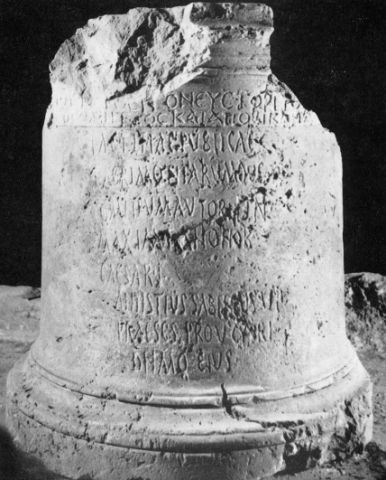
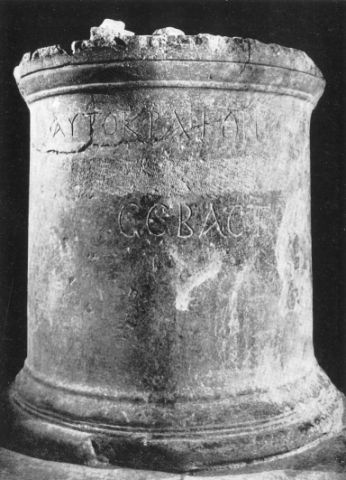
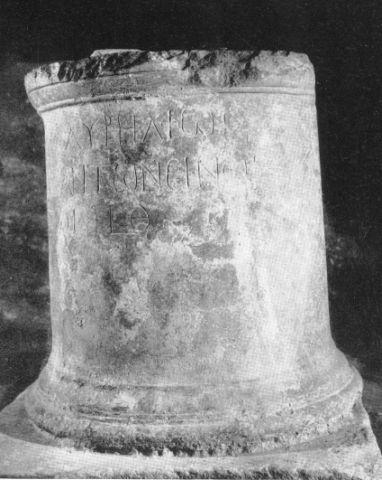
Inscription
Laetitiae publicae / caeremoniarumque / omnium autori (sic), d(omino) n(ostro) / Maximiano, nob(ilissimo) / (5) Caesari, / Antistius Sabinus, v(ir) p(erfectissimus), / praeses prov(inciae) Cypri, / d(evotus) n(umini) m(aiestatique) eius.
Inscription translation
To the source of public well-being and of all ritual observances (caeremoniarumque omnium), our lord Maximianus, the most noble Caesar; Antistius Sabinus, of perfectissimus rank, governor (praeses) of the province of Cyprus, devoted to his divine spirit and majesty, [set this up].
Bibliography
- Mitford, T. B. & I. K. Nicolaou, Salamis Vol. 6. The Greek and Latin inscriptions from Salamis, Nicosia 1974, pp. 167-8 no. 131
- Pouilloux, J., Roesch, P. & J. Marcillet-Jaubert, Salamine de Chypre XIII. Testimonia Salamina 2, Paris 1987, p. 68 no. 155
Discussion
INSCRIPTION
In eight lines:
Laetitiae publicae / caeremoniarumque / omnium autori (sic), d(omino) n(ostro) / Maximiano, nob(ilissimo) / (5) Caesari, / Antistius Sabinus, v(ir) p(erfectissimus), / praeses prov(inciae) Cypri, / d(evotus) n(umini) m(aiestatique) eius.
'To the source of public well-being and of all ritual observances (caeremoniarumque omnium), our lord Maximianus, the most noble Caesar; Antistius Sabinus, of perfectissimus rank, governor (praeses) of the province of Cyprus, devoted to his divine spirit and majesty, [set this up].'
Letter height 3 - 5 cm (Mitford & Nicolaou 1974).
DESCRIPTION (from Mitford & Nicolaou 1974 and the published photos)
Compact cylindrical base with mouldings at top and bottom. The top moulding and the top surface are largely broken and lost. The surface is weathered, with a large crack running across the centre of the inscription. Like its doublet with the dedicatory inscription to Constantius I (LSA-865, see below, 'Honorand, Awarder, and Date'), our base had earlier served as a statue base for Commodus (Mitford & Nicolaou 1974 no. 96), and probably, in its original use, as a funerary cippus (Mitford & Nicolaou 1974 p. 125). Unlike the doublet, however, our base does not preserve any part of the original funerary inscription.
Between the upper moulding and our inscription there is a narrow raised zone carrying a later, Greek, inscription to a comes and ex-vicar Eustorgius: '[κ]ὲ τοῦτο τὸ ἔργον Εὐστοργίου [τοῦ] / [ἁ]γνοῦ κόμητος καὶ ἀπὸ βικαρίας, 'Also this work (is) of Eustorgius, the pure comes and former vicar'. The precise office of Eustorgius remains obscure: 'ἀπὸ βικαρίας', instead of the 'ἀπὸ βικαρίου' which would be expected for a former vicar (PLRE II, 1230, Anonymous 64, and xxxviii (Addenda), Eustorgius). But his title as comes certainly dates him to Constantinian times or later. The inscription perhaps refers to a repair executed by Eustorgius.
PROVENANCE AND CURRENT LOCATION
The base was found in 1960 near the North parodos of the theatre of Salamis. It is now standing in the North parodos, mounted on a limestone-base with a late-1st century inscription.
HONORAND, AWARDER AND DATE
Galerius, the honorand, was Caesar 293-305. He is styled Maximianus nobilissimus Caesar in our inscription, his full name being Caius Galerius Valerius Maximianus.
The awarder Antistius Sabinus (PLRE I, 792, Antistius Sabinus 9) dedicated a second statue-base of the same type to the Caesar Constantius I (LSA-865), at the South parodos of the theatre, and a further honorific inscription to all the tetrarchs, likewise in the theatre (Mitford & Nicolaou 1974 no. 129 = LSA-867) .
FURTHER DISCUSSION
The older use of this base, for a statue to Commodus had suffered the damnatio memoriae of the emperor, as shown by his chiselled-out name (as also happened to LSA-865). Therefore, when re-used for Galerius, the base was already redundant and perhaps lying in a depot awaiting re-use.
Discussion references
- Jones, A. H. M. et al., The Prosopography of the Later Roman Empire. Vol. I 260-395, Cambridge et al. 1971 (1975)
- Martindale, J. R., The Prosopography of the Later Roman Empire. Vol. II A.D. 395-527, Cambridge 1980
- Michaelidou-Nicolaou, I., Antistius Sabinus, an unknown praeses of Cyprus, Acta of the 5th International Congress of Greek and Latin Epigraphy, Cambridge, 1967, Blackwell, 1971, pp. 381-3
Cite: Last Statues of Antiquity, LSA-866 (Ulrich Gehn).