
LSA-867
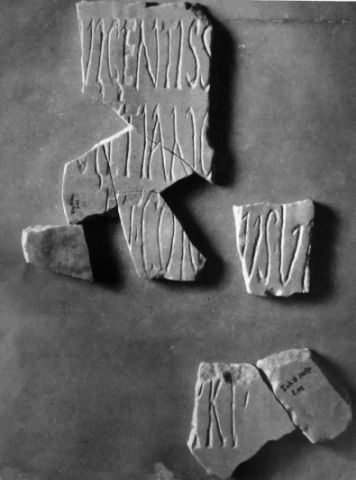
Eight fragments of plaque, probably associated with statues, with dedication to Diocletian, Maximian, Constantius I and Galerius, emperors. From Salamis (Cyprus). 293-305
Record details
Photographs
Inscription
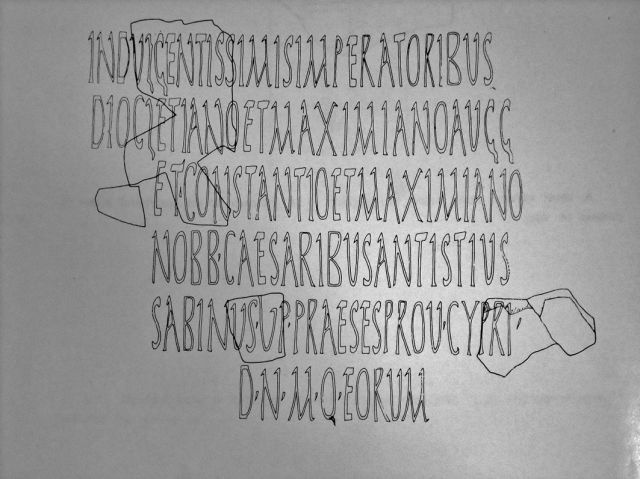
[Ind]ulgentiss[imis Impppp(eratoribus), dddd(ominis) nnnn(ostris)] / [Dio]cletiano [et Maximiano Augg(ustis)], / et Con[stantio et Maximiano] / [nob(ilissimis Caesaribus, Antistius Sabi/n]us, v(ir) p(erfectissimus), [praeses prov(inciae) Cy]pri, / [d(evotus) n(umini) m(aiestati)q(ue) eorum].
Inscription translation
To the most merciful emperors, our lords Diocletian and Maximian the Augusti, and Constantius and Maximian the most noble Caesars; Antistius Sabinus, of perfectissimus rank, governor (praeses) of the province of Cyprus,devoted to their divine spirit and majesty, [set this up].
Bibliography
- Mitford, T. B. & I. K. Nicolaou, Salamis Vol. 6. The Greek and Latin inscriptions from Salamis, Nicosia 1974, pp. 164-5 no. 129
- Pouilloux, J., Roesch, P. & J. Marcillet-Jaubert, Salamine de Chypre XIII. Testimonia Salamina 2, Paris 1987, p. 66 no. 151
Discussion
INSCRIPTION
In six lines:
[Ind]ulgentiss[imis Impppp(eratoribus), dddd(ominis) nnnn(ostris)] / [Dio]cletiano [et Maximiano Augg(ustis)], / et Con[stantio et Maximiano] / [nob(ilissimis Caesaribus, Antistius Sabi/n]us, v(ir) p(erfectissimus), [praeses prov(inciae) Cy]pri, / [d(evotus) n(umini) m(aiestati)q(ue) eorum].
'To the most merciful emperors, our lords Diocletian and Maximian the Augusti, and Constantius and Maximian the most noble Caesars; Antistius Sabinus, of perfectissimus rank, governor (praeses) of the province of Cyprus,devoted to their divine spirit and majesty, [set this up].'
Letter height 8.5 - 10 cm.
We reproduce the text essentially as completed by Mitford & Nicolaou 1974.
DESCRIPTION (from Mitford & Nicolaou 1974, Pouilloux et al. 1987, and the published images)
Eight fragments of a marble slab, 2 cm thick, forming three disconnected parts of the inscription. Above line 1, the upper rim of the slab is preserved. To the right of the indented line 3 and to the right of the last three letters of line 5, uncut spaces occur. Below line 5 there is a guideline, otherwise redundant, which suggests the existence of a 6th line. The surface is smoothly finished. Our inscription is carved on the back of an earlier inscription to Julia Domna, datable to 212-17 (Mitford & Nicolaou 1974, 126-7 no. 98).
PROVENANCE AND CURRENT LOCATION
The fragments were found in 1961 in the proskenion of the theatre of Salamis (Mitford & Nicolaou 1974, p.126 and p. 114 plan 2). Today in the Famagusta District Museum, without inv. no.
HONORANDS, AWARDER AND DATE
Diocletian was Augustus 284-305, Maximian 286-305; Constantius I and Galerius (full name Galerius Valerius Maximianus) were Caesars 293-305. The common reign of these emperors of the first tetrarchy, 293-305, provides the date-range for our inscription.
The identification of the awarder of this inscription as Antistius Sabinus, governor (praeses) of Cyprus (PLRE I, 792, Antistius Sabinus 9; Michaelidou-Nicolaou 1971), is hypothetical, since no more survives of the name of the dedicator than its final two letters '... us'. However the attribution is likely, since statue bases erected by Sabinus to two of our honorands, Constantius I and to Galerius(LSA-865, LSA-866), were found close by, also in the theatre of Salamis. Our inscription may have been a group dedication, prominently displayed and referring to four individual statues set up close by, each with its own base and inscription.
The governorship of Antistius Sabinus cannot be dated more precisedly than to the period of the first tetrarchy.
Discussion references
- Jones, A. H. M. et al., The Prosopography of the Later Roman Empire. Vol. I 260-395, Cambridge et al. 1971 (1975)
- Michaelidou-Nicolaou, I., Antistius Sabinus, an unknown praeses of Cyprus, Acta of the 5th International Congress of Greek and Latin Epigraphy, Cambridge, 1967, Blackwell, 1971, p. 382 pl. 41
Cite: Last Statues of Antiquity, LSA-867 (Ulrich Gehn).