
LSA-868
Fragmentary plaque from base for statue of Julian, emperor. Salamis (Cyprus). 361-363
Record details
Photographs
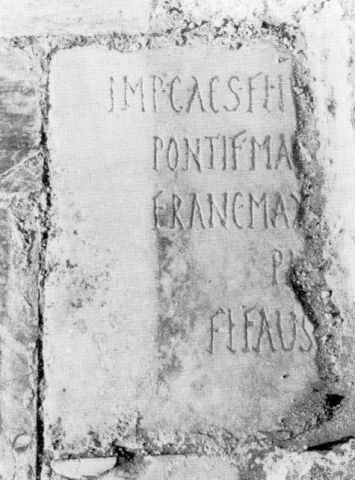
Inscription
Imp(eratori) Caes(ari) Fl(avio) Iu[---
pontif(ici) max(imo) [---
Franc(ico) max(imo) [---
pa[tri patriae ---
Fl(avius) Faus[---
-?-
Inscription translation
'To the emperor Caesar Flavius Iu... highest priest ... greatest victor over the Franks ... father of the fatherland ... Flavius Faus...’
Bibliography
- Marcillet-Jaubert, J., Dédicace à Julien, Anthologie Salaminienne (Salamine de Chypre IV), 121-123, Paris 1973
- Pouilloux, J., Roesch, P. & J. Marcillet-Jaubert, Salamine de Chypre XIII. Testimonia Salamina 2, Paris 1987, p. 69 no. 157
Discussion
INSCRIPTION
Parts of five lines survive:
Imp(eratori) Caes(ari) Fl(avio) Iu[---
pontif(ici) max(imo) [--
Franc(ico) max(imo) [---
pa[tri patriae --
Fl(avius) Faus[---
-?-
'To the emperor Caesar Flavius Iu... highest priest ... greatest victor over the Franks ... father of the fatherland ... Flavius Faus...’
Letter height 5 - 5.5 cm.
The extant text was plausibly completed as follows by the first editor Marcillet-Jaubert (and accepted by Pouilloux et al.), on the basis of another inscription to Julian from Serdica, which on the basis of its columnar form and poorly laid out script is certainly a milestone (CIL III suppl. II 12333 = Dessau 8945; Kalinka 1906, 70 no. 76 with drawing):
Imp(eratori) Caes(ari) Fl(auio) Iu[liano pio felici semper Augusto] / pontif(ici) max[imo Germ(anico) maximo Alam(annico) maximo] / Franc(ico) max[imo Sarm(atico) maximo imp(eratori) cons(uli)] / pa[tri patriae proconsuli] / Fl(auius) Faus[t—v(ir) c(larissimus) consularis prov(inciae)] / [Cypri n(umini) maiestati)q(ue) eius d(evotus).
With the name of the honorand in the dative and the name of an awarder, this inscription displays the crucial features of Latin statue-base inscriptions. However, as always with plaques, there is some doubt, and the long formula as given by Marcillet-Jaubert raises further uncertainty, as the standard epithets of pater patriae, proconsul and pontifex maximus, as well as victor titles, are not usually mentioned in imperial statue-base inscriptions of the fourth century in the region. The same is true for the reference to Julian's high priesthood (as pontifex maximus), which could be a specific pagan pious reference to please Julian.
Despite these considerations, we think it probable that this inscription once decorated a statue base to Julian.
DESCRIPTION (from Marcillet-Jaubert, Pouilloux et al., and the published photo)
Plaque of veined white marble, cut down roughly vertically on the right side. H 56, W 33, D not visible. The cut has removed the greater part of the inscription.
PROVENANCE AND CURRENT LOCATION
The plaque has been cut down, and was re-used set into the pavement of the basin of the gymnasium at Salamis, by its south-eastern wall.
HONORAND, AWARDER AND DATE
The imperial name as preserved in the inscription ('Fl(avio) Iu(lio)') allows for four completions, Flavius Iulius Crispus (= Crispus, Caesar 317-26), Flavius Iulius Constans (= Constans, Caesar 333-7, Augustus 337-50), Flavius Iulius Constantius (= Constantius II, Caesar 324-37, Augustus 337-361), or Flavius Claudius Iulianus (= Julian, Caesar 355-60, Augustus 360-3). As Marcillet-Jaubert 1973, 122 points out, the title of pontifex maximus excludes Crispus and Constans, and the title of Francicus maximus, extant in line 3, is testified to for Julian, but not for Constantius II. We therefore accept the identification of the honorand as Julian. Julian received that title in 361 (Pouilloux et al.).
The mutilated name of the awarder could plausibly be completed to Faustus, Faustinus, Faustianus, Faustinianus, or Faustillus. He is known only from this inscription, and there is no entry for him in PLRE. As Marcillet-Jaubert 1973, 123 points out, he is very likely to have held the office of provincial governor of Cyprus.
Discussion references
- Kalinka, E., Antike Denkmäler in Bulgarien (Schriften der Balkankommission, Antiquarische Abteilung, IV), Vienna 1906
- Wright, W. C., The Works of the Emperor Julian. With an English Translation by Wilmer Cave Wright. In three Volumes. I, London & New York 1913
Cite: Last Statues of Antiquity, LSA-868 (Ulrich Gehn).