
LSA-869
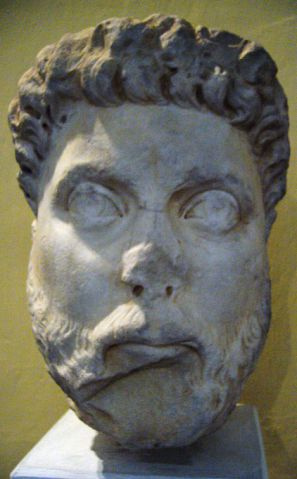
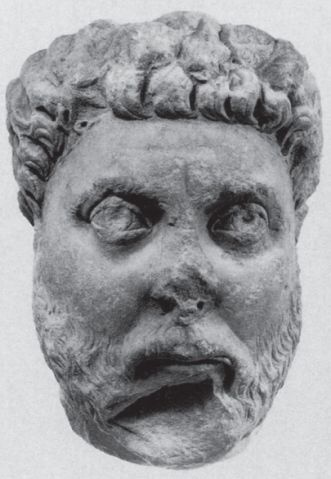
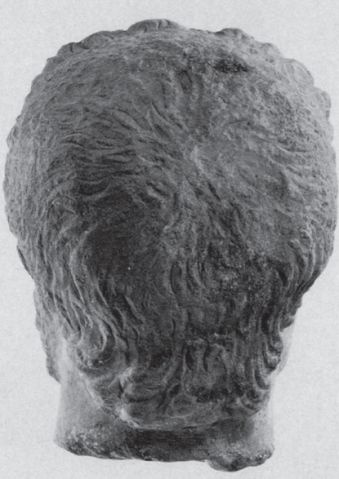
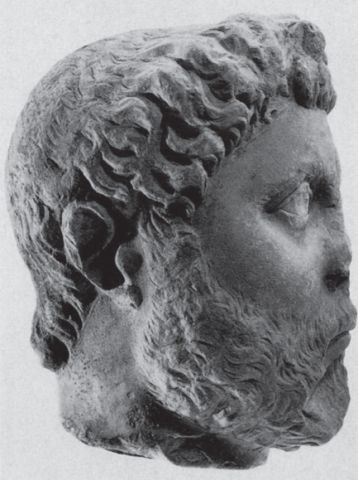
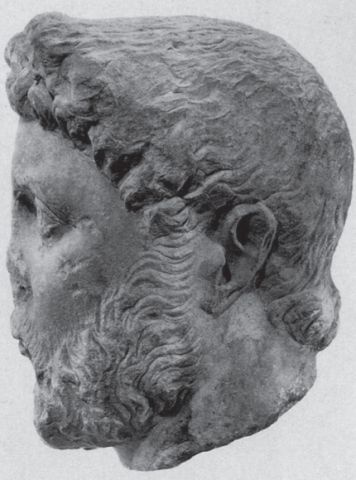
Portrait head of Oecumenius. Salamis (Cyprus). Late fourth to early fifth century.
Record details
Photographs
Bibliography
- Kranz, P, 'Ein Bildnis frühtheodosianischer Zeit in der Sammlung Georg Ortiz bei Genf', Archäologischer Anzeiger, Berlin 1979, 84, figs. 4 and 11
- Smith, R.R.R. 'The statue monument of Oecumenius. A new portrait of a late antique governor from Aphrodisias', The Journal of Roman Studies, 92, London 2002, 134-56, 140, 149, pl. 15
Discussion
DESCRIPTION (Object)
Over life-size head. H: 27.5 cm. White marble.
The head is broken through the top of the neck. The nose is missing, and the chin badly damaged.
The beard is rendered in medium-length locks with a flat chisel. The hair over the brow is rendered in two tiers of drilled locks. There is some drilling in the hair behind the right ear. At the top of the head the hair is only roughly rendered with a flat chisel; at the back and just behind the brow hair it is rendered more carefully with a flat chisel. The irises are almost circular and engraved with a flat chisel. The pupils are drilled and C-shaped.
PROVENANCE
The head was found in 1890 at Site F, ‘The Atrium’ in the southern part of Salamis in a building which was identified as a large Roman mansion.
DESCRIPTION (Subject)
The full-faced man wears hair combed forward. It remains flat on the head until the brow. There it rises in two tiers of deeply drilled curls around the face. A short moustache and a full beard, which grows in volume below the jaw line, cover much of the face. The brow has a single crease, and the cheeks are full. Only the hollows and wrinkles below the eyes indicate any age. The eyes are distinctive in their close spacing and emphatic aperture.
HONORAND
The portrait head is known in another life-size marble reproduction from Aphrodisias which was found with its base and thus identified as a certain Oecumenius, LSA-150 and LSA-151. Oecumenius was a praeses of Caria and may have been awarded a statue on Cyprus because it was his native home or because he was a governor there, a post at the more advanced rank of consularis . If the latter were the case, the Cypriote honour would post-date the Aphrodisian one.
A governor of Crete (again a post at the rank of consularis) in 382-83 bears the same name (see LSA-774. The relationship between these two men is unclear: it might be the same man, it might be a father-son scenario, or they may be wholly unrelated.
DATE
The epigraphy of the Aphrodisian monument (see LSA-151) and the fashion style and technique of the portraits suggest a date in the late fourth or early fifth century. For similar portraits, see: LSA-380, LSA-445, LSA-450, and LSA-2282
Cite: Last Statues of Antiquity, LSA-869 (J. Lenaghan).