
LSA-870
Base for statue of Constantine I, emperor. Alexandria (Aegyptus). About 314
Record details
Photographs
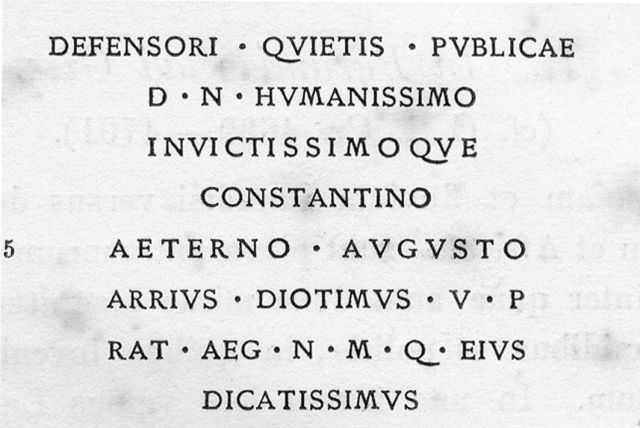
Inscription
Defensori quietis publicae, / d(omino) n(ostro) humanissimo / invictissimoque, / Constantino, / (5) aeterno Augusto; / Arrius Diotimus, v(ir) p(erfectissimus), / rat(ionalis) Aeg(ypti), n(umini) m(aiestati)q(ue) eius / dicatissimus.
Inscription translation
To the defender of public peace, our most humane and most invincible lord Constantine, eternal Augustus. Arrius Diotimus, of perfectissimus rank, rationalis of Egypt, most dedicated to his divine spirit and majesty, [set this up].
Bibliography
- Corpus Inscriptionum Latinarum; , III 17
- Corpus Inscriptionum Latinarum; , III suppl. I,1 6585
Discussion
INSCRIPTION
In eight lines:
Defensori quietis publicae, / d(omino) n(ostro) humanissimo / invictissimoque, / Constantino, / (5) aeterno Augusto; / Arrius Diotimus, v(ir) p(erfectissimus), / rat(ionalis) Aeg(ypti), n(umini) m(aiestati)q(ue) eius / dicatissimus.
'To the defender of public peace, our most humane and most invincible lord Constantine, eternal Augustus. Arrius Diotimus, of perfectissimus rank, rationalis of Egypt, most dedicated to his divine spirit and majesty [set this up].'
The inscription is recorded with identical wording and line divisions in CIL III 17 and CIL III suppl. I 6585.
Letter height not recorded.
DESCRIPTION
No description or measurements are given by CIL, the only publication of the inscription. No published photo.
PROVENANCE AND CURRENT LOCATION
The inscription was found in 1746 in Alexandria ('Alexandreae (...) inter rudera antiqua', CIL). There is no published record of its present location.
HONORAND, AWARDER, AND DATE
Constantine I was Augustus 306-37.
Arrius Diotimus, the awarder, held the office of the highest financial civil servant of the Egyptian diocese, the comes et rationalis summarum Aegypti, in our inscription shortened to rationalis Aegypti (line 7) (PLRE I, 261 Arrius Diotimus 2). The Notitia Dignitatum lists this office as a subordinate to the comes sacrarum largitionum (Neira Faleiro 2005, 202; Jones 1964, 428)
Beyond our inscription, Arrius Diotimus is known from two papyri, one of which is firmly dated to 314 (PLRE). Our inscription will therefore be of about the same date in the second decade of the 4th century.
Discussion references
- Jones, A. H. M., The Later Roman Empire, 2 vols., Oxford 1964
- Jones, A. H. M. et al., The Prosopography of the Later Roman Empire. Vol. I 260-395, Cambridge et al. 1971 (1975)
- Neira Faleiro, C., La notitia dignitatum. Nueva edición crítica y commentario histórico (Nueva Roma 25), Madrid 2005
Cite: Last Statues of Antiquity, LSA-870 (Ulrich Gehn).