
LSA-871
Base for statue of Constantine I, emperor. Alexandria (Aegyptus). 310-337
Record details
Photographs
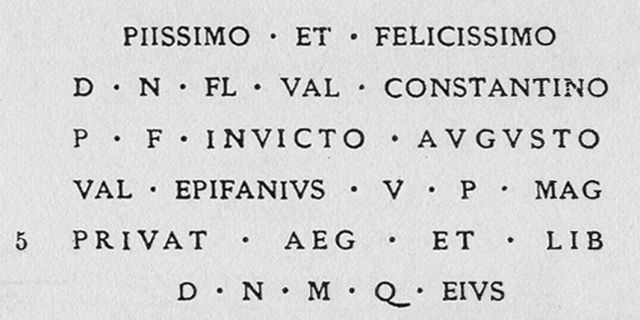
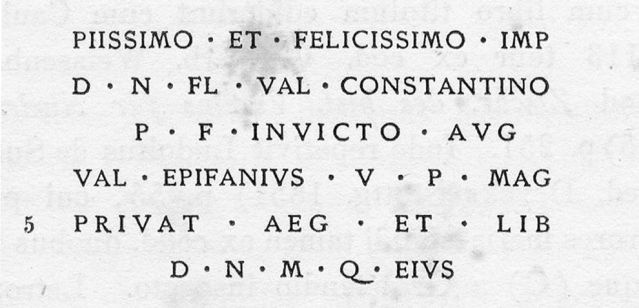
Inscription
Piissimo et felicissimo / d(omino) n(ostro), Fl(avio) Val(erio) Constantino, / p(io), f(elici), invicto Aug(usto); / Val(erius) Epifanius, v(ir) p(erfectissimus), mag(ister) / (5) privat(arum) Aeg(ypti) et Lib(yae), / d(evotus) n(umini) m(aiestati)q(ue) eius.
Inscription translation
To our most pious and fortunate lord, Flavius Valerius Constantinus, the pious, fortunate, unconquered Augustus; Valerius Epifanius, of perfectissimus rank, magister privatarum of Egypt and Libya, devoted to his divine spirit and majesty, [set this up].
Bibliography
- Corpus Inscriptionum Latinarum; , III 18
- Corpus Inscriptionum Latinarum; , III suppl. I,1, 6586
Discussion
INSCRIPTION
In six lines:
Piissimo et felicissimo / d(omino) n(ostro), Fl(avio) Val(erio) Constantino, / p(io), f(elici), invicto Aug(usto); / Val(erius) Epifanius, v(ir) p(erfectissimus), mag(ister) / (5) privat(arum) Aeg(ypti) et Lib(yae), / d(evotus) n(umini) m(aiestati)q(ue) eius.
'To our most pious and fortunate lord, Flavius Valerius Constantinus, the pious, fortunate, unconquered Augustus; Valerius Epifanius, of perfectissimus rank, magister privatarum of Egypt and Libya, devoted to his divine spirit and majesty, [set this up].'
Letter height not recorded.
We reproduce the text according to CIL III suppl. I (of 1902). The same inscription was recorded, with a slightly different wording in line 1 by CIL III 18 (of 1873):
'Piissimo et felicissimo imp(eratori) / d(omino) n(ostro), etc.' - 'To the most pious and fortunate emperor, our lord etc.'
DESCRIPTION
No description or measurements of the inscribed block are given by CIL, the only publication of the inscription. No published photo.
PROVENANCE AND CURRENT LOCATION
According to CIL the block was found in Alexandria in 1746. There is no published record of its present location.
HONORAND, AWARDER, AND DATE
Constantine I was Augustus from 306-337, but fully recognized in the East only from 310 (Kienast 1996, 298-9).
The awarder, Valerius Epifanius, held the office of magister privatarum Aegypti et Libyae (PLRE I, 281 Val. Epifanius 7). He was a high-ranking subordinate of the highest financial civil servant of the Egyptian diocese, the comes et rationalis summarum Aegypti (LSA-870). Valerius Epifanius is only known from this inscription. It is an attractive possibility that this dedication was set up together with the similar inscription to Constantine by the comes et rationalis summarum Aegypti Arrius Diotimus which can be dated within the second decade of the 4th century, around 314 (LSA-870). However there are no specific indicators in the wording of our inscription to allow us to narrow its dating within Constantine's reign.
Discussion references
- Jones, A. H. M. et al., The Prosopography of the Later Roman Empire. Vol. I 260-395, Cambridge et al. 1971 (1975)
- Kienast, D., Römische Kaisertabelle. Grundzüge einer römischen Kaiserchronologie, Darmstadt (2)1996
Cite: Last Statues of Antiquity, LSA-871 (Ulrich Gehn).