
LSA-873
Base for statue of Diocletian, emperor and 'Father of the Emperors'. Alexandria (Aegyptus). 305-316
Record details
Photographs
Inscription
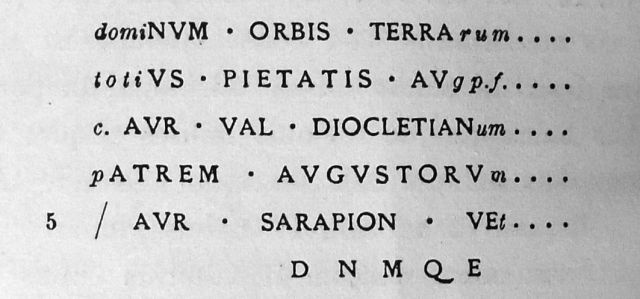
[domi]num orbis terra[rum ---], / [toti]us pietatis, Au[g(ustum) ---] / [C(aium)] Aur(elium) Val(erium) Diocletian[um ---], / [p]atrem Augustoru[m ---], / [-] Aur(elius) Sarapion, v(ir) e(minentissimus), [---] / d(evotus) n(umini) m(aiestati)q(ue) e(ius).
Inscription translation
The lord of the orb of the world ... of all piety, the Augustus ... Caius Aurelius Valerius Diocletianus ... the father of the Augusti ... Aurelius Sarapion, of eminentissimus rank, devoted to his divine spirit and majesty, [honours him].
Bibliography
- Corpus Inscriptionum Latinarum; , III suppl. 1, 6584
- Breccia, E., Catalogue générale des antiquités égytiennes du musée d'Alexandrie, nos. 1-568. Iscrizioni greche ed latine, Cairo 1911, no. 88
- Tkaczow, B., The topography of ancient Alexandria (An archaeological map), Warsaw 1993, no. 215
Discussion
INSCRIPTION
In six lines:
[domi]num orbis terra[rum ---], / [toti]us pietatis, Au[g(ustum) ---] / [C(aium)] Aur(elium) Val(erium) Diocletian[um ---], / [p]atrem Augustoru[m ---], / (5) [-] Aur(elius) Sarapion, v(ir) e(minentissimus), [---] / d(evotus) n(umini) m(aiestati)q(ue) e(ius).
'The lord of the orb of the world ... of all piety, the Augustus ... Caius Aurelius Valerius Diocletianus ... the father of the Augusti ... Aurelius Sarapion, of eminentissimus rank, devoted to his divine spirit and majesty, [honours him].'
We reproduce the text for the most part with completions very similar to those proposed in CIL III. In line 5, however, we suggest reading the rank or title of the awarder as v(ir) e(minentissimus), and not ve[t---] as proposed by CIL. Breccia 1911 reads [dec]us pietatis, Au[g(ustae)] in line 2.
Although written in Latin, the inscription follows Greek practice, by putting the name of the honorand in the accusative, rather than in the dative. In Alexandria, where the language of the elite was Greek, this would not have seemed strange.
DESCRIPTION (from Neroutsos-Bey 1875 and Tkaczow 1993)
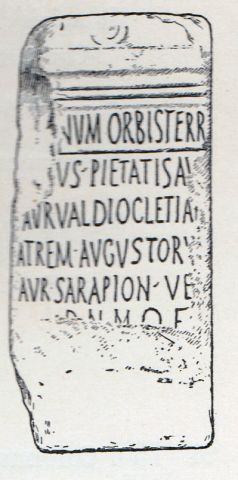
White marble base, H 96, W 43 cm (H according to Neroutsos c. 150 cm). The upper left corner is broken and leaves the first letters of lines 1-2 illegible. On top there are traces of the settings for the feet of a bronze statue, but there is no indication in the published account whether these were for our statue or the earlier one (see following). Our inscription is on the back side of a Greek honorific inscription to the rhetor Aelius Demetrius of the late 1st century. The last lines of both inscriptions have been been destroyed by a decorative moulding that was chiselled into the base when it was re-used as a building-block.
PROVENANCE AND CURRENT LOCATION
The block was first recorded in 1874 in the foundations of the house of Mr Adib, between the 'Cour Britannique' and the 'Rue de la Bourse' in Alexandria, the area of the ancient docks called 'Apostaseis' (Neroutsos-Bey 1875). This is the modern city quarter of Gheneneh, at the base of the Heptastadion (Tkaczow 1993, 41 and Plan II; findspot on map B. For the docks, situated at the Great Harbour in the area of the Caesareum, see Adriani 1966, and Fraser, Ptolemaic Alexandria, pp. 24-5; and for a map of ancient Alexandria, see Adriani 1966 pl. 2 figs. 2, 4).
The base is today in the Graeco-Roman Museum at Alexandria, inv. no. 17482b.
HONORAND, AWARDER, AND DATE
Diocletian was Augustus 284-305. After his abdication in 305 he became senior Augustus and 'father of the Augusti', as he is titled here (Barnes 1982, 24). The inscription therefore postdates his abdication. The year of Diocletian's death is not certain; according to the sources it could be 312, 313, or 316.
The awarder Aurelius Sarapion is known only from this inscription; he has no entry in PLRE. If in line 5 the reading of his rank as v(ir) e(minentissimus) is correct, then it is likely that he held some high ranking office in the administration of Egypt.
Discussion references
- Adriani, A., Repertorio d'Arte dell'Egitto Greco-Romano. Serie C. Vol. I-II, Palermo 1966
- Barnes, T. D., The New Empire of Diocletian and Constantine, Cambridge (Mass.) 1982, p. 24
- Jones, A. H. M. et al., The Prosopography of the Later Roman Empire. Vol. I 260-395, Cambridge et al. 1971 (1975)
- Neroutsos-Bey, Le Dr., Notice sur les Fouilles récentes exécutées a Alexandrie 1874-1875, Alexandria 1875, pp. 15-16
Cite: Last Statues of Antiquity, LSA-873 (Ulrich Gehn).