
LSA-875
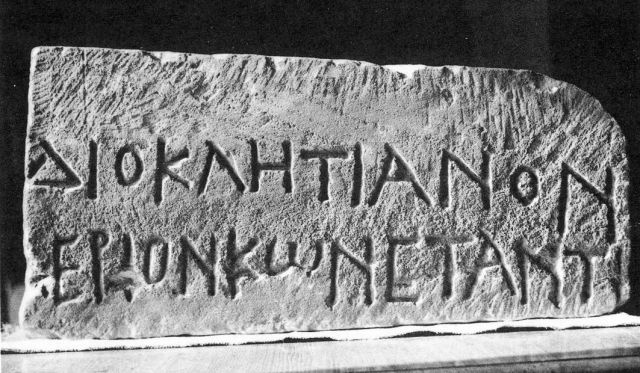
Fragment of a slab, possibly associated with statues, with dedication to Diocletian and Constantius I. From island of Philae (Thebais). 293-305
Record details
Photographs
Inscription
... Διοκλητιανὸν [...] / [... Οὐα]λ̣έριον Κωνστάντιον
Inscription translation
... [set this up to)] Diocletianus .... Valerius Constantius ...
Bibliography
- Bernand, É. , Les inscriptions grecques de Philae II, Paris 1969, pp. 209-12 no. 185 pl. 93
Discussion
INSCRIPTION
In two surviving lines:
... Διοκλητιανὸν [...] / [... Οὐα]λ̣έριον Κωνστάντιον
'... [set this up to] Diocletianus .... Valerius Constantius ...'
The dedication must once have contained the names of all four emperors of the first tetrarchy (Diocletian, Maximian, Constantius I, and Galerius). The text with the honorands in the accusative follows the usual formula of Greek statue base inscriptions. The accusative will have depended on a verb form like ἀνέθηκεν (he set up), ἐτίμησεν (he honoured), καθιέρωσεν (he dedicated), or similar.
Letter height 7 cm.
DESCRIPTION (from Bernand 1969 and the published photo)
Oblong slab of sandstone, broken on all sides.
H 35.55, W 76.2, D 15.5 cm.
PROVENANCE AND CURRENT LOCATION
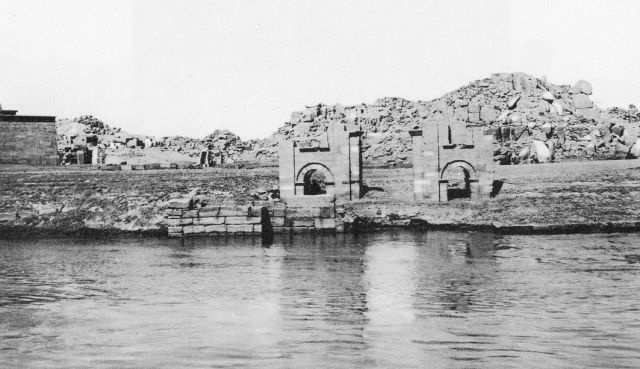
The block was found in the passage way which separates the two lateral arches of the entrance gate to the island of Philae (Bernand 1969, 212). Today in the British Museum, depot no. 1359.
HONORAND, AWARDER, AND DATE
Diocletian was Augustus 284 to 305; Constantius I was Caesar 293 to 305 and Augustus 305-6. The date range is given by the accession of the Caesars in 293 and Diocletian's abdication in 305.
FURTHER DISCUSSION
The inscription makes use of the traditional Greek formula for statue bases. It probably belonged to the entrance gate to the island, set up under the tetrarchs (Bernand 1969, 212). Possibly this gate was crowned with statues of the emperors, although no traces of such statues have been found.
Cite: Last Statues of Antiquity, LSA-875 (Ulrich Gehn).