
LSA-878
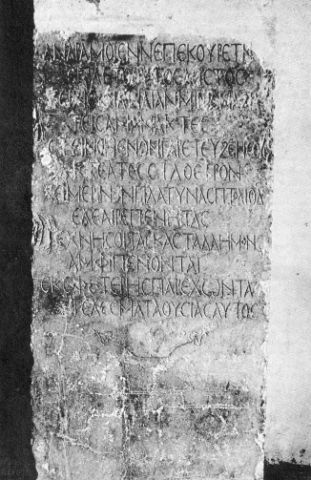
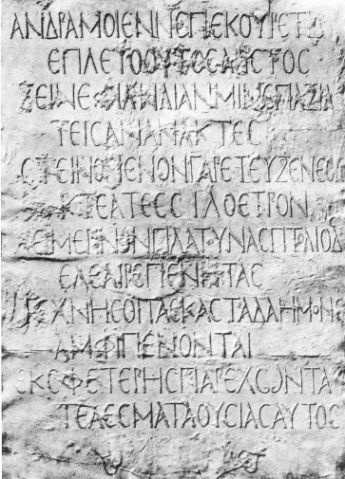
Block with honorific inscription to Elias, benefactor, possibly statue base. Epiphaneia (Syria). Fourth to sixth century
Record details
Photographs
Inscription
ἄνδρα μοι ἔννεπε, κοῦρε· τίς / ἔπλετο οὗτος ἄριστος; /
ξεῖνε, φιλ’, Ἠλίαν μιν ἐπάξια / τεῖσαν ἄνακτες· /
(5) στεινόμενον γὰρ ἔτοιξεν ἑοῖς / κτεάτεσσι λοετρόν /
χειμερινὸν πλατύνας, πτόλίος δ’ / ἐλέαιρε πένητας, /
τέχνης οἲ τὰ ἕκαστα δαήμονε[ς] / (10) ἀμφιπένονται, /
ἐκ σφετέρης παρέχων τὰ / τελέσματα οὐσίας αὐτός. (2 ivy leaves)
Inscription translation
Name me this man, young man; who is this felicitous man? Friendly stranger, it is Elias.
The emperors have rewarded him as he deserves it. Because from his own funds he widened the narrow winter-bath, showing mercy towards the poor folk of the city each of whom pursues his own craft, and he paid the salaries himself, from his own funds.
Bibliography
- Merkelbach, R. and J. Stauber (eds.), Steinepigramme aus dem griechischen Osten. Bd. 4. Die Südküste Kleinasiens, Syrien und Palaestina, Munich 2002, 260 no. 20/ 06/ 01
Discussion
INSCRIPTION
Six hexameters set over twelve lines:
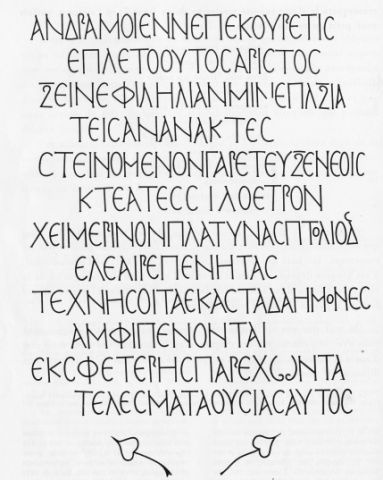
ἄνδρα μοι ἔννεπε, κοῦρε· τίς / ἔπλετο οὗτος ἄριστος; /
ξεῖνε, φιλ’, Ἠλίαν μιν ἐπάξια / τεῖσαν ἄνακτες· /
(5) στεινόμενον γὰρ ἔτοιξεν ἑοῖς / κτεάτεσσι λοετρόν /
χειμερινὸν πλατύνας, πτόλίος δ’ / ἐλέαιρε πένητας, /
τέχνης οἲ τὰ ἕκαστα δαήμονε[ς] / (10) ἀμφιπένονται, /
ἐκ σφετέρης παρέχων τὰ / τελέσματα οὐσίας αὐτός.
(2 ivy leaves)
'Name me this man, young man; who is this felicitous man? Friendly stranger, it is Elias. The emperors have rewarded him as he deserves it. Because from his own funds he widened the narrow winter-bath, showing mercy towards the poor folk of the city each of whom pursues his own craft, and he paid the salaries himself, from his own funds.'
Letter height not recorded.
The verse praises the benefactions of Elias towards the city, who rebuilt a bath and thereby provided work and livelihood for the poor. He was rewarded with a portrait once associated with the inscription. Each hexameter is laid out in two lines with the second line indented. The text makes extensive use of homeric vocabulary (Mouterde & Mondésert 1957, 285-6).
DESCRIPTION (from the published photo)
Tall rectangular block, without mouldings. No measurements are given. A minor break on the upper right corner, chips along the edges. The surface is smoothly finished, but covered with superficial chips and cracks. The epigraphic field is not framed.
PROVENANCE AND CURRENT LOCATION
According to Mango 1986, 28 the block was identifed in 1954, built into a pillar in the western wall of the Great Mosque of Hama, which had previously served as a Byzantine church (Jalabert & Mouterde 1959, 13 no. 1999; Mango 1986, 29),. Mango describes it as set above a moulded block of 'protobyzantine date' ('un bloc mouluré de l'époque protobyzantine') and seems to suggest that our inscription formed part of the original structure of the church.
HONORAND AND DATE
The absence of any allusion to a state office makes it almost certain that the honorand, Elias, was a local man, who can not readily be identified with any of the men named Elias listed in PLRE. The name indicates that he was a Jew or Christian.
A date for the inscription is not easy to determine. Jalabert & Mouterde 1959 cautiously proposed a date around 500, or even in the 6th century, on the basis of the letter forms; this dating finds some support in the fact that, within the Christian community of Syria, the name Elias is more frequently attested in the 6th century than in the 4th and 5th (Mouterde & Mondésert 1957, p. 285 n. 3b; Jalabert & Mouterde 1959, 14). On the other hand, the plurality of emperors referred to in line 4, unless successive emperors honoured Elias, probably points to a date not later than the mid-fifth century, after which western colleagues were seldom formally recognized by the eastern rulers.
FURTHER DISCUSSION
While the early editors of the inscription, Mouterde & Mondésert 1957 and Jalabert & Mouterde 1959 both stated that this was undoubtedly a statue base ('Il s'agit sans doute d'une base de statue', Mouterde & Mondésert 1957, 284, repeated in Jalabert & Mouterde 1959, 13), Mango 1986, 29 argued that the inscriptions refers to a lost painted portrait of Elias, perhaps painted onto the block below the inscription. Mango supported his argument with the assumption that the base is in situ and formed part of the original church-building in Epiphaneia, arguing that in such an environment a statue was hard to imagine. Mango's assumption was originally rejected by Feissel 1984, but adopted by Feissel, Bulletin epigraphique1987 no. 867; Merkelbach & Stauber 2002 likewise adopt Mango's assumption and propose a 6th-century date.
The rectangular form of the block is quite in keeping with a statue base, so the argument that it in fact supported a painted image depends entirely on whether it is in situ, and therefore originally within a church.
Mango is quite correct that a statue to a benefactor of a city, inside a church, has no parallels and is therefore extremely unlikely. However, we should note that four inscriptions in Stratonicea to a certain Maximus (LSA-657, LSA-1200, LSA-1201, LSA-1202), probably of similar date, show that he was honoured statues in the very close vicinity of a church.
Discussion references
- Feissel, D. 'Notes d' Épigraphie chrétienne', Bulletin de Correspondance Hellénique 108, 545-579, Paris 1984, p. 548
- Jalabert, L. & R. Mouterde, Inscriptions greques et latines de la Syrie. Tome V: Émésène, Paris 1959
- Mango, C., Epigrammes honorifiques, statues et portraits a Byzance, Αφιέρωμα στον Νίκο Σβορώνο, 23-35, Rethymno 1986
- Mouterde, R. & Cl. Mondésert, Deux inscriptions greques de Hama, Syria 34, 284-7, Paris 1957
- Roueché, C., Aphrodisias in Late Antiquity (Journal of Roman Studies Monograph 5), London 1989
Cite: Last Statues of Antiquity, LSA-878 (Ulrich Gehn).