
LSA-879
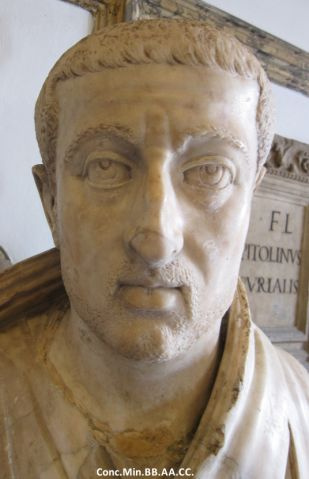
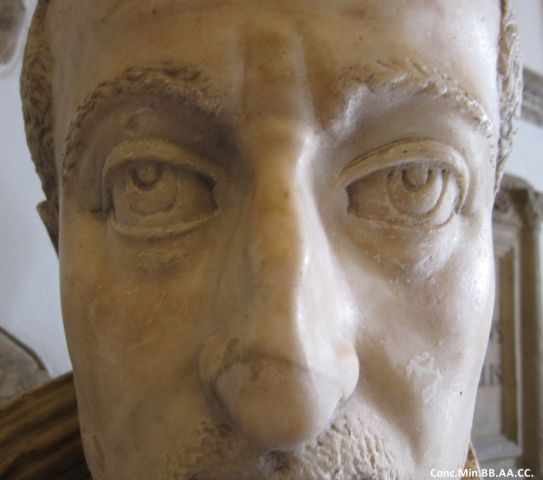
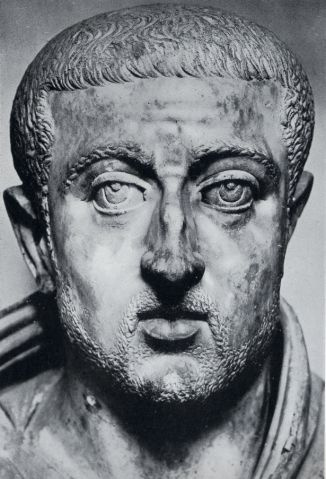
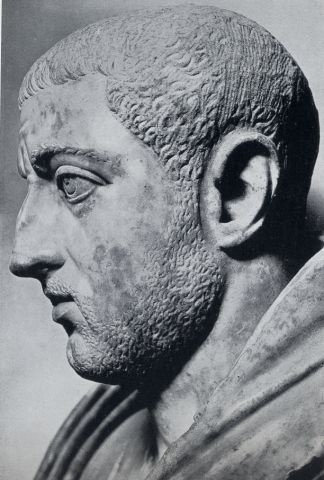
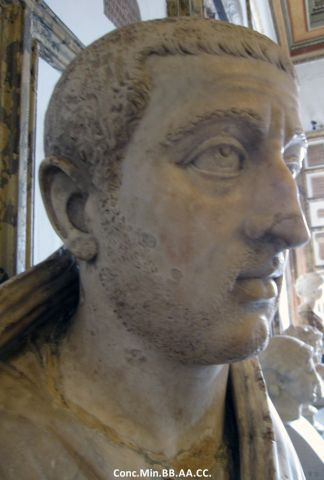
Re-cut portrait of Cethegus set on draped bust and with inscribed tabula. Probably from Rome. Later fourth century.
Record details
Photographs
Bibliography
- Fittschen, K., P. Zanker, and P. Cain, Katalog der Porträts in den Capitolischen Museen und den anderen kommunalen Sammlungen der Stadt Rom. Band II. Die männliche Privatporträts, Berlin 2010, 178-9, no. 177, pls. 220-221
- Stuart Jones, H. (ed.), A catalogue of the ancient sculptures preserved in the municipal collections of Rome. [Vol.1]. The sculptures of the Museo capitolino , Oxford 1912, 312, no. 2, pl. 82
Discussion
DESCRIPTION (Object):
Over life-size portrait bust consisting of three ancient elements: head, bust, and foot with inscription. H (total): 88, W: 64, D: 35 cm. H (of head): 27.5 cm. White marble.
Head
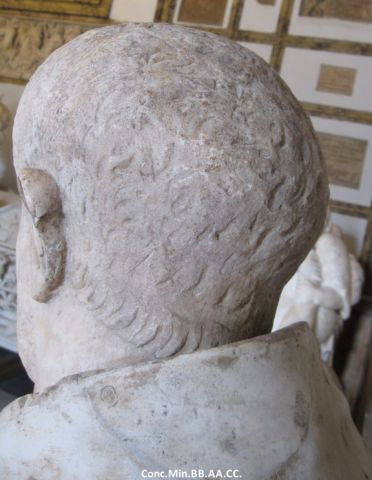
The head is preserved with the neck and has been set carefully into the bust. An edge of yellowing modern plaster is visible around the front and proper right sides. The back of the head and nape of the neck do not touch the uppermost fold of the toga which in fact rises above the nape and the lower edge of the hairline.
The tip of the nose has broken off and been restored. The outside of the left ear has broken off, and the right ear lobe has a crack. There is a chip, modern scar or imperfection in the marble, just below and behind the right ear lobe. Apart from some burial encrustation and some traces of white plaster (?) on the face, the fully finished smooth surface is well-preserved.
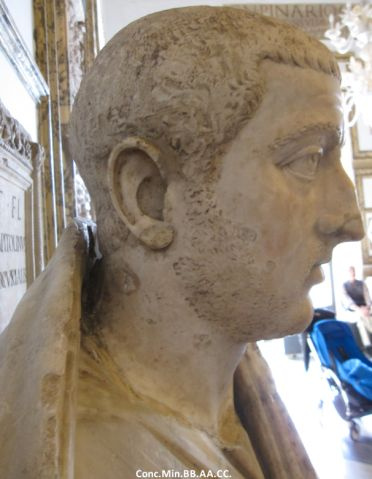
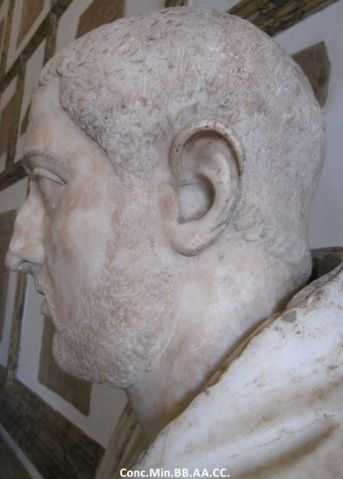
The portrait has been skilfully re-worked from an earlier, clean-shaven portrait. This is visible in four areas; 1) the hair, 2) the beard, 3) the nose, and 4) the eyebrows and eyes.
The short hair across the brow, both the individual strands and the gaps between locks or groups of locks, is defined by a flat chisel. The same is true for the hairline between the temples and the ear and behind the left ear; as well as just above the left ear. In these places, the workmanship of the original first-century AD portrait head remains.
Above the left ear towards the back of the head are a series of vertical claw chisel strokes. The back and top of the head have been picked with a large chisel, presumably to remove some of the original hair and to give the head a new shape. The area above the hairline at the back of the neck the head has been taken back so as to give the cranium a more pronounced curve (and perhaps to allow it to fit better behind the tall uppermost fold of the bust). A horizontal line of a flat chisel is visible in the hair at the nape.
The beard and the moustache have both been engraved (with a small flat chisel) into the smooth surface of a once clean-shaven portrait. The defining lateral ridges of the philtrum, generally invisible on a mature man with a full moustache, are still partially preserved.
The nose has been noticeably narrowed at the bridge and then down the ridge. Moreover, the alteration is not just in terms of width but also in depth. By taking down some of the surface both at the root and below the bridge a bulge has been created at the bridge.
The eyebrows have been raised, and the upper lids thickened. The eyes have been enlarged. The corners of the inner canthi has been extended downward to meet a new lower lid and thus have an unusual crescent shape. The iris and the pupil have been engraved as concentric arcs.
Bust
The bust is worked in one piece from the drapery around the neck and shoulders to the area of the costal arch. The uppermost fold of the toga, which wraps around the neck, stands tall off the head and is finished except at one point, at the back, proper right. It would seem that the original head of the bust probably touched the upper fold at this juncture.
The back of the bust has a relatively narrow spine and is finished. It has, however, not been fully smoothed and thus pick and chisel, even finer claw chisel, marks are still visible
Tabula and Foot
The tabula is made together with a moulded cylindrical foot. The back proper left of the foot is missing. The upper moulding of the tabula is no longer preserved or is concealed beneath plaster.
PROVENANCE:
The bust was certainly part of the collection of Ippolito Vitelleschi (d. 1654). It passed to his daughter Sulpizia Vitelleschi Tasso and then her adopted son Leone Veropsi Vitelleschi. It is recorded in the family collection in 1685 as a ‘busto di un Cesare di Gracchi’, in 1701 as ‘testa e busto antico vestito con lettere nel pieduccio’ and in 1726 as ‘busto ammantato con lettere nel pieduccio.’ It was purchased by Cardinale Alessandro Albani who sold it to Pope Clemente XII in December of 1733. It is almost assuredly to be associated with a bust of Cethegus seen by Jodocus Hondius (Joost de Hondt, 1563-1612) in the Villa of Julius III (cf. Lanciani III p. 34). Thus, it seems that Vitelleschi acquired this item from the collection of Julius III (Pope 1550-1555) and not from his own property around the Horti Sallustiani.
DESCRIPTION (Subject):
The bust portrays a mature male who wears a tunic and toga. He has short hair, an engraved beard, and large marked eyes. The nameplate (or tabula) identifies him as Cethegus, the father of Furius Maecius Gracchus.
The toga is tucked tightly under the right arm pit and is pulled across and up over the chest. Its uppermost border consists of a large vertical fold (a balteus without an umbo) that runs from the right armpit tightly to the left side of the neck and then behind the head. Another broad flat fold rises vertically alongside the body to the left shoulder. Only a small portion of the tunic around the proper right side of the neck is visible.
The head turns to its right, following the curve of the drapery around the neck, and tilts downward. The face is large and full but the lower face lacks depth and is set close to the neck. This is because it has been re-cut from an earlier portrait (see above). The broad brow has two horizontal creases and two vertical furrows which originate at the inner corners of the eyebrows. The eyebrows project and arch well above the large eyes . The nose has a fine ridge which widens at points. The mouth is bow-shaped with a particularly full lower lip. The cheeks are sensitively modelled.
The hair is short and recedes slightly at the corners of the brow. All of the locks of the fringe bend to the proper left. At the sides the hair is brushed forward with ends that turn downwards.
The inscribed tabula has moulding on its lower frame and unfretted scrolls make its lateral frames. The face of the tabula is not vertical but slopes backwards.
INSCRIPTION
The tabula bears a three-line inscription (CIL VI 1709=31907):
Cethego, v(iro) c(larissimo), patri. / F(urius) Maechius / Gracchus, v(ir) c(larissimus).
'To Cethegus, of clarissimus rank, father. Furius Maechius Gracchus, of clarissimus rank [set this up].'
The first line is tightly spaced, and the second and third lines run upwards. There is blank space beneath the third line.
DATE:
The tabula and foot are easily dated. Both dedicator, son, (PLRE I, 400 Gracchus 3) and honorand, father, (PLRE I, 199-200 Cethegus) are known. The son Furius Maecius Gracchus was a corrector Flaminiae et Piceni in 350-52 (see LSA-1689) and was possibly the Praefectus Urbis Romaein 376-7 (PLRE I, 399 Gracchus 1). The father (incidentally also attested on a slave collar) is recorded as executed shortly AD 368 for adultery (Ammianus Marcellinus, 28.1.16)
The bust by itself can be dated on technical grounds and on the type of clothing. The size, handling of the back, and the fact that it was worked separately from its supporting foot belong after the middle of the second century. The toga has a tight balteus and no umbo; it is a variation of the toga contabulata. This makes a date in the third century or later most likely.
Stuart-Jones compared the style of the portrait to coins of Aemilian (Emperor 253). L’Orange believed it to be Tetrarchic mainly on account of the engraved beard. Bergmann has suggested late Constantinian because of its smooth oval shape and naturalistic appearance. Parisi-Presicce places it between 300-320.
INTERPRETATION
Stuart-Jones correctly noted bust and foot were of different date. Von Heintze believed that head and bust went together but that the tabula was alien. Bergmann noted that all three elements were of different date. The problem lies not in the observation that the elements did not originally go together but in the assessment of when they might first have been put together.
The elements were noted as a unit already in the collection of Julius III in the middle of the sixteenth century. It seems highly unlikely that a Renaissance restorer would have created a pastiche in which the head and foot were chronologically roughly contemporary and in which the togate body was the popular contemporary choice for the senatorial rank of the man named on the foot. It is easier to assume that this is a carefully worked late antique pastiche. This assumption has a fortuitous and important consequence; a private portrait with a secure date. This portrait bust should belong in the third-quarter of the fourth century, just before or just after the death of the father Cethego.
Discussion references
- Demandt, A. and J. Engemann, (eds.), Konstantin der Grosse, Mainz 2007
, no. I.15.29 (C. Parisi Presicce: 300-320) - Donati, A. and G. Gentili, Costantino il Grande. La civiltà antica al bivio tra Occidente e Oriente, Milan 2005
- Ensoli, S. and E. La Rocca (eds.), Aurea Roma: dalla città pagana alla città cristiana, Roma 2000, 540-41, no. 187 (Bergmann)
- Goette, H.R., Studien zu römischen Togadarstellungen, Mainz 1990, 152, no. 74, pl. 57.3
- L'Orange, H. P., Studien zur Geschichte des spätantiken Porträts, Oslo 1933, 32, 118, no. 36, figs. 80-81
Cite: Last Statues of Antiquity, LSA-879 (J. Lenaghan).