
LSA-882
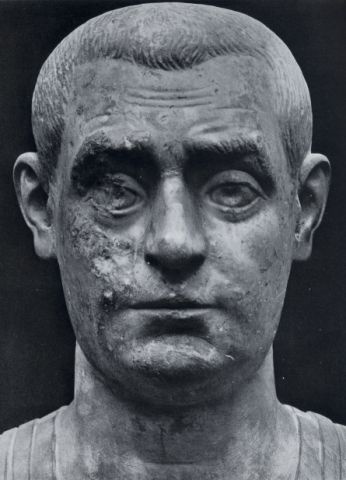
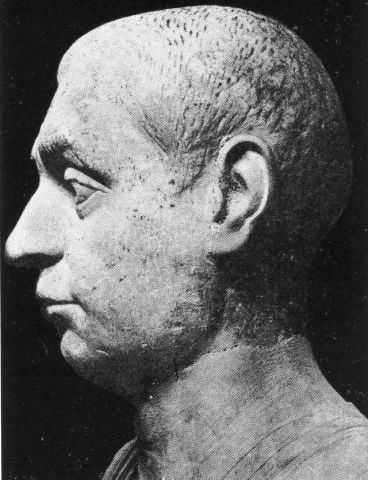
Portrait of clean-shaven man with short-cropped hair. Rome (Via Appia). Fourth century.
Record details
Photographs
Bibliography
- Visconti, P.E., Catalogo del Museo Torlonia di sculture antiche, Rome 1880, 148, no. 391
Discussion
DESCRIPTION (Object)
Colossal (L’Orange), life-size (Calza). Height is listed by Calza as 23 cm? Marble.
The head is broken at the top of the neck and has been attached to a neck and base.
The hair is indicated by fine curving lines made with a flat chisel. The eyes are marked by large and deep crescent-shaped hollows which indicate irises and pupils.
PROVENANCE
Via Appia, Casal Rotondo.
DESCRIPTION (Subject)
The head depicts a mature, clean-shaven man with short hair. The hair recedes at the temples, and the locks of the central, projecting part of the fringe turn to the proper left.
The brow is traversed by three short, closely-spaced parallel creases. The eyebrows are heavy and cause folds in the brow above them. The eye markings fill most of the eyeball. The mouth is straight and thin-lipped. The chin is small, round, and receding. The recession of the chin makes the lower lip seem to project.
DATE
The head has traditionally been dated to the Tetrarchic period (L’Orange, Calza, von Sydow). It should, however, be noted that the large crescent-shaped eye-markings and clean-shaven face are respectively technical and fashion details that occur in monuments securely dated to the second half of the fourth century. Such eye markings are typical of the Valentinian imperial portraits (see LSA-581 , LSA-582, and LSA-597).
The clean-shaven aspect is more difficult to assess. The portrait of a Tetrarch from Felix Romuliana, LSA-845, appears clean-shaven but probably had a painted beard. All securely dated portraits (for example, LSA-903 or LSA-46) are bearded until c. 370s (for example, LSA-180 and LSA-2502).
Discussion references
- Calza, R., Iconografia Romana Imperiale. Da Carausio a Giuliano (287-363 d. C.), Rome 1972, 204, no. 121, pl. 68, 229-230 (comparable to Licinius)
- L'Orange, H. P., Das spätantike Herrscherbild von Diokletian bis zu den Konstantin-Söhnen, 284-361 n. Chr. Das Römische Herrscherbild. III. Abteilung ; Bd. 4 , Berlin 1984, 117 (private portrait)
- L'Orange, H. P., Studien zur Geschichte des spätantiken Porträts, Oslo 1933, 22, 119 no. 38, fig. 85
- Sydow, W. von, Zur Kunstgeschichte des spätantike Porträts im 4. Jahrhundert. n. Chr, Bonn 1969, 7-9 (c. 300)
Cite: Last Statues of Antiquity, LSA-882 (J. Lenaghan).