
LSA-883
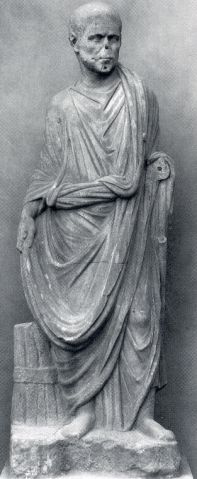
Togate portrait statue of man with short-cropped hair and short beard. From Italy. Late third century.
Record details
Photographs
Bibliography
- Goette, H.R., Studien zu römischen Togadarstellungen, Mainz 1990, 139,no. Bb 178, pl. 26.4 (portrait head c. 240-250, statue post-Severan))
Discussion
DESCRIPTION (Object)
Life-size statue.
The statue is preserved from the plinth to the head. The head is large for the body and appears to be re-cut. The relationship of the head to the body (when and how they are attached) is unclear from the published descriptions and photographs.
The left hand and forearm were added separately. There is a trace of a strut on the drapery over the outer left chest. The tip of the nose and the chin were repaired and attached by pins. Again the date of these repairs is undeterminable.
The plinth is tall and rectangular. The statue support, a vertical set of scrolls, is tall and broad. Both hair and beard have been cut down. The irises appear to be engraved semi-circles, and the pupils are drilled.
PROVENANCE
Unknown
DESCRIPTION (Subject)
The statue depicts a man wearing a toga with equestrian shoes. On the outside of his right foot is a bunch of tall scrolls which are bound together by a broad ribbon.
The figure stands with its weight over the right leg. The right hand holds the edge of the broad sinus that reaches the knee. The balteus makes almost a 90 degree angle and the umbo is close to the proper left side of the body. A vertical object was held in the left hand.
The head turns to the proper left. It wears short hair and a short beard.
DATE
The relationship of the head and statue cannot be properly assessed. Generally both the form of the statue, which is similar to that of LSA-1642 and the fashion of the re-cut portrait belong to the second half of the third century. The recurrent tendency in the fourth century to construct new statue honours from extant toga bodies combined with re-cut heads (see, among others, LSA-44, LSA-46, LSA-903, LSA-1130, LSA-2136) forces us to consider this statue as a confection of the later third or earlier fourth c.
Discussion references
- Heintze, H. von. 'Drei spätantike Portätstatuen', Antike Plastik 1, Berlin 1962, 18, 24, fns. 29 and 50 (late third to fourth)
Cite: Last Statues of Antiquity, LSA-883 (J. Lenaghan).