
LSA-884
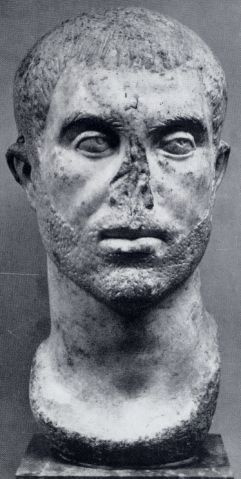
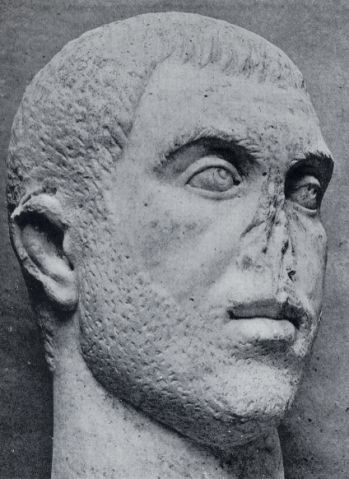
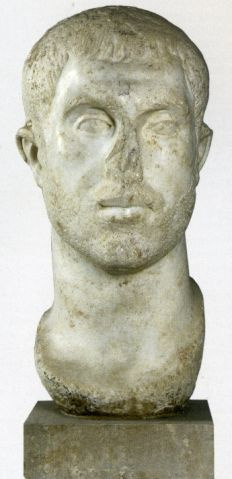
Portrait head of Maxentius (?). Ostia. Later third century to early fourth century.
Record details
Photographs
Bibliography
- Blanck, H., Wiederverwendung alter Statuen als Ehrendenkmäler bei Griechen und Römern, Rome 1969, 54, no. A 31, pls. 22-3.
- Donati, A. and G. Gentili, Costantino il Grande. La civiltà antica al bivio tra Occidente e Oriente, Milan 2005, 207-208, no. 5 (I. Romeo: Maxentius)
Discussion
DESCRIPTION (Object)
Over life-size head, worked separately. H: 43 cm, H (chin to hairline): 26 cm. Marble.
The head, which was worked separately, is missing the nose.
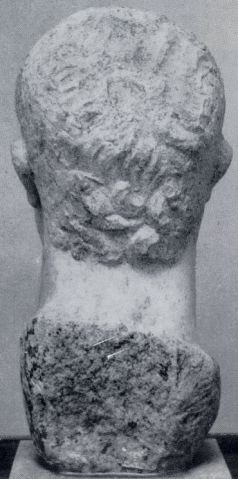
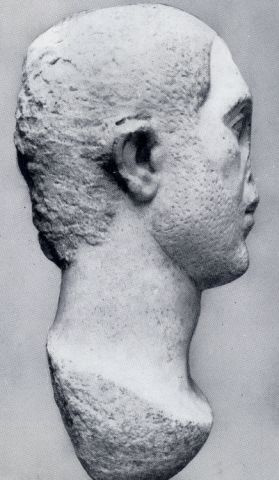
The head has been re-cut from an earlier portrait (possibly Antonine) which had longer hair. Some locks of the original the original portrait are visible at the back of the head. Both ears also have traces of long locks which curled into the shells of the ears. The hair has been evenly truncated across the brow.
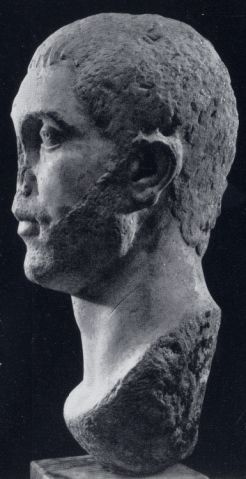
The new fringe is rendered with a fine chisel. The beard and moustache are pecked in with the tip of a flat chisel. The irises are engraved arcs that do not touch the bottom lid. The pupil of the right eye is U-shaped; the pupil of the left eye seems to consist of two contiguous drill holes
PROVENANCE
Found at Ostia near the Porta Marina.
DESCRIPTION (Subject)
The head shows a young man with short hair and a stubble beard. The hair over the brow recedes at both corners and comes forward at the centre. There is a parting over the left eye; a and two or three small partings over the right eye.
The face has an ‘Antonine’ aspect that reflects its original use. It has heavy-lidded eyes and a large mouth with full lips. The cheeks are carefully modelled to present real flesh. The chin is long and was once heavily bearded.
The head turns to its left. The chest-shoulder area is cut evenly on both sides. This suggests that the head was once inserted into a cuirassed statue.
DATE AND HONORAND
This re-cut portrait owes much of its physiognomy to its first use. In its second use, the brow hair has been carefully worked over and seems to correspond to numismatic evidence for Maxentius and to a series of portraits which clearly follow one model (Dresden-Stockholm type); see LSA-895, LSA-896, LSA-897, and LSA-2662. It seems highly probable that this portrait was re-cut and re-used to represent Maxentius.
Discussion references
- Calza, R., Museo Ostiense, Rome 1947, 15, no. 70
- L'Orange, H. P., Studien zur Geschichte des spätantiken Porträts, Oslo 1933, 36 (Gallienus to Tetrarchy), 119, no. 40, fig. 86
Cite: Last Statues of Antiquity, LSA-884 (J. Lenaghan).