
LSA-886
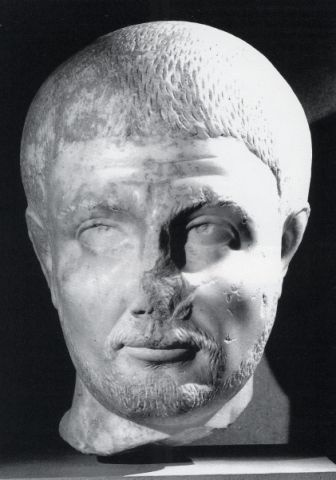
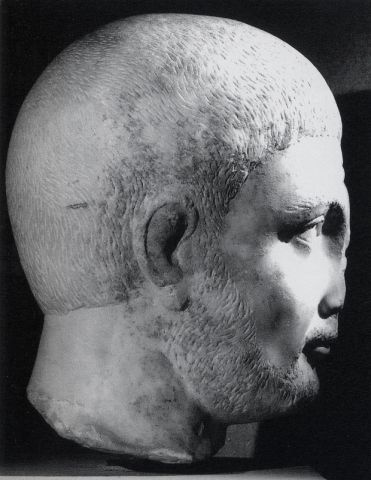
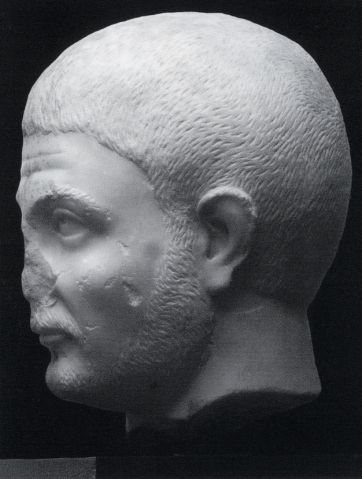
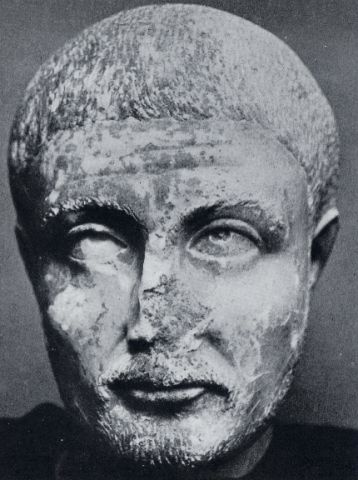
Portrait of man with short-cropped hair and beard. From Modern Spielfeld (Noricum Mediterraneum). Later third to earlier fourth century.
Record details
Photographs
Bibliography
- Hudeczek, E., Die Rundskulpturen des Stadtgebietes von Flavia Solva. Corpus signorum Imperii Romani. Österreich ; Bd. 4, Fasc. 1 , Vienna 2008, 15-16, no. 1, pls.1-2
Discussion
DESCRIPTION (Object)
Over life-size head. H: 32, W: 21, D: 26 cm. H (of head): 27 cm. Fine-grained, probably Italian marble.
The head is broken through the middle of the neck. The tip of the nose has broken off. The flesh preserves a high polish.
The head has been re-cut from an earlier portrait. The hair has been cut back to a uniform volume, and individual locks have been engraved regularly into the surface with a flat chisel. Traces of longer locks which touched the outer ear are still visible on the right side. The beard, moustache, and eyebrows have been likewise engraved into the surface. The right ear has been reduced. A flat chisel has been used crudely in the eyeballs to create shallow bean-shaped pupils.
PROVENANCE
The head was found before 1900 in a vineyard at Spielfeld, at the river Mur, in Steyria (Austria). This is some kilometres south of the municipium of Flavia Solva (LSA-1139, LSA-1140).
DESCRIPTION (Subject)
The head shows a man with short hair and a short but full beard and moustache. The head turns to its right. The tall brow is furrowed; the eyebrows follow high arches; the cheekbones project; and the naso-labial folds are deep and fine. Though clearly belonging to a mature man, the regular features and full face suggest strength.
DATE
L’Orange placed the head in the post-Gallienic era, in the 270s or 280s. Meischner considers it to belong to the period of the second Tetrarchy.
The original head, which had unmarked eyes, belongs to the first century and probably represented a man with a Julio-Claudian hairstyle. The re-cutting could have occurred at any time between the mid-third century and the early fourth century; for similar re-cuttings, see LSA-396 and LSA-800 (which, however, re-uses a second century portrait). In the case of the head under discussion the poorly-cut pupils suggest a later, rather than earlier, moment within this time frame.
Discussion references
- L'Orange, H. P., Studien zur Geschichte des spätantiken Porträts, Oslo 1933, 36 (under Gallienus to Tetrarchy), 120, no. 42, fig. 88
- Meischner, J., Die Porträtkunst der ersten und zweiten Tetrarchie bis zur Alleinherrschaft Konstantins: 293 bis 324 n. Chr., Archäologischer Anzeiger 1986, 223-250, Berlin 1986, 231-4, fig. 11 (period of second Tetrarchy)
Cite: Last Statues of Antiquity, LSA-886 (J. Lenaghan).