
LSA-887
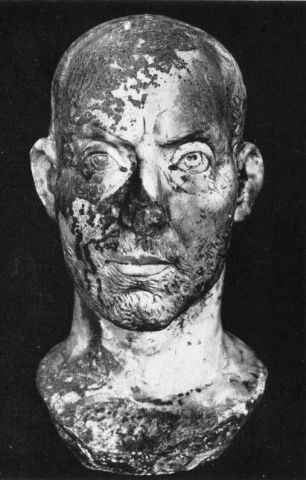
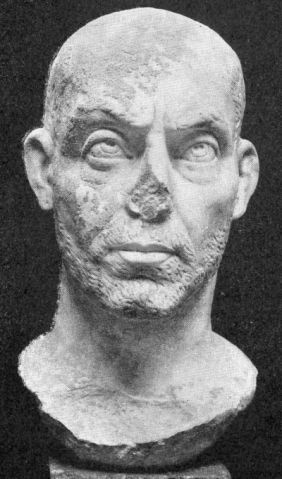
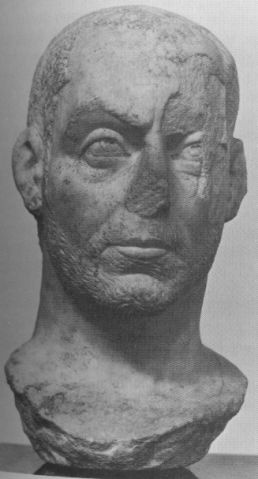
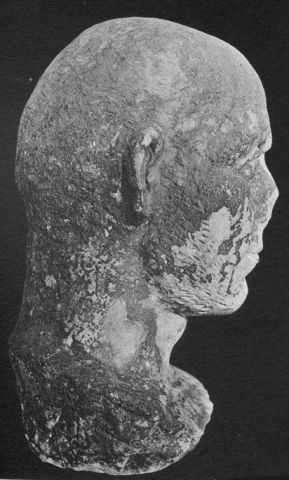
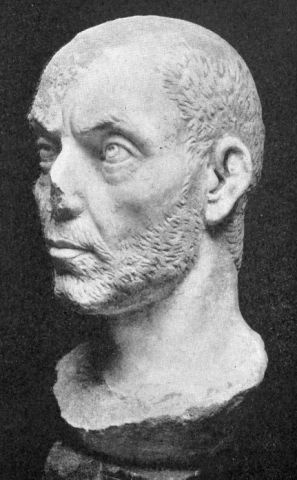
Portrait head for insertion of man with short hair and beard. From Italy. Late third to early fourth century.
Record details
Photographs
Bibliography
- Bieber, M. (ed.), Die antiken Skulpturen und Bronzen des Königl. Museum Fridericianum in Cassel , Marburg 1915, 34, no. 57, fig. 6 and pl. 31.
Discussion
DESCRIPTION (Object)
Over life-size head, worked separately. H: 38 cm. H (chin to crown): 27.5, W (ear to ear): 16.5 cm. White marble.
The tip of the nose and the right nostril have broken off. The left eye, eyebrow, and adjacent areas of the brow and cheek are damaged. This damage does not appear in the older photographs.
The head was worked with a socket for insertion into a statue, possibly a togate statue on account of the rounded front area of the chest. The head has been re-worked from an earlier portrait; the shape of the back of the head, the long hair on the nape, and the protrusion of the ears indicate this.
The hair, on the head and of the beard, moustache, and eyebrows, has been rendered with a flat chisel. The iris is indicated by a semi-circular engraved line, and the pupils are represented by two large adjacent drill points which form a 'bean' shape. The inner canthi are drilled.
PROVENANCE
The find location is unknown. The piece was, however, purchased from the Italian art market in 1913.
DESCRIPTION (Subject):
The head depicts a short-haired man with a tall balding brow. The receding hair is long, however, on the nape. He wears a short beard and moustache.
The face is long and narrow. The eyebrows have a high arch. The eyes are large with parallel wrinkles below them. The cheekbones project through the gaunt cheeks. The nose is hooked, and the naso-labial folds are marked. The mouth is full-lipped and bow-shaped. The rounded upper edge of the chin is well-defined under the lower lip.
DATE
The short hair and beard style of this portrait’s secondary and final use continued from the mid-third century through most of the fourth century. The large eyes and flaring eyebrows of this portrait can be found in imperial portraits from the Tetrarchy (see LSA-836) , through Constantine (see LSA-558)and his sons (see LSA-561), to the emperors of the Valentinian dynasty (see LSA-582). All scholars to date, however, have placed this head in the Tetrarchic period.
Discussion references
- Kaschnitz von Weinberg, G., Römische Bildnisse , Berlin 1965, 59, pl 36.1 (280s)
- L'Orange, H. P., Studien zur Geschichte des spätantiken Porträts, Oslo 1933, 36 (under Gallienus to Tetrarchy), 120, no. 43
- Stutzinger, D. (ed.), Spätantike und frühes Christentum. Ausstellung im Liebieghaus, Museum alter Plastik, Frankfurt am Main. 16. Dezember bis 11. März 1984, Frankfurt a.M. (1983), 406-7, no. 26 (Tetrarchic)
- Von Sydow, W., Zur Kunstgeschichte des spätantike Porträts im 4. Jahrhundert. n. Chr, Bonn 1969, 6, fn. 7 (shortly before first Tetrarchy)
Cite: Last Statues of Antiquity, LSA-887 (J. Lenaghan).