
LSA-889
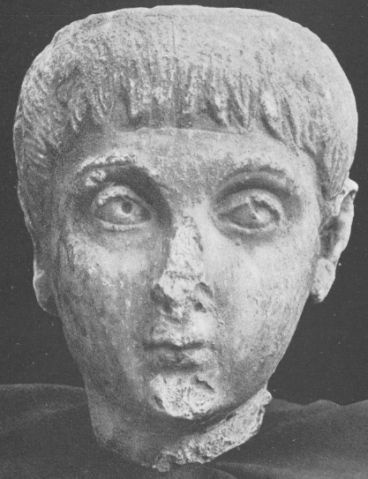
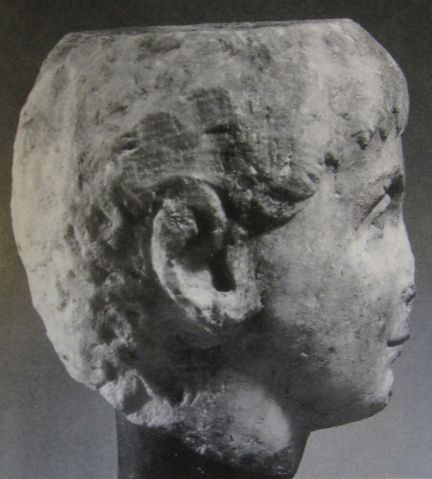
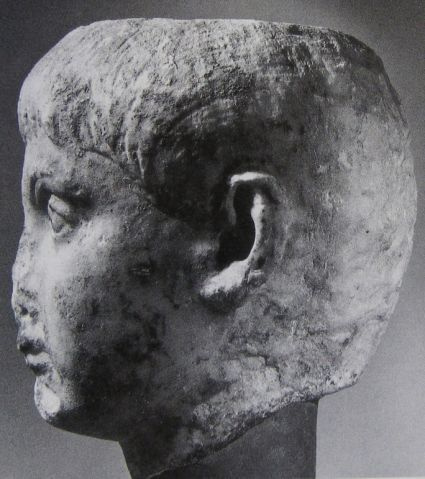
Portrait head of boy. From Italy. Fourth century.
Record details
Photographs
Bibliography
- Kiilerich, B.' A head of a boy in Oslo. Theodosius' grandson?' , Istanbuler Mitteilungen 40, Istanbul 1990, 201-206
- L'Orange, H. P., Studien zur Geschichte des spätantiken Porträts, Oslo 1933, 53, fig. 143 (early fourth century)
Discussion
DESCRIPTION (Object)
Life-size head. H: 18.7 cm. H (of head): 16.5, W (of face): 11 cm. Fine-grained white marble.
The head is broken off through the middle of the neck. The nose, chin, and an area of the back of the head are missing. The top of the head was separately worked. In the join surface is a central dowel hole and the outer edge has a 1 cm band of anathyrosis.
The head has been re-worked from another portrait. The back of the head shows longer hair, especially behind the right ear, that has been roughly worked down with a pick.Around the right ear and particularly below the lobe, there is a significant mass of marble, pertaining to an original larger portrait.. There are also distinctive chisel marks above the right ear. The left side of the back of the head seems to have been worked down more smoothly. The eyebrows have also been raised.
The pupils of the eyes are marked by a large, well-rounded hole made with a drill.
PROVENANCE
The find location is unknown. The head was, however, purchased in Italy in 1930.
DESCRIPTION (Subject)
The head portraits a boy between the ages of 5 and 12. He has straight hair that is combed forward. It falls to the middle of the brow. There it ends in short, separate spits between which small areas of the forehead appear.
The face is marked by large eyes with three-dimensionally rendered, high-arching eyebrows. The lower face tapers, though the left cheek is slightly fuller. The mouth is distinctly short from side to side. The lips are full and bow-shaped. The upper lip projects since the chin recedes slightly.
DATE
The combination of the hairstyle and the rendering of the eyes and arching eyebrows indicate a fourth century date at earliest. The fact that the head has been re-worked from an earlier portrait corroborates the dating to this century.
L'Orange in 1933 made reference to the portrait in a section in which he discussed late Tetrarchic works. Killerich uses dated comparanda, the Obelisk of Theodosius and the diptych of Stilicho, to argue that it is better placed in the Theodosian period.
IDENTIFICATION
Kiilerich suggests that this portrait head represents Eucherius, the son of Stilicho and Serena. It is reminiscent of the boy who appears on the Obelisk of Theodosius on the southeast panel in the imperial box to the proper right of the Emperor and is reminiscent of the boy in the Monza diptych of Stilicho and Serena. Whereas the identification is tempting, as Kiilerich herself acknowledges, young boys are difficult to distinguish and that the representation of age often only loosely concords with reality. Moreover, the identity of the child on the Obelisk of Theodosius is not clear. Thus, the head might represent Eucherius; it might represent Honorius; and it might, with lesser probability, represent an aristocratic child of the same era.
Cite: Last Statues of Antiquity, LSA-889.