
LSA-890
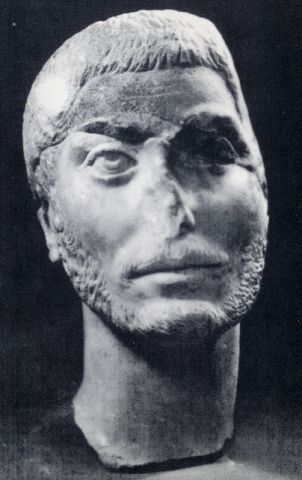
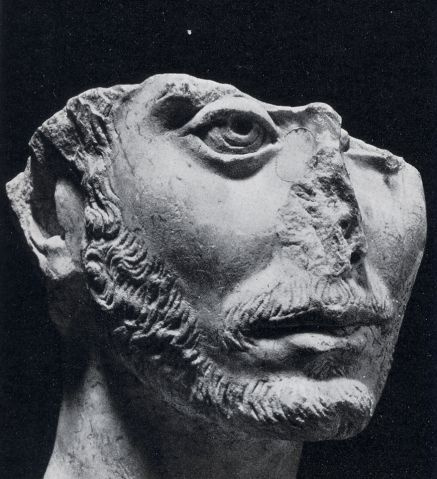
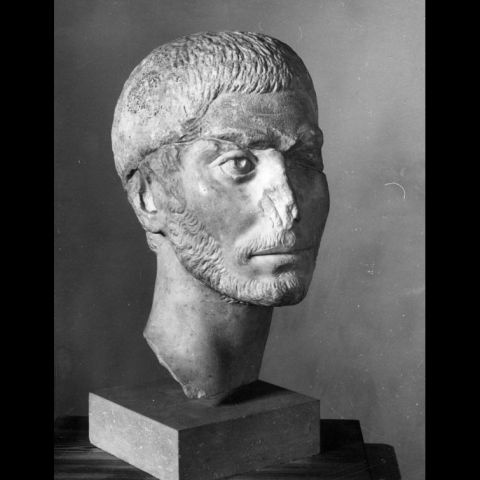
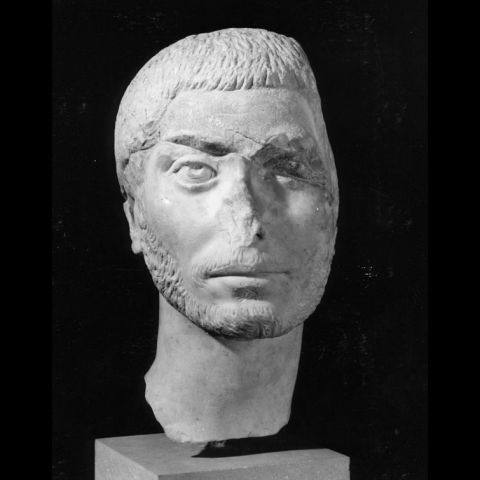
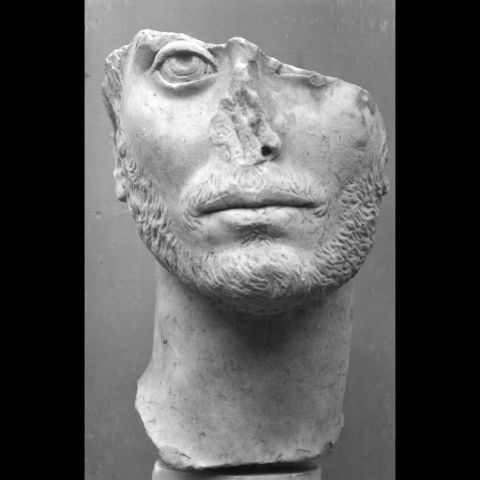
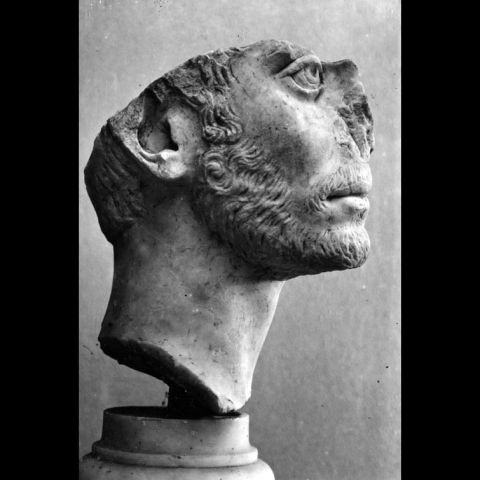
Portrait of man with short hair and light beard. Ostia. Late third century?
Record details
Photographs
Bibliography
- Soprintendenza alle antichità di Ostia, Museo Ostiense. Nuove Immissioni (Supplemento alla Guida), Ostia 1971, 27-8, pl. III.2 (Calza: 280-285)
Discussion
DESCRIPTION (Object)
Over life-size head. H (of lower fragment, from base of neck to eye): 22 cm. Fine-grained marble.
The head is preserved in two fragments: (1) the neck and head until the level of the eyes and (2) forehead and top of head. The head is broken around the base of the neck. Most of the nose and a portion of the proper left side of the head are missing.
The hair, on the head and of the beard, moustache, and eyebrows, has been rendered with a flat chisel. The fine workmanship of the facial hair contrasts to the roughened surface and repetitive strokes that constitute the hair. The irises are indicated by a semi-circular engraved lines, and the pupils are represented by a large, drilled-out hollow. An engraved line defines the inner canthi.
The portrait may have been re-cut from an earlier head. There seem to be traces of longer hair behind the right ear. Longer hair also may have originally touched the upper rim of the right ear.
PROVENANCE:
The upper part of the head was found in 1962 in the Baths of the Cisiari in a lime kiln. The find location of the lower half is unknown.
DESCRIPTION (Subject):
The head depicts a young man with short hair and a light beard of medium length. He turns to the proper right.
The hair is cut high across the forehead and then falls downwards at the temples. The beard on the cheeks is full and curls below the ear. It however is shorter and sparser in the area of the chin. There it is rendered in straight locks and covers only the lower edge of the mandible and chin. A few hairs even continue onto the neck. The moustache is also rendered with short locks which leave a space of exposed skin at the centre of the lip. There is separation between the sideburn and the beard and between the moustache and the beard. A small and separate tuft of hair is rendered under the lower lip.
The face is distinctive and fine. The brow slopes forward and has a single light horizontal line. The eyes are large, and the cheekbones project strongly. The nose was hooked. The mouth is broad with full lips. The chin is short and projecting. The neck is long and without anatomical detail.
DATE
The technical detail of the large eyes with the emphatic round pupils and the fashion detail of a three-dimensional beard that touches the neck in conjunction with a short hairstyle have led scholars to give this a date in the later third century. L’Orange puts it between Gallienic and Tetrarchic; Calza compares it to the so-called Carinus in the Capitoline and dates it to 280-285.
The Ostia web site, which suggests that a fifth-century date might also be possible, is unsupported. An earlier date in the third century, for example c. 235, however, should not be excluded.
Discussion references
- L'Orange, H. P., Studien zur Geschichte des spätantiken Porträts, Oslo 1933, 36 (under Gallienus to Tetrarchy), 122, no. 49, fig. 94
Cite: Last Statues of Antiquity, LSA-890 (J. Lenaghan).