
LSA-892
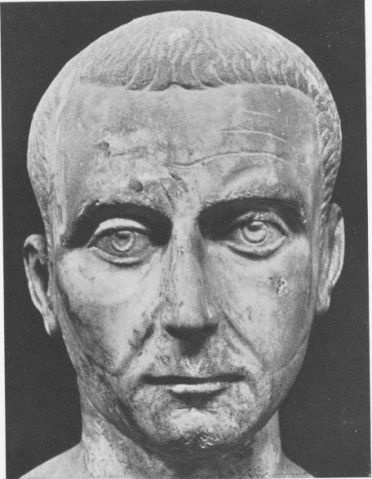
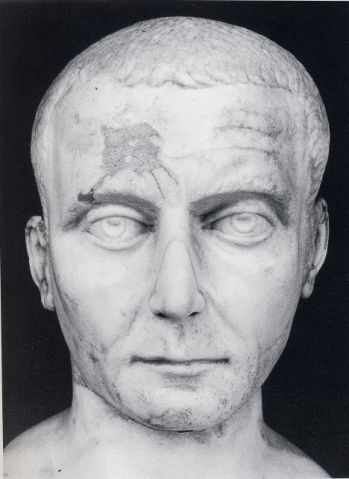
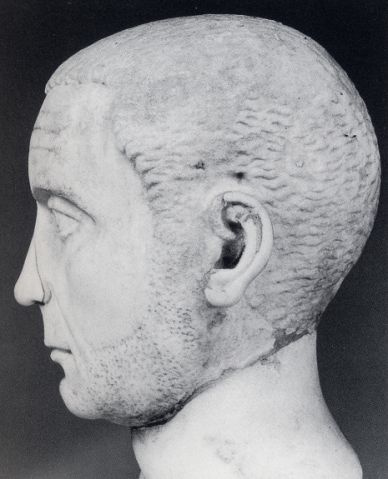
Life-size portrait head of man with short hair and stubble beard. From Italy. Late third to early fourth century.
Record details
Photographs
Bibliography
- Andreae, B. et al. , Museo Chiaramonti III. Bildkatalog der Skulpturen des Vatikanischen Museums, vol. I, Berlin 1995, 97, pl. 1003, no. 574a (late Severan head re-cut)
Discussion
DESCRIPTION (Object)
Life-size head. H: 21 cm. Marble
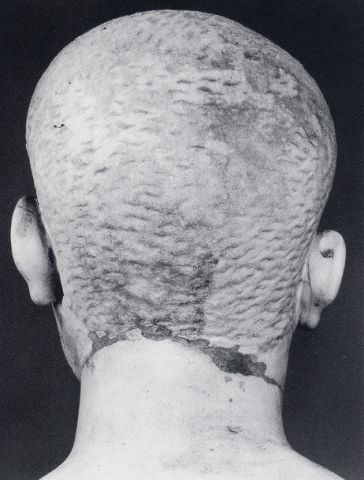
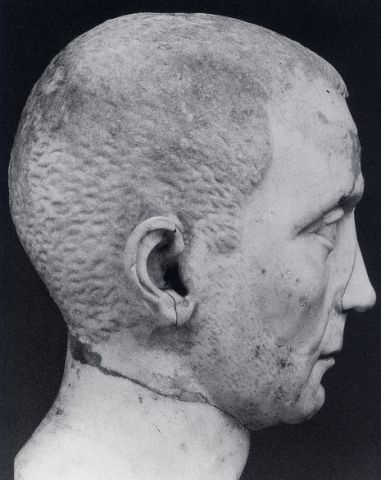
The head is cut from under the juncture of the chin and neck diagonally upwards to the hairline at the nape of the neck. This diagonal cut is part of the modern restoration; it has been carefully set on a modern bust and neck. The nose and most of the ears are also restoration.
The hair has been rendered by short, parallel, and horizontal strokes of a thick flat chisel. This represents a working down of an original hairstyle whose short but fuller locks can be seen above the nose and at the left temple. A stubble beard has been scored into the face by short strokes of a small point chisel. The irises are an engraved almost semi-circular line of a flat chisel. The pupils are marked by deep full crescent-shape engravings.
PROVENANCE
Previously in the 'Guardaroba Vaticana'. It appears in the inventory of 1808 and was probably restored in 1823 by Michele Ilari.
DESCRIPTION (Subject):
The head depicts a middle-aged man with short hair and a stubble beard. He turns to the proper right.
The hair is cut high across the forehead and is brushed forward above the ears. The hair of the fringe recedes above the right temple, and the central part of the fringe comes forward. The locks part above the right side of the root of the nose. The perimeter line of the cheek side of the beard is continuous and engraved. The moustache is barely visible in the photographs.
The tall brow is marked by three curving, parallel creases. The ridge of the eyebrows has been given coarse hair. The cheeks are slim, and the naso-labial folds are indicated. The mouth is broad and has a thin upper lip. The lower lip rolls out above a short rounded chin. There is loose skin beneath the chin.
DATE
The stubble beard and short hair of the extant portrait are fashion traits that begin in the mid-third century and continue into the fourth century. Here the continuous line that separates the beard from the cheek and the indication of stubble with the point of a chisel are characteristics of portraits from the Tetrarchic period. The combination of this technique and the short locks over the brow can be seen in the confidently dated portraits of two Tetrarchs from Alba Fucens (LSA-1045 and LSA-1046) and in the portraits which probably represent Maxentius (see (LSA-895 and LSA-896).
In the latest catalogue of the Chiaramonti collection, the first portrait use of the head is ascribed to the Severan period.
Discussion references
- L'Orange, H. P., Studien zur Geschichte des spätantiken Porträts, Oslo 1933, 36 (under Gallienus to Tetrarchy), 123, no. 51, fig. 97
- Sydow, W. von, Zur Kunstgeschichte des spätantike Porträts im 4. Jahrhundert. n. Chr, Bonn 1969, 7-8 (accepts L'Orange)
Cite: Last Statues of Antiquity, LSA-892 (J. Lenaghan).