
LSA-894
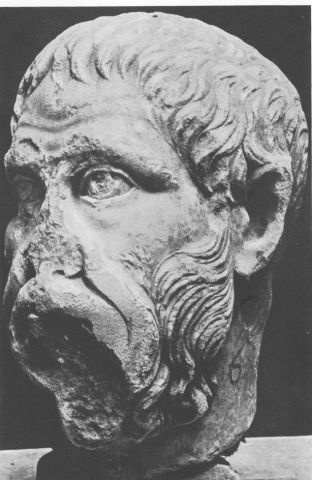
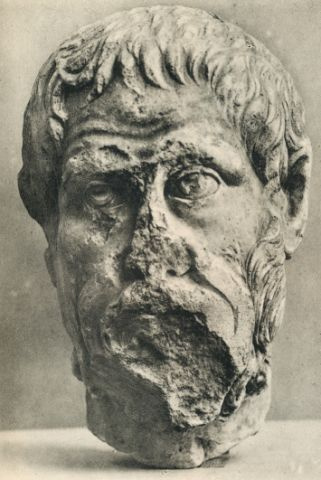
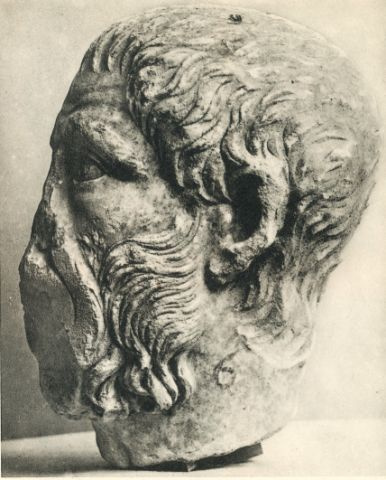
Portrait head of man with long beard in 'Iamblichus-type'. From Italy. Fourth century.
Record details
Photographs
Bibliography
- Kaschnitz von Weinberg, G., Sculture del magazzino del Museo Vaticano, Vatican City 1937, 282-3, no. 679, pl. 106
- L'Orange, H. P., Studien zur Geschichte des spätantiken Porträts, Oslo 1933, p. 40 no. 9, pp. 42-3, 125 cat. no. 61 fig. 115
Discussion
DESCRIPTION (Object)
Over life-size head. H: 30 cm. Medium-grained 'Greek' marble.
The head has broken at the neck around a round dowel hole. The lower lip, the chin and beard attached to it, the nose are missing.
The long hair of the head, beard, and moustache is well-rendered with flat chisels of different sizes. The irises are engraved and larger than semi-circular. The pupils are marked by full crescent-shape engravings.
PROVENANCE
In the storerooms of the Vatican. The head presumably came from Rome or its environs.
DESCRIPTION (Subject):
The head follows a type which is known in c. 10 copies and is called the ‘Iamblichus’ type by modern scholarship. The other versions of the type are: LSA-79, LSA-110, LSA-111, LSA-112, LSA-113, LSA-114, LSA-115, LSA-116, and LSA-2292 .
The portrait shows a man who turns to his right. He has long unkempt and straggly hair that mainly comes forward. It parts over the centre of the brow. The beard is also long and comes down the cheek in curling sweep of hair which builds in volume below the mandible. The thick moustache continues well beyond the corners of the mouth.
The tall brow is carefully modelled and has curving creases. The eyebrows are shaggy and protruding. The eyes are large, and the cheekbones prominent.
DATE
The eye-markings, the stylized crescent-shaped pupils, are not possible before the later third century. They become a standard mode in the later fourth century; see, for example, the portraits of the Valentinian emperors LSA-580, LSA-581, and LSA-582. L’Orange placed this head among what he considered to be the later versions of the type in early fourth century.
HONORAND
The widespread diffusion of the portrait type, and the places where it has been found, suggest that the man commemorated was indeed a man of culture. Nine of the ten come from the heart of the Greek world (Athens-4, Corinth, Delphi-2, Eleusis, Epidaurus), and one comes from Rome. All are at earliest later third century in date. Finally, the portrait has an unkempt beard and tall brow --usually with concentric creases that dip over the nose. All of these facts combine to indicate that the honorand was a much-admired man of traditional Greek values, and one with cultural aspirations.
L’Orange identified the man as the Syrian Iamblichus (c. 245–c. 325). E. Harrison suggested Publius Herennius Dexippus, a historian whose role against the Herulians earned him great patriotic Greek favour (PLRE I, 250-251, Publius Herennius DEXIPPUS 2). As L’Orange, I too believe that he must have been an important intellectual of the later third century and one with a more enduring and more widespread importance than Herennius Dexippus. At least four of the portraits (LSA-79, LSA-111, LSA-114, and LSA-115) show technical details that suggest a date at the very end of the third century, if not later, and this one was found in Rome.
Discussion references
- Harrison, E. B., Portrait Sculpture: The Athenian Agora I, Princeton, N. J. 1953, 101-104, no. 10
- L'Orange, H. P., Studien zur Geschichte des spätantiken Porträts, Oslo 1933, 40, no. 61, fig. 115 (early fourth)
Cite: Last Statues of Antiquity, LSA-894 (J. Lenaghan).