
LSA-895
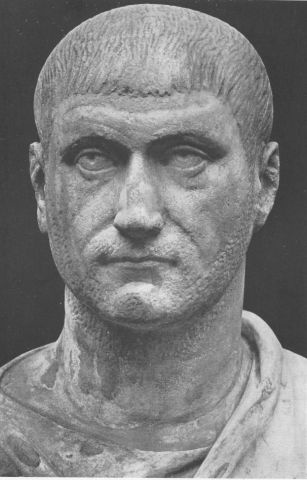
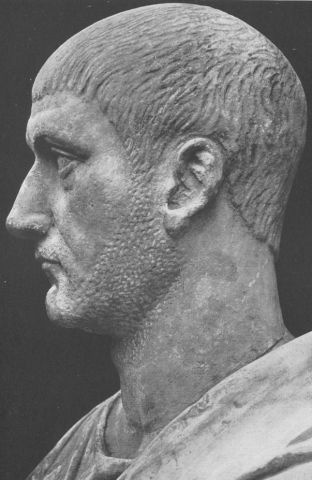
Portrait of Maxentius in variation of 'Dresden-Stockholm' type. From Italy. Early fourth century.
Record details
Photographs
Bibliography
- Evers, C. 'Betrachtungen zur Ikonographie des Maxentius' , Niederdeutsche Beiträge zur Kunstgeschichte 31, Munich 1992, 9-13 (not typologically correct)
- Visconti, P.E., Catalogo del Museo Torlonia di sculture antiche, Rome 1880, 227, no. 508
Discussion
DESCRIPTION (Object)
Over life-size head. H: 36 cm. Marble.
The head appears to be broken through the neck and set on a bust.
The hair is engraved with a flat chisel, and a light beard has been carefully engraved with a rounded tip of a chisel. The irises seem finely engraved, and the pupils are drilled holes.
PROVENANCE
From the Vitali collection.
DESCRIPTION (Subject)
The head shows a young man with straight hair that is combed forward and a light beard. The hair over the centre of the brow falls lower than that at the sides and its ends turn in in different directions with two small parts over the inner corner of each eye.
The low brow has a horizontal crease. The eyes are hooded by arching brows. The cheekbones are broadly spaced, and the cheeks fleshy. There are naso-labial folds The mouth is broad but thin-lipped. The upper edge of a round projecting chin is defined by a curving line beneath the lower lip. The beard covers the cheeks and continues on to the neck; the moustache covers the upper lip. Both are light.
DATE AND HONORAND
This portrait is over life-size and relates closely to a type (Dresden-Stockholm) known in three replicas: LSA-896, LSA-897, and LSA-2662. The size and number of replicas indicate that that type represented an imperial figure. Moreover, the type corresponds to portrait images of Maxentius.
The Torlonia head, just as the others, is over life-size, from Italy, and wears no headgear. Recently Evers (p.12), however, has considered it to vary too greatly from the others to be considered of the same type. This position seems to me to be unnecessarily typological. All of the portraits of this type were probably re-cut from other heads, and thus a certain amount of variation should be expected. This head bears the same physiognomy (albeit with lines of maturity added) and shares the exact same shape of the hair, moustache, and beard. It is probably better to consider it a variation of the type.
Discussion references
- Calza, R., Iconografia Romana Imperiale. Da Carausio a Giuliano (287-363 d. C.), Rome 1972, 257-8, no. 174, pl. 90, 318 (Delmatius)
- L'Orange, H. P., Das spätantike Herrscherbild von Diokletian bis zu den Konstantin-Söhnen, 284-361 n. Chr. Das Römische Herrscherbild. III. Abteilung ; Bd. 4 , Berlin 1984, 115, pl. 26 (Maxentius)
- L'Orange, H. P., Studien zur Geschichte des spätantiken Porträts, Oslo 1933, 52, 105 (Maxentius), 129, no. 70, figs. 137-8
Cite: Last Statues of Antiquity, LSA-895 (J. Lenaghan).