
LSA-896
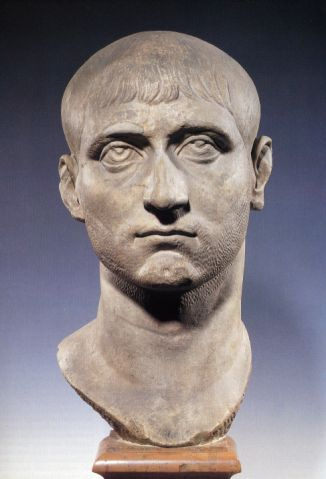
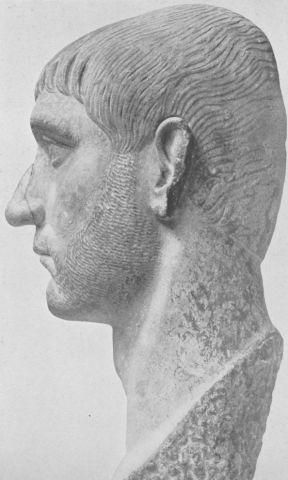
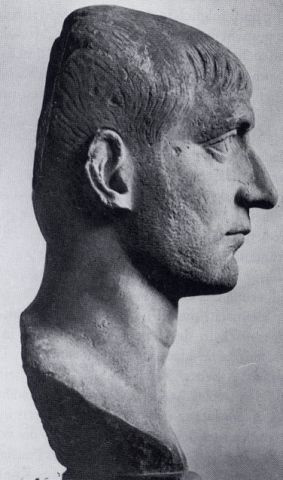
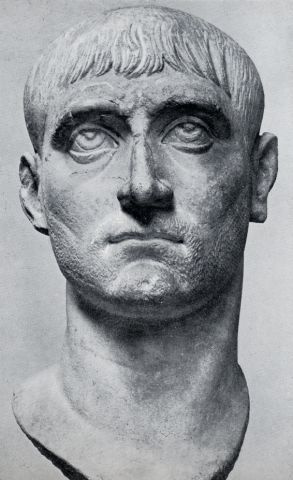
Colossal portrait of Maxentius in 'Dresden-Stockholm' type. From Italy. Early fourth century.
Record details
Photographs
Bibliography
- Demandt, A. and J. Engemann, (eds.), Konstantin der Grosse, Mainz 2007
, no. I.7.5 (F. Sinn) - Protzmann, H. (ed) et al., Die Antiken im Albertinum. Staatliche Kunstsammlungen Dresden, Skulpturensammlung., Mainz1993, 66-7, no. 36
Discussion
DESCRIPTION (Object)
Colossal head, worked separately. H: 61 cm, H (chin to hairline): 26 cm. Marble.
The head, which was worked separately, is missing a small area at the back right (which it may never even have had due to a marble problem). The nose has been restored.
The hair is engraved with a flat chisel. A light beard has been carefully engraved with a fine chisel used systematically. The irises are finely engraved, and the pupils are drilled in a deep U-shape. The tenon is well-preserved and roughly picked on the underside.
The workmanship of the hair at the top of the head and the lack of volume at the top of the head suggest that the head has been re-carved from an earlier portrait. It is however well-executed.
PROVENANCE
Originally in the collection of Bellori. In 1698 it was sold and between 1722 and 1726 it was purchased in Berlin.
DESCRIPTION (Subject)
The head shows a young man with straight hair that is combed forward and a light beard. The hair follows a particular pattern over the brow. There is a parting over the inner corner of the left eye; a section of hair above the nose that is longer than the rest and turns to the proper right; and two small partings over the right eye. The hair falls low on the brow.
The face has a ‘Julio-Claudian’ structure with a horizontal brow and widely-spaced cheekbones. The eyes are large with some modelling beneath them. The mouth is broad but thin-lipped. The upper edge of a round projecting chin is defined by a curving line beneath the lower lip. The beard, a slightly raised surface, covers the cheeks and continues on to the neck; the moustache covers the upper lip. Both are light.
The head turns to the right. More of the right shoulder is included with the head than of the left shoulder. On the left side, the area of insertion is vertical.
DATE AND HONORAND
This portrait is well over life-size and known in three other replicas or variants: LSA-895, LSA-897, and LSA-2662. The size and number of replicas indicate that this represented an imperial figure. All of the extant versions of the type are from Italy, and none wear a crown or diadem. Numismatic evidence makes it clear that the honorand was Maxentius. It should date between 306 when he was proclaimed Emperor (at c. 27 years of age) and 312 when he lost to Constantine at the Milvian bridge.
STATUE TYPE
The shape of the neck for insertion indicates that the head was made for a togate statue. Even though the head has probably been re-used, there is a strong possibility that it was set on a togate statue. The cut at the back of the head might even have been hidden by a capite velato.
Discussion references
- Calza, R., Iconografia Romana Imperiale. Da Carausio a Giuliano (287-363 d. C.), Rome 1972, 196, no. 114
- Evers, C. 'Betrachtungen zur Ikonographie des Maxentius' , Niederdeutsche Beiträge zur Kunstgeschicte 31, Munich 1992, 9-22, figs. 2, 8, 14.
- L'Orange, H. P., Das spätantike Herrscherbild von Diokletian bis zu den Konstantin-Söhnen, 284-361 n. Chr. Das Römische Herrscherbild. III. Abteilung ; Bd. 4 , Berlin 1984, 114, pl. 27a-b (Maxentius)
- L'Orange, H. P., Studien zur Geschichte des spätantiken Porträts, Oslo 1933, 52, 105 (Maxentius), 129 no. 71, figs. 139-40
Cite: Last Statues of Antiquity, LSA-896 (J. Lenaghan).