
LSA-897
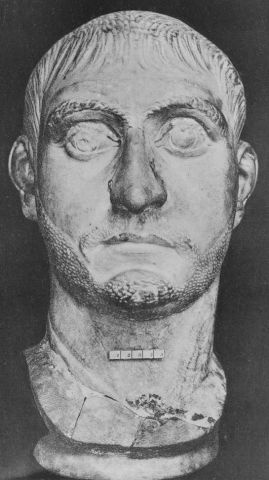
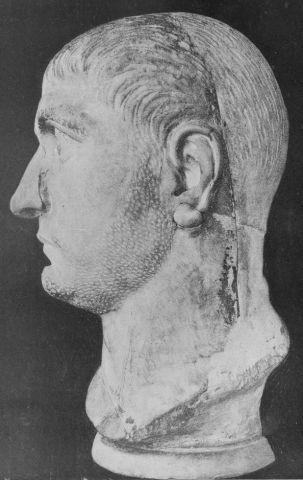
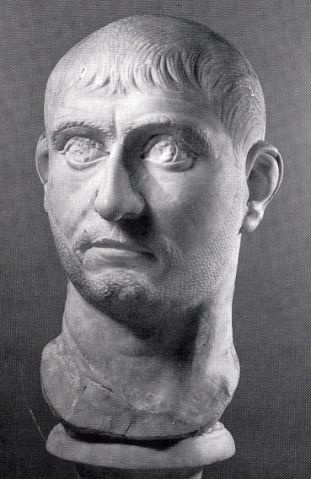
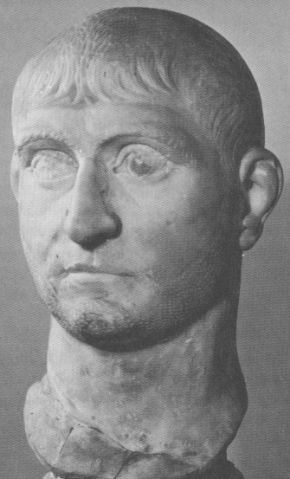
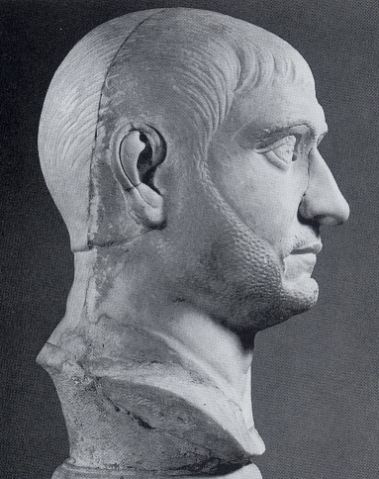
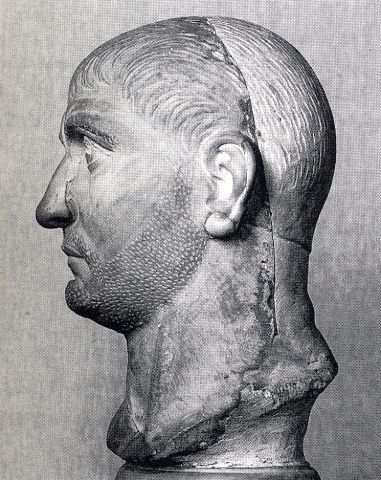
Portrait of Maxentius in 'Dresden-Stockholm' type. From Italy. Early fourth century.
Record details
Photographs
Bibliography
- Brising, H., Antik konst i Nationalmuseum , Stockholm 1911, 131, no. 106, pl. 57
- Evers, C. 'Betrachtungen zur Ikonographie des Maxentius' , Niederdeutsche Beiträge zur Kunstgeschichte 31, Munich 1992, 9-22, figs. 6, 10, 13
Discussion
DESCRIPTION (Object)
Over life-size head, worked separately. H: 40 cm. Marble.
The back of the head, the right edge of the chest, most of the ears, and the nose have been restored. The eyeballs are damaged, perhaps deliberately.
The hair is engraved with a flat chisel. A light beard has been carefully engraved with the round tip of a chisel on a raised surface. The irises are finely engraved, and the pupils are now illegible. The inner canthi are defined by rounded drill points
The lack of volume at the top of the hair and the flatness of the hair suggest that the head has been re-carved from an earlier portrait.
PROVENANCE
From the Barberini collection.
DESCRIPTION (Subject)
The head shows a young man who turns to his right. He has straight hair that is combed forward and a light beard and moustache. The hair falls low on the brow and curves to each side. Above the nose the hair is longer than that elsewhere on the brow. There is a small parting over the inner corner of the left eye, and the locks over the right eye are slightly more separated.
The face has large eyes with rope-like and arching eyebrows. The cheekbones are widely-spaced, and the mouth is broad. The upper edge of a round projecting chin is defined by a curving line beneath the lower lip. The beard covers the cheeks and continues on to the neck; the moustache covers the upper lip. Both are light.
DATE AND HONORAND
This portrait is over life-size and known in three other replicas or variants, one of which is colossal: LSA-895, LSA-896, and LSA-2662. The size and number of replicas indicate that the type represented an imperial figure. All of the extant versions of the type are from Italy, and none wear a crown or diadem. Numismatic evidence makes it clear that the honorand was Maxentius. It should date between 306 when he was proclaimed Emperor (at c. 27 years of age) and 312 when he lost to Constantine at the Milvian bridge.
Stylistically C. Evers notes that this head has much in common with the so-called portrait of Fausta LSA-573. They do certainly seem to have a workshop connection.
Discussion references
- Calza, R., Iconografia Romana Imperiale. Da Carausio a Giuliano (287-363 d. C.), Rome 1972, 157-6, no. 69, pl. 47, 140-41
- Demandt, A. and J. Engemann, (eds.), Konstantin der Grosse, Mainz 2007
, no. I.7.4 (A.M. Leander Touati) - L'Orange, H. P., Das spätantike Herrscherbild von Diokletian bis zu den Konstantin-Söhnen, 284-361 n. Chr. Das Römische Herrscherbild. III. Abteilung ; Bd. 4 , Berlin 1984, 115-16, pl. 27c-d (Maxentius)
- L'Orange, H. P., Studien zur Geschichte des spätantiken Porträts, Oslo 1933, 52, 105 (Maxentius), 129-30, no. 72
- Stutzinger, D. (ed.), Spätantike und frühes Christentum. Ausstellung im Liebieghaus, Museum alter Plastik, Frankfurt am Main. 16. Dezember bis 11. März 1984, Frankfurt a.M. (1983), no. 35
Cite: Last Statues of Antiquity, LSA-897 (J. Lenaghan).