
LSA-898
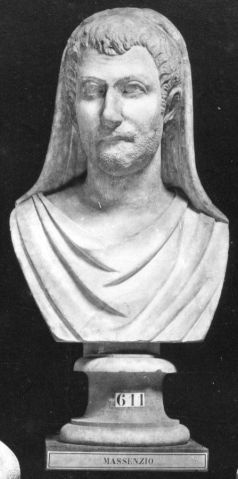
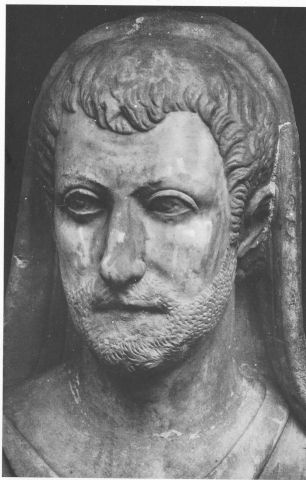
Colossal portrait of man in toga. Rome (Circus of Maxentius). Late third to early fourth century.
Record details
Photographs
Bibliography
- Visconti, P.E., Catalogo del Museo Torlonia di sculture antiche, Rome 1880, 231, no. 521
Discussion
DESCRIPTION (Object)
Colossal head on modern bust. H: 95 cm. Marble.
The head is broken through the neck and mounted on a modern bust. The lower part of the neck, the drapery on both sides of the head until above the ears, the nose, most of the chin, and probably the upper lip are restored.
The hair of the fringe has been rendered in short locks made of three to four strands; this has been done with flat chisels of different sizes. Above the fringe the hair around the ears seems to be schematically indicated with short strokes of the same chisel. Above the brow, the hair has not been indicated. A stubble beard has been scored into a raised surface on the face with a small chisel; the longer locks on the chin appear to be part of a restoration. Modern cleaning has obscured the eye markings. The irises were engraved with a flat chisel. The pupils were small and crescent-shaped.
PROVENANCE
The head was supposedly found in the Circus of Maxentius.
DESCRIPTION (Subject):
The head depicts a man with short, brushed-forward hair and a stubble beard. He turns to the proper right and wears a toga pulled over his head.
The hair forms a thick cap which is well-defined around the face. It recedes at the corners of the brow, and the central area of the fringe comes forward with the locks turning to the proper left. The thick sideburns descend into a stubble beard ; the moustache is similarly rendered.
The face is long with a slightly creased brow. The cheekbones protrude, and the naso-labial folds are indicated. The chin is deep. The tall brow is marked by three curving, parallel creases. The ridge of the eyebrows has been given coarse hair.
DATE
The stubble beard and short hair of the extant portrait are fashion traits that begin in the mid-third century and continue into the fourth century. Here the stubble beard on a surface separate from the cheek and the short locks over the brow recall portraits on the tondi of the Arch of Constantine and the portraits which probably represent Maxentius; see LSA-895 and LSA-896.
COMMENT
The head originally belonged to a traditional togate statue. This was the preferred mode of dress for the fourth century. LSA-852 provides an example of a portrait with its head capite velato.
Discussion references
- L'Orange, H. P., Studien zur Geschichte des spätantiken Porträts, Oslo 1933, 53-4, 130, no. 73, fig. 141
Cite: Last Statues of Antiquity, LSA-898 (J. Lenaghan).