
LSA-899
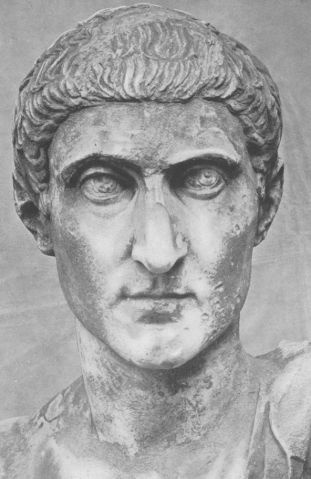
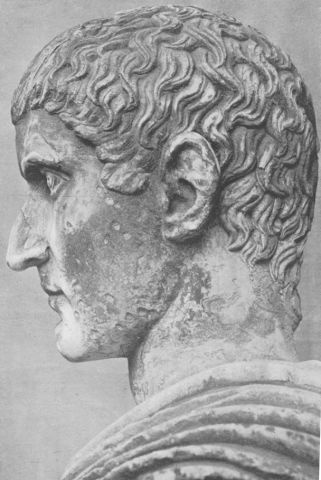
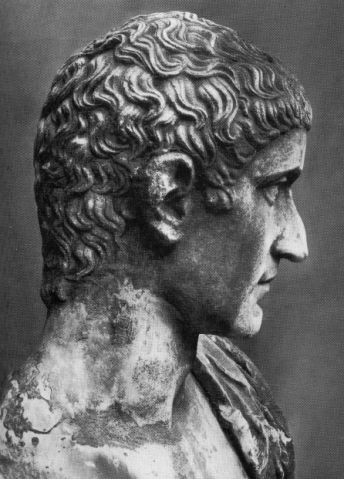
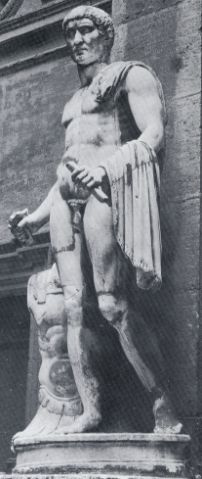
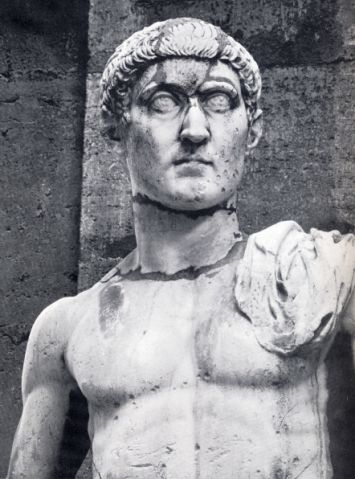
Over life-size portrait head of Constantine. Rome? Early fourth century.
Record details
Photographs
Bibliography
- Guerrini, L. (ed.), Palazzo Mattei di Giove : le antichità, Rome 1982, 147-8, no. 21, pls. 38 and 42 (F. Carinci)
- Guerrini, L. (ed.), Sculture di Palazzo Mattei, Rome 1972, 26-7, no. 5, 32, pls. 36, 37, and40 a-c (F. Carinci)
Discussion
DESCRIPTION (Object)
Over life-size head H: 36 cm. Fine-grained white marble.
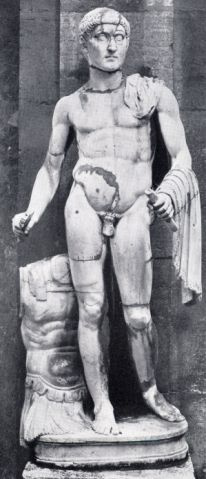
The head has been set on ancient statue to which it never belonged in antiquity. The ancient head is cut at the top of the neck directly under the chin and fitted onto a neck which in turn is fitted to the statue. The central part of the forehead and fringe, the nose, part of the right eyebrow, and all of the left eyebrow are restoration.
The portrait has been re-worked from an earlier head. The hair scheme of the top, sides, and back of the head belong to the head of an ideal youth. Only the sideburns and hair of the fringe have been altered.
The hair of the head is finely worked with a series of chisels of different sizes. The irises, have been marked twice; both times they are three-quarters of a circle and engraved with a flat chisel. The second marking was probably done by the restorer to minimize the new left turn of the head on its new statue (see Carinci 1972). The pupils are drilled out in a U-shape.
PROVENANCE
The statue, already restored and referred to as Tiberius, was acquired in 1607 by Asdrubale Mattei from an orphanage. It was then in pieces; he gave it to Pompeo Ferrucci to restore.
DESCRIPTION (Subject)
The over life-size head (too large for the statue on which it is mounted) represents Constantine the Great; he is shown as a beardless youthful man with large eyes and medium-length hair.
He has a broad brow, widely-spaced cheekbones, and a square, strong jaw-line which terminates in a projecting chin. The cheeks are pulled tightly around this skeletal structure, and the mouth is full-lipped but short from side to side. It has small creases at the corners.
The hair is full and curly. At the top and sides it falls in overlapping S-curls that reach low down the nape of the neck. The fringe and the sideburns are of medium length and are combed forward (in contrast to all of the other locks of the head). The extant locks of the ancient part of the fringe (those on sides) turn inwards.
DATE
The head certainly represents Constantine and follows the same model as the colossal Constantine from the Basilica Maxentius, LSA-558. It is known in c. 15 versions, and the model may correspond to an image created for Constantine’s quinquennalia since the type appears on coins first in 310. Similar portraits, all likely to have come from the area of Rome, include a head in the Conservatori (LSA-596), another in the Prado (LSA-599), and one from Frascati LSA-834). All of these have been, as this one, re-worked from earlier heads. They all have the same organization of the fringe and the same strong bone structure.
Discussion references
- Calza, R., Iconografia Romana Imperiale. Da Carausio a Giuliano (287-363 d. C.), Rome 1972, 227, no. 149, pl. 78, 273-4 (Constantine)
- Fittschen, K. and P. Zanker, Katalog der Porträts in den Capitolischen Museen und den anderen kommunalen Sammlungen der Stadt Rom, Band I, Mainz 1985, (2)1994, 150, no. A 6 (Zanker: essential example of main type)
- L'Orange, H. P., Das spätantike Herrscherbild von Diokletian bis zu den Konstantin-Söhnen, 284-361 n. Chr. Das Römische Herrscherbild. III. Abteilung ; Bd. 4 , Berlin 1984, 126-7, pl. 39a-b (youthful portrait of Constantine)
- L'Orange, H. P., Studien zur Geschichte des spätantiken Porträts, Oslo 1933, 55, 131, no. 75, figs. 146-7 (Constantine)
- Von Sydow, W., Zur Kunstgeschichte des spätantike Porträts im 4. Jahrhundert. n. Chr, Bonn 1969, 22 and 27
Cite: Last Statues of Antiquity, LSA-899 (J. Lenaghan).