
LSA-90
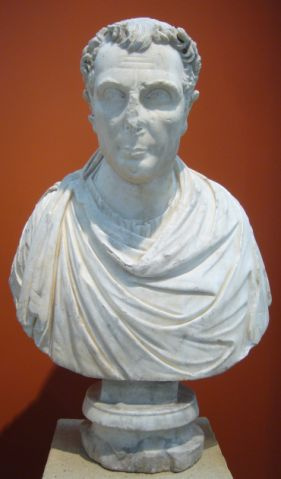
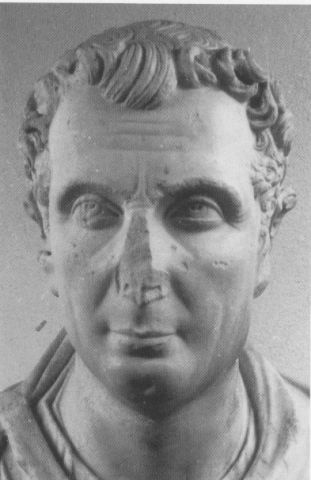
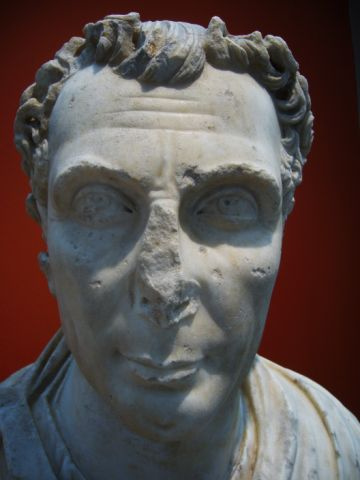
Bust of man wearing chlamys. From modern village of Naoussa (Macedonia). Early fifth century.
Record details
Photographs
Bibliography
- Despinēs, G, Stephanidou Tiveriou, Th, and Voutyras, E., Katalogos glyptōn tou Archaiologikou Mouseiou Thessalonikēs I-III, Thessaloniki 1997-2010, III, 192-95, no. 522
- L'Orange, H. P., 'Der subtile Stil. Eine Kunstströmung aus der Zeit um 400 n. Chr.', Antike Kunst , 4 (1961) 68-75, 68 ssq. pl. 27 1, 3
- Rüsch, A., Das kaiserzeitliche Porträt in Makedonien, Jahrbuch des Deutschen Archäologischen Instituts 84, 1969, 59-196, p. 131 no. P37 fig. 46-7
Discussion
DESCRIPTION (Object)
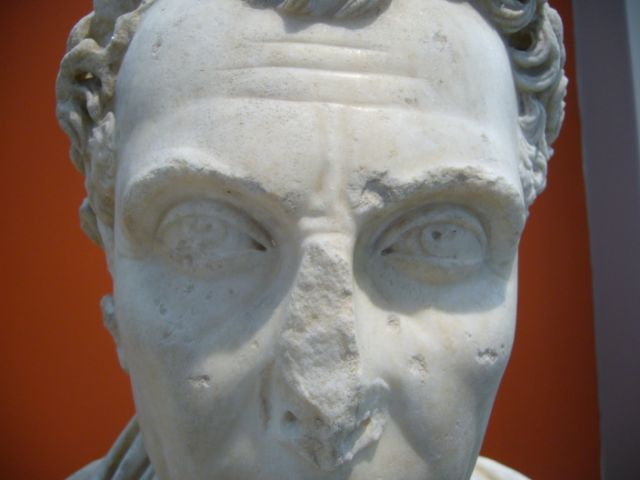
The bust is of fine grained marble, probably pentelic (L’Orange 1961); H (total) 72, (without foot) 58.5 cm. The footing is worked separately but is apparently contemporary with the bust (L’Orange 1961, 68). The nose, earlaps, the eyebrows, the hair above the right temple, and the mouldings of the foot are chipped, and there are minor chips scattered on the surface of head and garment. The fibula that holds the cloak on the right shoulder was separately worked – probably in metal, as indicated by a small pin hole - and is now missing.
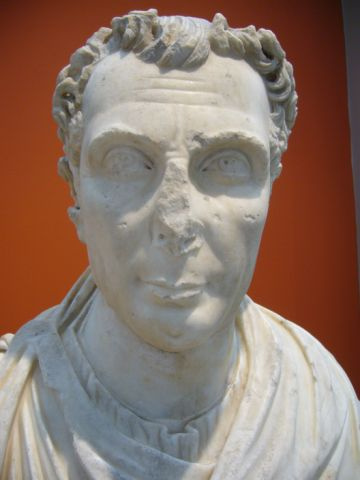
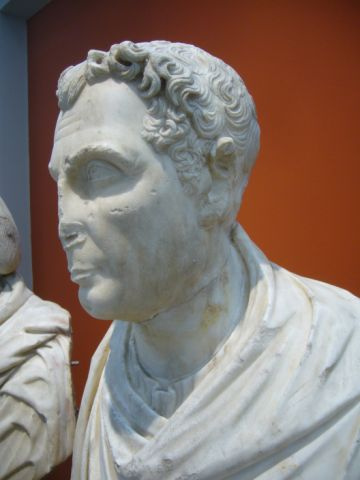
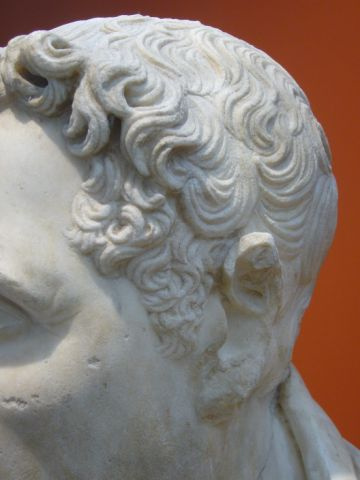
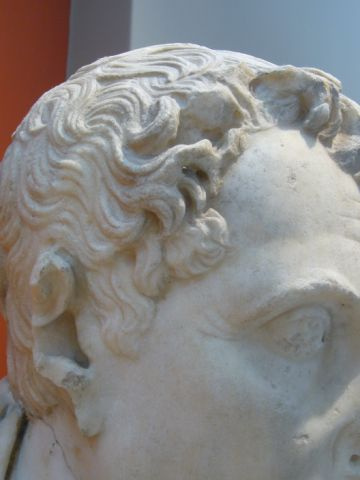
The hair is arranged into vividly moved curly compartments. On the skull and in front of the temples it is articulated by chisel work, but above the brow it is loosened up by extensive drill work. The chromatic appearance of the hair makes a striking contrast against the highly polished flesh.
The eyebrows form high regular arches; the orbital is separated from the upper lid by a drill line that parallels the arch of the brows. The iris is circumscribed by an incised circular line; the pupils are drilled into a pelta shape.
A system of three horizontal and two short vertical folds is incised on the brow. Cheeks, mouth and chin are vividly and smoothly modeled with only few short but sharp inscriptions (e. g. in the corners of the mouth). On the chin there is a dimple, slightly out centered. The left side of the face is broader than the right side; this is a result of the head’s slight turn to the right (see also below, ‘Description (Subject)’).The lower face gives the impression of a vivid realism to which the wide opened eyes with their concentric linear system form a marked contrast. The dimple at the chin, the fleshy cheeks and the double chin, and the arrangement of the curly hair in front of the ears and above the brow are some of the elements which make this head an artfully individualized portrait.
The garment is characterized by vivid folds; numerous gradations in their plastic values are accompanied by narrow but sharp cut shadow lines. The material of the colobium, visible at the front neck, is plastically clearly distinguished from that of the cloak.
PROVENANCE AND CURRENT LOCATION
The head, together with its female counterpart LSA-91 was brought into Thessaloniki from the village of Naoussa, north of Mt. Olympus between Edessa and Veria (Beroia). It is today in the Thessaloniki Archaeological Museum, inv. no. 1061.
DESCRIPTON (Subject)
The portrayed is a man of mature age as indicated by the wrinkles around his eyes, the fleshy flabby cheeks and double chin, and by the receding hairline at the temples. He is clean shaven; his hair is arranged with diligence. It is short on the skull but puffed up into a bulge around the forehead. At the temples the hairline is receding; four lank strands, slightly bending to the right, are brushed into the centre of the brow. In front of the temples the hair twists into compartments of irregularly falling small curls. The eyes are wide open; the lips are smiling; the dimple in the full fleshy chin is a further element to individualize the portrayed (see also above, ‘Description (Object)’).
The man is dressed in a chlamys that was held by a fibula at the right shoulder. At the front neck a richly crimped tunic, the colobium, is visible, and at the right neck, the seam of a second, lower tunic (tunica manicata) shines up. This is the dress of officials of the late antique imperial administration (militia inermis). Our man was probably a high ranking state official, a provincial governor, vicar, or praetorian prefect (see also below, ‘Further Discussion’).
DATE
The hairstyle with the small yet notable coil above the temples is similar to coiffure types displayed by high ranking officials on the reliefs of the obelisk base in Thessaloniki. The accentuated hair around the face is also observable on portraits of high ranking state officials on sarcophagi of the late 4th century, contemporary with the reliefs of the obelisk base. The emergence of a hairstyle appropriate for high ranking magistrates that characterizes portraits of this elevated group of persons in a similar way as the imperial hairstyle does imperial portraits was obviously a development of the Theodosian period; it becomes the dominating hairstyle of the 5th century and undergoes development from moderate to more elaborate forms (Gehn 2012, 305-14).
The terminus post quem of ca 390 (date of the obelisk base) suggested by the hairstyle is supported by the chlamys of the portrayed. This cloak was probably introduced as the official dress of high ranking state officials already in the tetrarchic period, but is absent from the senatorial self-representation in the earlier and mid-4th century. Apparently it became a pattern of senatorial representation only in the reign of Theodosius I in the late 4th century when it enters the pictorial testimonies massively (Gehn 2012 ch. III).
The stylistic features of the bust with its subtle shapings, notably in the lower face, the artful realisms and the sharp shadow lines that contrast with the polished surface was assessed as a development of the Theodosian style of the late 4th century by L’Orange 1961. L’Orange in this ground breaking article introduced the Tessaloniki couple (our head and its female pendant LSA-91) as prototypes for the ‘subtle style’ (‘Subtiler Stil’) of the time of the sons of Theodosius I around 400. A comparison with the imperial statue from Aphrodisias now in Istanbul (Valentinian II or Arcadius, LSA-163), firmly dated to 388/92, supports this dating; the statue in Istanbul works with similar plastic values, but without the sharp contrasts that lend an aura of mannerism to our bust.
FURTHER DISCUSSION
A copy of our portrait head has been found in Corinth (LSA-358); this supports the idea that the portrayed is a notable of supra regional importance; he is probably rather a vicar or a praetorian prefect than a provincial governor.
Our bust was set up together with a female pendant (LSA-91).
Discussion references
- Gehn, U., Ehrenstatuen in der Spätantike. Chlamydati und Togati, Wiesbaden 2012, 457-60 no. O 35
Cite: Last Statues of Antiquity, LSA-90 (Ulrich Gehn).