
LSA-902
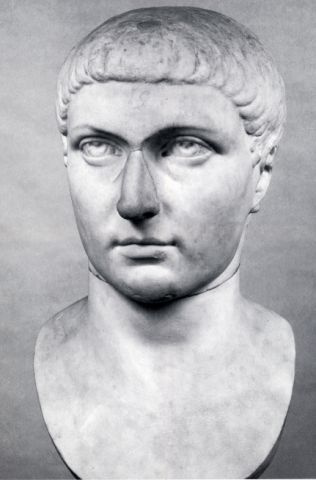
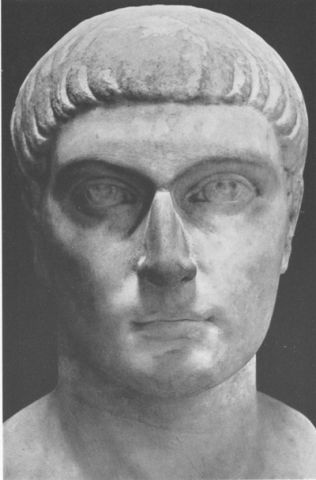
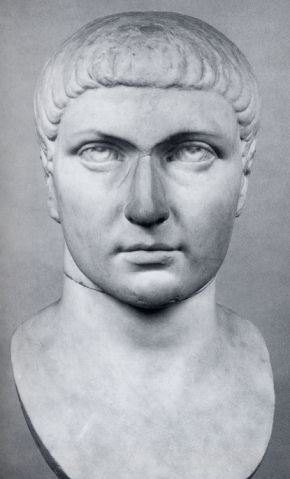
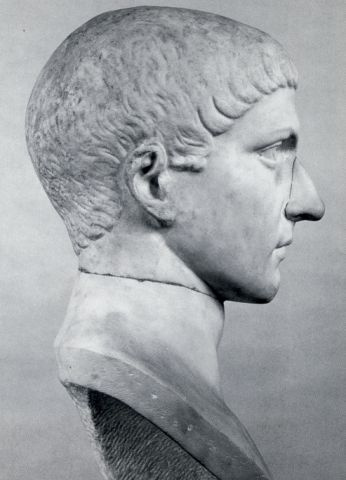
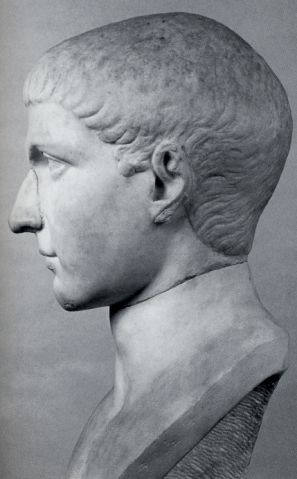
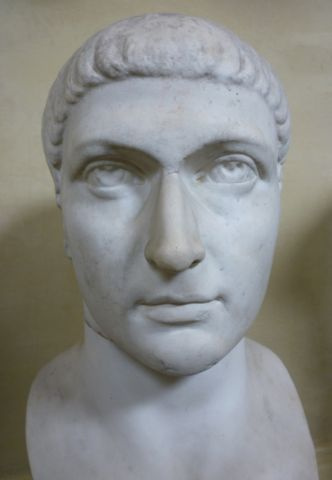
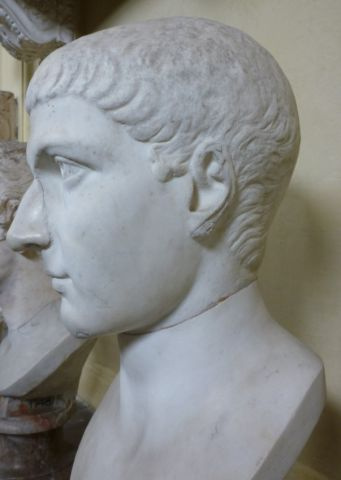
Portrait head of clean-shaven man, Constantine or son of Constantine? From Italy. Fourth century.
Record details
Photographs
Bibliography
- Andreae, B. et al. , Museo Chiaramonti III. Bildkatalog der Skulpturen des Vatikanischen Museums, vol. I, Berlin 1995, 97*, no. 136, pls. 1004-1005
Discussion
DESCRIPTION (Object)
Over life-size head. H: 29 cm. Fine-grained marble.
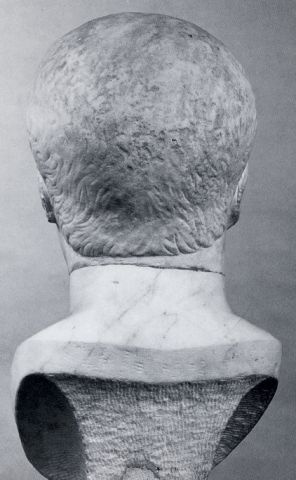
The head has been cut through the upper part of the neck and mounted on a modern bust. The nose is restored. The left ear was once restored in plaster. At the top of the head and the middle of the back of the head hair has not been rendered.
The head has probably been re-cut from an earlier portrait. The smooth top of the head, the shape of the back of the head, the small-size of the right ear, and the break in the shell of the left ear are all potential indications.
The irises are finely engraved and larger than semi-circular; the line of the canthi is also engraved. The pupils are drilled out in a U-shape; the inner corners of the eyes are also drilled. The hair of the brow is rendered with a flat chisel.
PROVENANCE
The head was presumably found in or around Rome. It was restored in 1823 by Giuseppe D'Este.
DESCRIPTION (Subject)
The head shows a clean-shaven young man who has medium-length, combed-forward hair. The hair crosses the brow in a very low arch. The fringe locks turn inwards and meet at a point over the nose. In front of each ear is a small sideburn made of two curling locks.
The brow is unmarked and broad. The cheekbones are wide-set, and the cheeks are full. The eyes are long. The mouth is broad and full-lipped. The chin is rounded and slightly withdrawn.
DATE AND IDENTIFICATION
The hairstyle of the portrait recalls that of Constantine. The combed-inwards fringe converges above the nose (see LSA-558, LSA-554, LSA-834). Yet this portrait seems to show a younger man and has a slightly different physiognomy. The cheekbones do not project, and the jaw line is less square and prominent.
The similarity of the hair arrangement has led Zanker to classify the head as version of the main Constantine type. Other scholars and even Zanker himself (in an earlier discussion of a portrait of Helena cited) have been led by the youthful aspect and more rounded physiognomy to suggest a son of Constantine. Related portraits, which present a similar problem, are LSA-556, LSA-596, and LSA-753. It is unlikely that the portrait represents a private person; the image of Constantine was not emulated.
Discussion references
- Fittschen, K. and P. Zanker, Katalog der Porträts in den Capitolischen Museen und den anderen kommunalen Sammlungen der Stadt Rom, Band I, Mainz 1985, (2)1994, 150, no. C 10 (Zanker: dependant on main type of Constantine)
- Fittschen, Klaus and P. Zanker, Katalog der Porträts in den Capitolischen Museen und den anderen kommunalen Sammlungen der Stadt Rom, Band III , Mainz 1983, 36, fn. 7 (son of Constantine)
- L'Orange, H. P., Das spätantike Herrscherbild von Diokletian bis zu den Konstantin-Söhnen, 284-361 n. Chr. Das Römische Herrscherbild. III. Abteilung ; Bd. 4 , Berlin 1984, 136 (son of Constantine or private portrait of that era)
- L'Orange, H. P., Studien zur Geschichte des spätantiken Porträts, Oslo 1933, 64, 139, no. 90, fig. 165
- Sydow, W. von, Zur Kunstgeschichte des spätantike Porträts im 4. Jahrhundert. n. Chr, Bonn 1969, 23 fn. 12, 31-32 (different physiognomy, possibly son of Constantine)
Cite: Last Statues of Antiquity, LSA-902 (J. Lenaghan).