
LSA-903
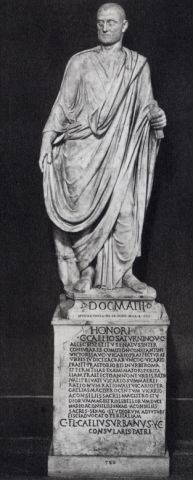
Togate portrait statue of C. Caelius Saturninus signo Dogmatius (base LSA-1266). Rome. 324-337
Record details
Photographs
Bibliography
- Bergmann, M. 'La ritrattistica privata di età constantiniana: l'abbandono del prototipo imperiale', Costantino il Grande, Milan 2005, 159-160
- Gehn, U., Ehrenstatuen in der Spätantike. Chlamydati und Togati, Wiesbaden 2012, 498-504 cat. no. W 3
- Giuliano, A., Catalogo dei ritratti romani del Museo Profano Lateranense, Vatican City 1957, 81-2, no. 99, pls. 59-60
Discussion
DESCRIPTION (Object)
Over life-size statue. H: 219, H (of head) 28 cm. Large-grained white marble.
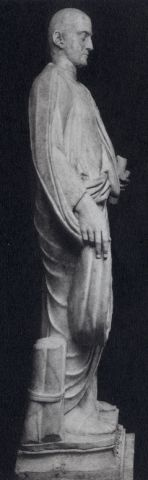
The head is worked separately and inserted into the statue. The left hand with the wrist and some of the forearm was probably also worked separately. The statue is worked in one piece from the shoulders to the plinth. The plinth is moulded and bears one line of inscription on its cavetto. A large support of scrolls stands on the outside of the proper right leg.
The nose, the ears, some chips in the neck and the toga around the neck, the left hand with scroll, the right hand, and drapery folds are restoration.
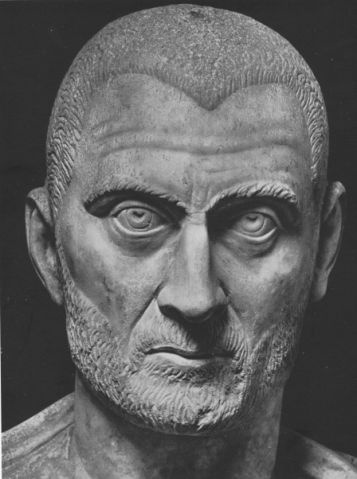
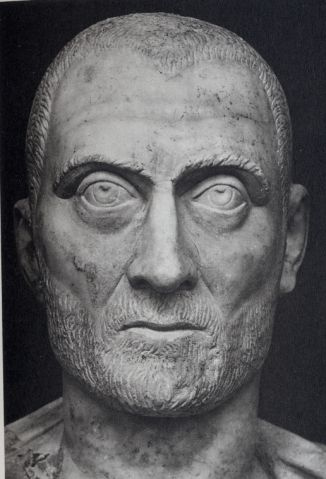
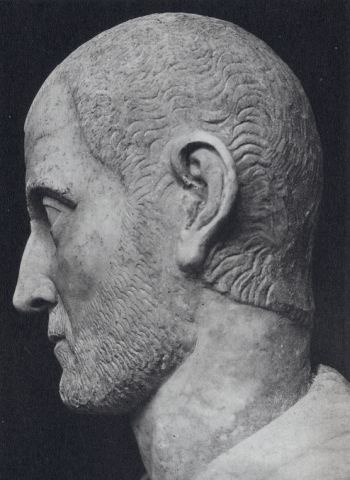
The hair of the face and head is rendered with precise, numerous, and small curving strokes of a flat chisel. The irises are engraved and greater than semi-circular. The pupils are crescent-shaped.
Both the statue and the head are re-used. The lack of depth of the face, the flatness of the back of the head, and the long contour of the hair on the neck all indicate a re-cutting.
PROVENANCE AND CURRENT LOCATION
From the foundations of Palazzo Filippani alla Pilota in 1856. This is the western slope of the Quirinal hill. The statue was found with its inscribed statue, LSA-1266. Both were probably displayed in the family home.
The statue is now in the Vatican, Museo Gregoriano Profano inv. no. 10493.
DESCRIPTION (Object)
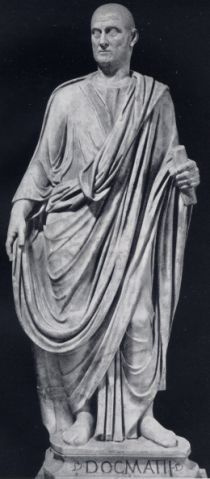
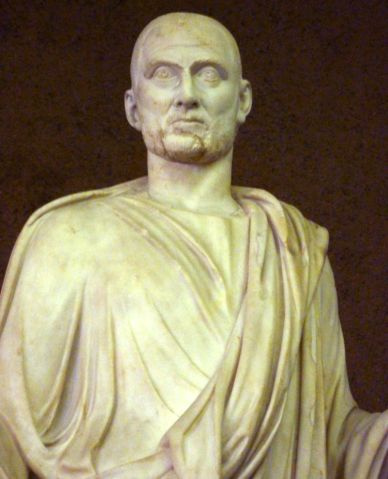
The statue shows a bearded man dressed in a traditional toga and tunic. He wears the closed leather shoes which had been associated with the equestrian order. It was found with its base (LSA-1266) which identifies it as a statue of Caius Caelius Saturninus signo Dogmatius.
He stands with his weight over his right leg. The right arm, covered almost entirely by the sleeve of the tunic, rests at the side of the body and holds the edge of the sinus. The left arm is bent at a 90 degree angle and supports the end of the toga. A series of scrolls, held together by a strap, rests against the right leg.
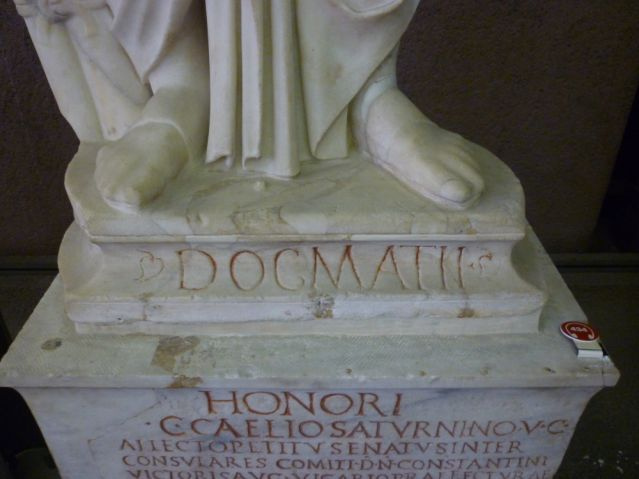
The toga of the figure has a full lacinia which touches the ground, a broad sinus that reaches the knee, and a small umbo which is centrally placed. The plinth is finely moulded and bears a one line inscription between two ivy leaves, DOGMATII (=of Dogmatius).
The statue has been carefully re-used. It has a separately worked and re-cut head. He has a short hairstyle, short beard, and short moustache, all composed of very short slightly C-shaped locks. The receding hair comes to a distinguished point over the nose. The brow is traversed by two horizontal creases. The projecting bushy eyebrows meet at the nose. The open eyes have sunken skin below them and lines parallel to the lower lid. The mouth is broad and down-turned. The naso-labial folds are inscribed but fine. The chin is deep and projecting.
HONORAND AND DATE
The base (LSA-1266), set up by the son, provides the honorand’s, Caius Caelius Saturninus signo Dogmatius’, name and long career. He was an equestrian with a fine financial career who was elevated to senatorial rank. His career began under the Tetrarchs and continued through the Constantinian period.
The base cites Saturninus as a comes of our lord Augustus Constantine the Victor. Constantine was thus alive when the statue was erected and had already assumed the title victor. The monument can be confidently dated between 324 and 337. It probably can be placed even more specifically c. 324 since it does not mention Saturninus’ post of praetorian prefect which was held between 325 and 335.
IMPORTANCE
This is one of the most closely dated portrait statues of the fourth century. It is an example of the fashion of 325-335, the lack of influence of the image of Constantine, and the continued importance of the traditional Roman toga.
Discussion references
- Blanck, H., Wiederverwendung alter Statuen als Ehrendenkmäler bei Griechen und Römern, Rome 1969, 34-5, no. A8, pl. 9
- L'Orange, H. P., Studien zur Geschichte des spätantiken Porträts, Oslo 1933, 64, 139, no. 92, figs. 167 and 170
Cite: Last Statues of Antiquity, LSA-903 (J. Lenaghan).