
LSA-904
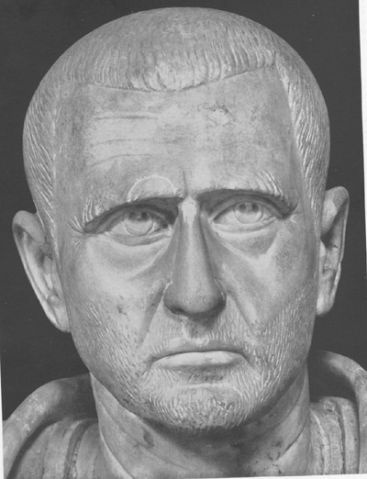
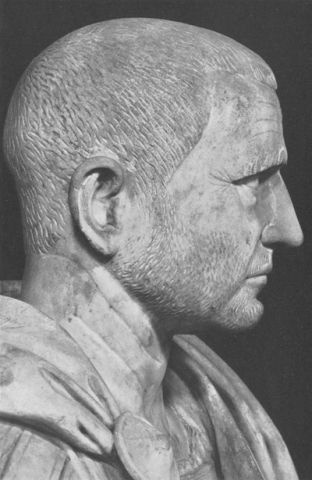
Portrait of man with short hair and stubble beard, set on bust. Rome (Castrum Praetorium). Early fourth century.
Record details
Photographs
Bibliography
- Visconti, P.E., Catalogo del Museo Torlonia di sculture antiche, Rome 1880, 226, no. 500
Discussion
DESCRIPTION (Object)
Over life-size head, mounted on bust. H: 88 cm. Marble.
The head is preserved with its neck; it may have been made separately from its statue. The bust, nose, and part of the right eyebrow are restorations.
The hair has been rendered by short, parallel strokes of a fine flat chisel. The hair of the head sits within a raised area that rises as a shelf off the brow. The irises are an engraved and semi-circular lines that touch the lower lids.. The pupils are marked by deep, full U-shaped drilled areas.
PROVENANCE
From the Castrum Praetorium in Rome.
DESCRIPTION (Subject):
The head depicts a mature man with short hair and a stubble beard. He has multiple lines on both sides of the neck. It is thus difficult to determine which way he turned originally.
The hair is cut high across the forehead, recedes at the corners of the brow,and is brushed forward above the ears. The locks of the central part of the fringe turn inwards and converge over the nose. The beard grows into the cheek on the right side.
The tall brow is marked by three creases. The ridge of the eyebrows has been given coarse hair and slopes downwards at the outer corners. The corners of the eyes have significant crow’s feet wrinkles. The skin beneath the eyes is loose and sunken. The naso-labial folds are indicated. The mouth has full lips and downturned corners. The chin is short and rounded.
DATE
The stubble beard and short hair of the extant portrait are fashion traits that begin in the mid-third century and continue into the fourth century. For example, Visconti identified the head as Philip the Arab (244-249) and L’Orange considered it early fourth century. The large U-shaped pupils favour L’Orange’s assessment; see the portrait of Constantine from the Forum of Trajan, LSA-833.
Discussion references
- Calza, R., Iconografia Romana Imperiale. Da Carausio a Giuliano (287-363 d. C.), Rome 1972, 183-4, no. 101, pl. 61, 192-3
- L'Orange, H. P., Das spätantike Herrscherbild von Diokletian bis zu den Konstantin-Söhnen, 284-361 n. Chr. Das Römische Herrscherbild. III. Abteilung ; Bd. 4 , Berlin 1984, 113
- L'Orange, H. P., Studien zur Geschichte des spätantiken Porträts, Oslo 1933, 64, 139, no. 93, figs. 168-9 (early fourth century)
- Sydow, W. von, Zur Kunstgeschichte des spätantike Porträts im 4. Jahrhundert. n. Chr, Bonn 1969, 36, 38 (Constantinian)
Cite: Last Statues of Antiquity, LSA-904 (J. Lenaghan).