
LSA-905
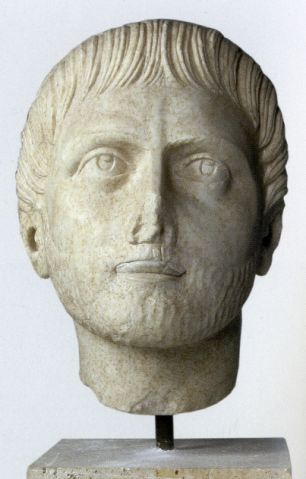
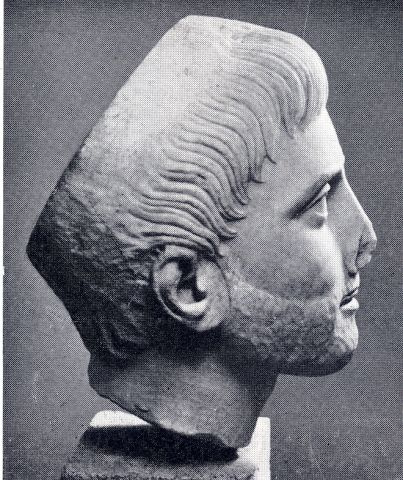
Portrait of man with lank hair and short beard. Ostia. Late fourth or earlier fifth century.
Record details
Photographs
Bibliography
- Donati, A. and G. Gentili, Costantino il Grande. La civiltà antica al bivio tra Occidente e Oriente, Milan 2005, 214-215, no. 11 (I. Romeo: late fourth to early fifth c.)
Discussion
DESCRIPTION (Object)
Life-size head. H: 28, W: 17 cm. Fine-grained white marble.
The head has been regularly cut through the middle of the neck. The back of the head was worked separately and is missing. There is a hole for the dowel. Part of the left ear and nose are missing. The upper lip was restored in antiquity; it is a separately worked piece.
The hair is carefully worked with flat chisels around the brow and nape. On the rest of the head it is a flat surface. The beard is a raised surface which bears the grooves of the large flat chisel that was used to take down a higher surface. The irises are thick crescent-shape with a flat surface that is below the level of the eyeball. The pupil is the raised area between the prongs of the crescent.
The size, the removed beard, the fine nose, and the piecing of the upper lip are all indications that this portrait was worked out of another head. The lack of rendering of hair behind the brow and the drill holes above the right ear are not indications for a diadem or crown. The drill holes probably belong to the original hairstyle or to the removal of the upper part of the ear.
PROVENANCE
According to Calza (Iconografia, p. 275), the head was found on the Decumanus near the Theatre in 1910. According to Romeo, the head has no specific find location.
DESCRIPTION (Subject)
The head depicts a young man with lank hair that is combed forward onto the brow. He also wears a short but full beard and moustache. The locks of hair which are rendered only around face are long and C or S-shaped. They terminate in pointed ends. The fringe has a central part but above the ears the ends turn upwards.
The face is without indication of age. The brow has a vertical ridge above the nose and light swelling above the eyebrows. The eyes are large, and the nose is fine. The mouth is small.
HONORAND AND DATE
Much of the early literature on this head was misled by the erroneous idea that it wore a crown and was thus an emperor. The portrait is of a private individual.
The short and brushed forward hairstyle that gains volume around the face plus the full beard are fashion markers that are generally associated with the Theodosian court and the end of the fourth and early fifth century. There are numerous examples of this sort of portraiture from Asia Minor (see for example the so-called older magistrate of Aphrodsias, LSA-169 or LSA-380). These Asia Minor examples, as this head in Ostia, leave the top and most of the back of the head as a smooth and undifferentiated surface.
There are far fewer examples of this sort of fashion and workmanship from the West. A portrait of an emperor now in the Louvre has been mentioned in relationship to this head because of their similar fringe (LSA-563). Coincidentally, however, it is another head in the Louvre, a private portrait of a man of the Valentinian period, that probably shares more in terms of style and fashion.
Discussion references
- Calza, R., Iconografia Romana Imperiale. Da Carausio a Giuliano (287-363 d. C.), Rome 1972, 274, no. 185, pls. 95,355 and 96,341 (Constantinian family member)
- Calza, R., Museo Ostiense, Rome 1947, 12, no. 45 (Constantius II)
- L'Orange, H. P., Das spätantike Herrscherbild von Diokletian bis zu den Konstantin-Söhnen, 284-361 n. Chr. Das Römische Herrscherbild. III. Abteilung ; Bd. 4 , Berlin 1984, 133 (late Constantinian)
- L'Orange, H. P., Studien zur Geschichte des spätantiken Porträts, Oslo 1933, 75, 141-2, no. 99, fig. 189 (Theodosian)
Cite: Last Statues of Antiquity, LSA-905 (J. Lenaghan).