
LSA-906
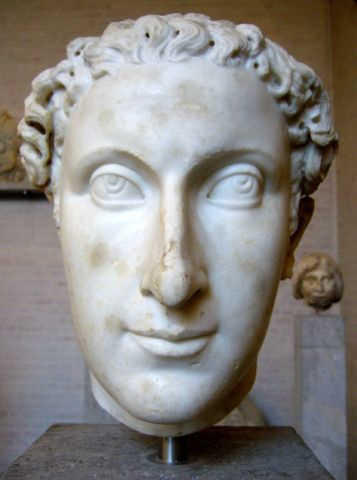
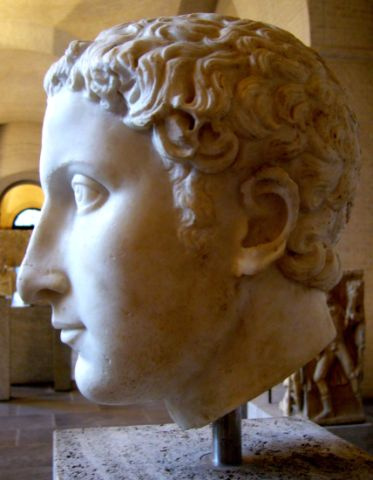
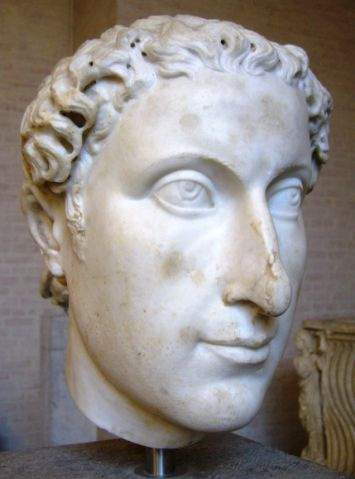
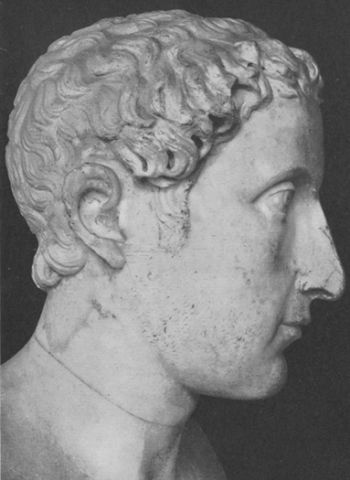
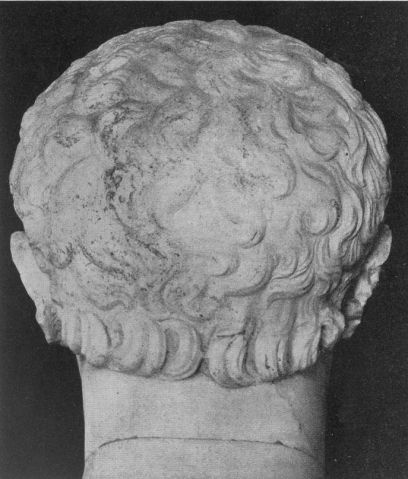
Portrait of man with long-face and lightly engraved facial hair. From Italy. Late fourth century.
Record details
Photographs
Bibliography
- Baumstark, R. (ed.), Rom und Byzanz : Schatzkammerstücke aus bayerischen Sammlungen , Munich 1998, 72-3, no. 1
Discussion
DESCRIPTION (Object)
Over life-size head. H: 30 cm.. Fine-grained white marble.
The head has been regularly cut through the middle of the neck. This is probably the work of a modern art dealer. The tip of the nose is restored, and the rim of the left ear is chipped
The drill has been used sparingly but to effect in the hair over the brow and temples. Both drill points and bridges are visible. The remainder of the hair, the eyebrows, and fine facial hair on the cheeks and upper lip are indicated with careful chisel work. The irises are ndicated by an engraved half-circle made by a flat chisel. The pupils are also defined by a curving line of the flat chisel that widens near the bottom, giving it almost a crescent-shape.
PROVENANCE
The head was purchased in 1821 from the art dealer Vitali.
DESCRIPTION (Subject)
The head depicts a young man with a long face, curly hair, and light growth on his cheeks and upper lips. The hair, which comes forward, is rendered in thick locks which follow and thus define the shape of the cranium at the top and back of the head. Individual strands have been carefully engraved in these naturalistic locks. Over the brow and temples the hair gains some volume and length as the locks curl more pronouncedly and fall in two tiers. There is drilling within the locks (for example, on the left side in front of the ear); there are drilled out areas between the locks which are connected by small bridges of marble (for example, around the temples); there are small drill holes between locks (for example, at the centre of the brow). This drilled hair, however, ends high on the brow.
The face is a long oval which is generally smooth and unmodelled. The features are elegant and fine. The eyebrows are sharp fine ridges that follow a semi-circular arch. The ridge of the nose is also narrow. The lips are bow-shaped with a slightly pouting lower lip and upturned corners which make the mouth seem to smile.
The eyes bulge and have pronounced inner markings. The irises and pupils are too large and are not centrally set but rather touch the upper lid and not the lower one, giving the impression that the figure looks upwards. Moreover, they are not placed at the same point in each eye.
The rendering is careful and of high quality. It is, in fact, difficult to determine whether this portrait head is an original work of the fourth century or whether it has been re-cut from an older Antonine head. The fine carving of the hair at the back and the long locks with marble ‘bridges’ between them occur on portraits of Marcus Aurelius and Commodus. In either case, the careful carving might suggest that the head came from a bust,intended to be seen at eye level, rather than from a statue set high on a base. It would be interesting to know whether there is any trace of an original surface in the section of the neck.
DATE
The head is stylistically close to the portrait of a togate statue in the Museo Nazionale Romano LSA-907and to a head in Thessaloniki (LSA-90) These heads all have similarly elongated physiognomies with light facial hair and are intended to convey youth. They are, furthermore, all carefully carved. L’Orange defined this group as having a ‘subtle style’. They are often associated with the reign of Honorius (393-423) and certainly resemble the portraits of Theodosian princes (compare, for example, the head from Syria now in Philadelphia, LSA-754).
Discussion references
- Albizzati, C. 'Quattro sculture dell'ultimo periodo romano', Historia. Studi storici per l'Antichità classica 3, Milan 1929, fig. 15
- Calza, R., Iconografia Romana Imperiale. Da Carausio a Giuliano (287-363 d. C.), Rome 1972, 352-3, no. 248, pl.120,438 (Flavius Nepotianus)
- Ensoli, S. and E. La Rocca (eds.), Aurea Roma: dalla città pagana alla città cristiana, Roma 2000, 548-9, no. 201
- L'Orange, H. P., Das spätantike Herrscherbild von Diokletian bis zu den Konstantin-Söhnen, 284-361 n. Chr. Das Römische Herrscherbild. III. Abteilung ; Bd. 4 , Berlin 1984, 139-40 (private portrait c. 400)
- L'Orange, H. P., Studien zur Geschichte des spätantiken Porträts, Oslo 1933, 75, 142, no. 101, figs. 192-3
Cite: Last Statues of Antiquity, LSA-906 (J. Lenaghan).