
LSA-907
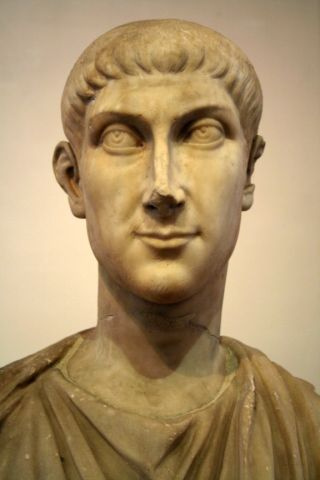
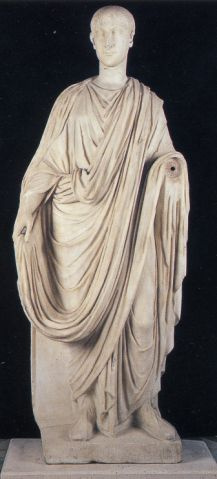
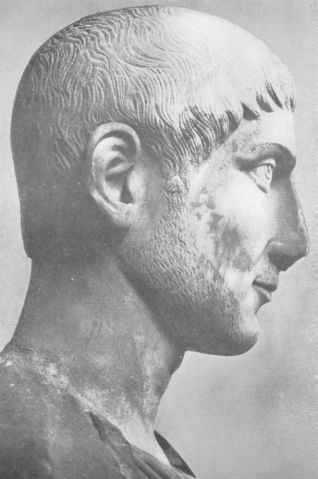
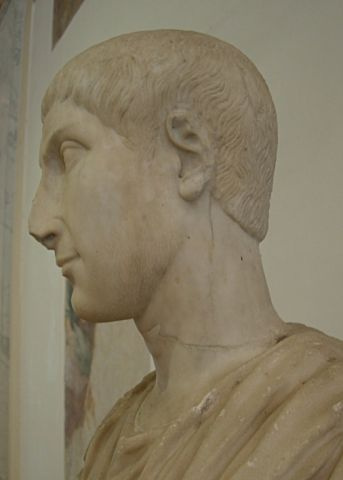
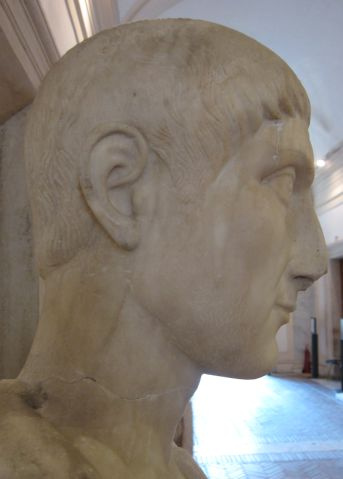
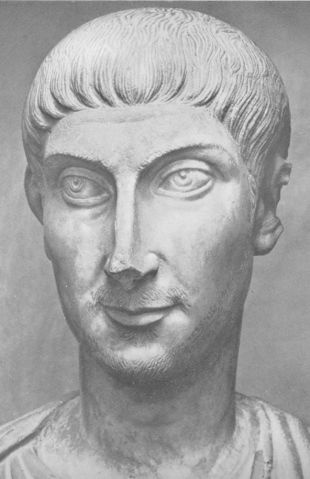
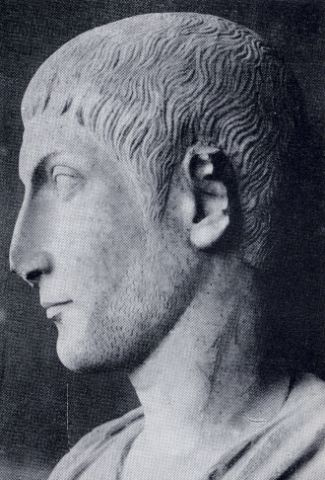
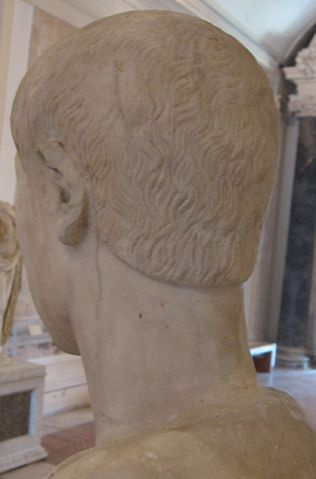
Togate statue of man with light beard. Rome. Late fourth century.
Record details
Photographs
Bibliography
- Felletti Maj, B.M., I ritratti, Rome 1953, 162, no. 323
- Giuliano, A. (ed), Museo Nazionale Romano. Le Sculture I,2. Ali del Chiostro, Rome 1981, 34-6, no. 26
Discussion
DESCRIPTION (Object)
Over life-size statue with separately worked head. H: 181 cm. H (without plinth): 172 cm. H: (of head): 33 cm. Fine-grained white marble (head) and Greek marble (body).
The portrait has been re-worked from an earlier head and set onto the togate body. The left hand with the wrist was also worked separately and is now missing; the dowel hole is visible in the section of the forearm. The rest of the body is worked in one piece from the shoulders to the plinth. The plinth is low and rectangular. It is slightly undercut beneath the large rectangular statue support on the outside of the right leg. The head has broken off its neck and chest area but been reattached. The tip of the nose and part of the left ear are missing.
The hair has been rendered with long curving lines of a flat chisel. Behind the right ear, some of the lines even continue beyond the raised surface of the hair. The facial hair has been engraved attentively with a very fine chisel. The irises are engraved and more U-shaped than semicircular; they do not touch the lower lid. The pupils are indicated by a thicker but concentric engraving within the irises.
PROVENANCE
The statue was apparently not inventoried until after 1900 (L. Nista). Both catalogues of the Museo Nazionale (Felletti-Maj and Nista) assert that the statue was found during building of the Ministero delle Finanze between 1872-1877. The Ministero is no. 97 on via 20 Settembre which is behind or to the northeast of the Quirinal Hill. Stucchi and L’Orange in contrast give the provenance as S. Sebastiano on the via Appia. Calza is the only author who acknowledges that there is a discrepancy.
DESCRIPTION (Subject)
The statue shows a young man with a stylized portrait who is dressed in a traditional toga and tunic. He wears the leather shoes with straps that marked the senatorial order.
He stands with his weight over his right leg. The right arm, covered almost entirely by the sleeve of the tunic, rests at the side of the body and holds the edge of the sinus. The left arm is bent at a 90 degree angle and supports the end of the toga. A tall rectangular block rests against the outside of the right leg. The toga of the figure has a lacinia which touches the ground, a broad sinus that reaches the knee, and an umbo which is to the proper right of the centre.
The statue has been re-used with a re-cut head which seems large for the body and which has a long neck. The head turns to its right. The hair is of medium length, wavy, and slightly unruly. However these locks have been engraved onto a raised cap which gives them an overall sense of uniformity and order. Across the brow, the fringe ends in separate locks which all turn inwards and converge over the nose. The sideburns are full but yield to a light beard which covers only the jaw line, which is separate from the moustache, and which is separate from a tuft of hair under the lower lip.
The face is long, fine, and distinguished by a slightly smiling mouth. The brow has a single crease. The eyes are large and set under fine eyebrows. The nose is fine and hooked. The upper lip has a central projection, and the lower lip is full. The chin is deep.
DATE AND COMMENTARY
The stylized, fine and mannered portrait is striking. It led Stucchi and Calza to try to identify it as Constantius Gallus who has a similar profile on coin portraits. There is, however, not enough evidence to justify this identification. L’Orange noted it as an example of the ‘subtle style’ which he associated with the Theodosian period.
A date of c. 370 seems to me most probable. The portrait has many technical similarities with the bust of Cethegus, LSA-879, who died in 369. Moreover, the use of the traditional toga is typical of the fourth century AD and becomes rarer after the introduction of the new Theodosian type toga (see LSA-163).
The portrait should be compared to two other portraits from Rome, LSA-907 and LSA-951. These share similar physiognomical and fashion aspects; technically these other two portraits, however, use the drill in the hair.
Discussion references
- Calza, R., Iconografia Romana Imperiale. Da Carausio a Giuliano (287-363 d. C.), Rome 1972, 354-6, no. 249, pl. 120,440-41(Constantius Gallus)
- Ensoli, S. and E. La Rocca (eds.), Aurea Roma: dalla città pagana alla città cristiana, Roma 2000, 550, no. 203 (A. Cioffarelli: 400-440)
- L'Orange, H. P., Das spätantike Herrscherbild von Diokletian bis zu den Konstantin-Söhnen, 284-361 n. Chr. Das Römische Herrscherbild. III. Abteilung ; Bd. 4 , Berlin 1984, 136-7 (private from period between Theodosius to Honorius)
- L'Orange, H. P., Studien zur Geschichte des spätantiken Porträts, Oslo 1933, 75, no. 102, figs. 194-5
- Stucchi, S. 'Un nuovo volto della famiglia imperiale costantiniana: Costanzo Gallo', Bollettino d' Arte 36, Milan 1951, 201-205 (Constantius Gallus)
Cite: Last Statues of Antiquity, LSA-907 (J. Lenaghan).