
LSA-908
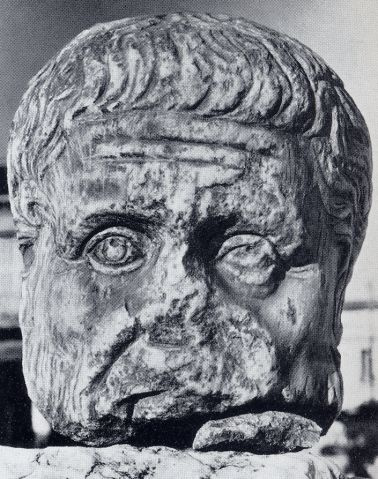
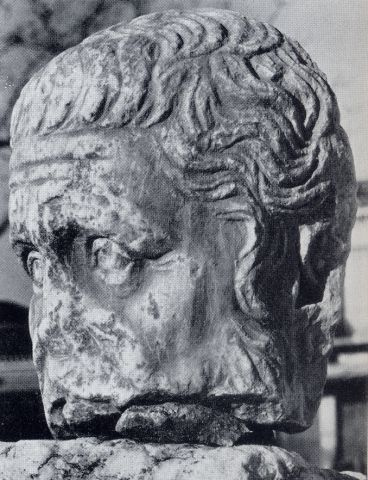
Portrait head of Plato. Athens (Achaea). Late third to fourth century.
Record details
Photographs
Bibliography
- Dorhn, T. ‘Ein spätantikes Platonporträt’, Mitteilungen des Deutschen Archäologischen Instituts. Athenische Abteilung 63-64, Berlin 138-1939, 163-7, pls. 65-66 (c. 275-320)
Discussion
DESCRIPTION (Object)
Fragment of over life-size head. H: 24 cm. White Pentelic marble.
The head has broken through the mouth. The back of the head and right ear are also missing. The nose has broken off. The left eye and eyebrow are battered.
The hair and beard are finely rendered with flat chisels. In the fully preserved right eye, the iris seems to be a raised area that is more U-shaped than circular. In the centre of its upper border is a round drilled hole that represents the pupil.
PROVENANCE
The fragmentary head was noticed first in early 1937 among fragments at the Tower of the Winds (in the agora of Athens). It had been excavated in the vicinity.
DESCRIPTION (Subject)
The head is an immediately recognizable version of the portrait of Plato (compare, LSA-710, LSA-712 and LSA-2537). He wears a long beard, long moustache, and medium-length hair; the fringe of which curves to his right. There are two furrows across the brow. Two vertical lines rise over the nose. The eyes are large, have thick wrinkles below which echo the lower lids, and have marked crow’s feet wrinkles at their outer corners. The cheekbones project.
DATE
The large wide open eyes and the rendering of the irises and pupils are unusual details in portraits of Plato and suggest a late date. Dorhn interestingly compared the head to a head in Solin, LSA-893. Three other late versions of Plato are attested (see above).
Discussion references
- Danguillier, C., Typologische Untersuchungen zur Dichter- und Denkerikonographie in römischen Darstellungen von der mittleren Kaiserzeit bis in die Spätantike, Oxford 2001, 254, no. 28 (late third to early fourth c.)
- Richter, G.M.A., The Portraits of the Greeks, London 1965, 167, no. 20, figs. 938 and 941
Cite: Last Statues of Antiquity, LSA-908 (J. Lenaghan).